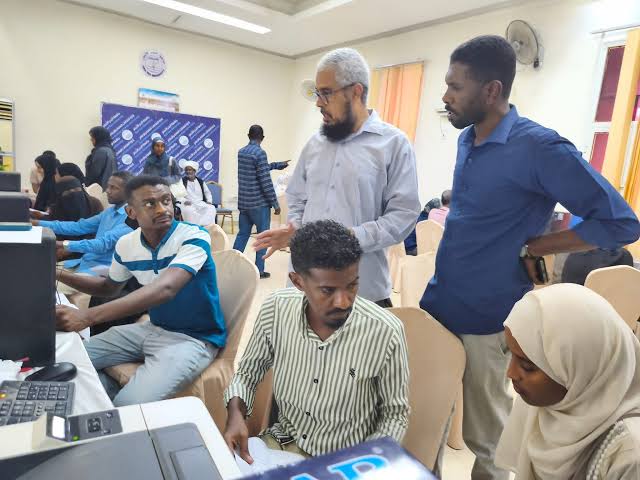
As the fierce war between the Sudanese Armed Forces and the Rapid Support Forces (RSF) continues since April 15, 2023, its economic and social repercussions have deepened—particularly for younger generations, who have been affected in unprecedented ways. With the collapse of the education system, the decline in job opportunities, and the expansion of internal and external displacement, many young Sudanese have been forced to rethink their visions for the future.
Gone are the traditional aspirations once tied to university education or career stability. Today, for youth living in conflict zones, displacement centers, or exile, priorities have shifted toward survival and adaptation in a world that changes rapidly and offers few guarantees.
—
An Uncertain Future
As Sudan’s war enters its third year, the priorities and perspectives of its younger generations are transforming. The future, once envisioned as a linear path from education to employment, has become a blurred concept overshadowed by fear and uncertainty. Many young Sudanese no longer ask “What will I become?” but rather “Will I even make it to tomorrow?”
Mohab Al-Tayeb, a former engineering student at the University of Sudan, now displaced in Wad Madani, embodies this shift. “I was about to graduate—only one semester left—when the war broke out,” he says. “Our home burned down, my papers and certificates were destroyed, and with the cost of living rising, I had no choice but to find any work to help my family. I don’t think about the future anymore; my goal is to get through each day.”
Mohab’s story mirrors that of thousands of students whose academic journeys were cut short—not because of poor performance or lack of opportunity, but due to the war that has crippled Sudan’s education system and forced institutions to shut down or relocate.
Amid these challenges, young people’s thinking has shifted dramatically. The once-prevalent ambition of competing for prestigious jobs has given way to more sobering questions: Can I finish my education? Will this job last? Is there still a future to build?
According to Dalia Salim, a researcher in educational sociology, this psychological transformation will have long-term consequences. “We’re facing a generation that grew up amid revolution and then suddenly found itself in a war,” she explains. “This double shock disrupted personal planning and reshaped ambition itself. Many young people have lost the basic tools for planning their lives because the foundations—stability, education, and safety—no longer exist.”
She adds, “The greatest impact is the overlap between survival and identity. Choices like working in a market or relocating to another city now mean abandoning earlier dreams of who they wanted to be. Yesterday’s student has become today’s displaced person without documents.”
Still, Salim notes that individual acts of resilience persist: “Some youth have returned to online learning, while others are teaching themselves new skills like programming or foreign languages. These efforts are inspiring, though limited, given the lack of institutional or national support for a generation at risk of losing its future entirely.”
—
Lack of Employment Policies
With universities closed and no clear employment policies, hundreds of thousands of Sudanese youth are trapped in a cycle of forced unemployment and displacement, with no educational or professional prospects. The war has not only shut down universities, factories, and markets, but also disrupted the entire life cycle of a generation poised to build its future.
Amina Abdelrahim, a graduate of Nilein University’s Faculty of Education, fled Khartoum to Port Sudan after the conflict began. Today, she works as a tea vendor on the seaside to cover her basic needs. “I was waiting for a teaching position after graduation,” she says. “But recruitment stopped, and when I was displaced, I couldn’t find a job in any school. I had no choice but to sell tea, even though I studied for four years to become a teacher—not a vendor.”
Amina’s story reflects a widespread pattern among youth: university degrees have lost their value amid a collapsed economy and paralyzed state institutions. In displacement areas, competition over limited resources is fierce, pushing many—especially women—into unstable, often unsafe informal jobs.
In states like Gezira, River Nile, Red Sea, and Sennar, the influx of displaced youth has overwhelmed local infrastructure, from schools to markets to training centers. Many, especially young women, have turned to informal labor without any legal or social protection.
Hassan Al-Tahir, a former official with the livelihood-support NGO Sawaaid, warns that the situation “threatens to produce a generation without professions.” He explains, “Mass displacement and halted education have paralyzed an entire youth sector. Many lost their jobs, others never had a chance to start one. Today, most work for daily wages or in unskilled labor. Without alternative state or NGO programs for training and employment, the crisis will only worsen.”
He adds, “This reality has prompted some youth to think outside traditional paths—starting small initiatives, freelancing, or attempting migration. But these options remain limited, depending on each individual’s adaptability in a volatile environment.”
—
Everyday Resilience
Despite the hardship, Sudanese youth have not stood idle. In the absence of functioning institutions and educational systems, individual and collective initiatives have emerged to adapt and preserve a sense of purpose.
In Omdurman, despite insecurity and frequent power cuts, Hisham Al-Sirr, a computer engineering graduate, launched an educational channel on TikTok and YouTube offering free Arabic-language programming lessons for displaced or unemployed youth. “After graduation, I lost my job because of the war,” he says. “I felt my time was slipping away, so I decided to share what I know online. I also run group sessions through live streams—it’s a small contribution, but it gives me purpose.”
In Port Sudan, a group of displaced young women started a small workshop for recycling clothes into bags and accessories. The initiative, run by graduates of economics and arts faculties, relies on a single sewing machine and community donations.
Sara Mahjoub, one of the participants, explains: “At first, it was just an escape from stress and despair. Later, neighbors started buying our products, so we decided to expand. The profits are small, but it feels meaningful—we’re creating something from nothing.”
According to Asim Al-Tijani, a social psychologist, such initiatives represent “self-driven resilience in a collapsed environment.” He adds, “In Sudan’s case, we see a pattern of quiet, daily resistance—not through protest, but through persistence. These small acts maintain psychological balance and prevent total disengagement or despair.”
—
Beyond the War
Amid continued fighting, political paralysis, and economic decline, Sudanese youth now face three main paths:
1. Migration abroad,
2. Withdrawal from public life, or
3. Rebuilding themselves within current realities, however limited the means.
Bilal Mohamed Nour Al-Din, a 25-year-old, shares his migration attempts: “I used to work in telecom, but after the war my company closed. I saw no future here, so I tried to reach Egypt—but travel costs were too high. Then I thought about Libya, but the route is dangerous. Now I’m just waiting for a chance to go anywhere in Africa to start over.”
Meanwhile, Riham Abdel-Salam, an economics graduate, chose a different path: “I couldn’t afford to migrate, and I didn’t want to take risks. At first, I was completely hopeless—I’d wake up with no purpose. Then I decided to step back from everything, even social media. That withdrawal gave me balance. I started a small home-based dessert business, and with patience and persistence, it’s now bringing in a decent income.”
Between these two extremes—a desire to flee and a need to withdraw—a third group is emerging: young Sudanese determined to rebuild from within, even amid fragility. Their tools may be simple, but their awareness and resilience stand out.
Dr. Khalid Babiker, a sociologist at Sennar University, explains: “Sudanese youth are now in a constant negotiation with reality. Migration isn’t accessible to all, and isolation isn’t sustainable. So many combine small projects, online learning, and community work. These efforts don’t solve the crisis, but they show a generation that hasn’t lost its ability to adapt and persist. In a context as difficult as Sudan’s, this quiet resilience may be the most vital and enduring form of resistance.”
-
-
-
-