Twenty years after the Darfur war, which witnessed some of the worst atrocities of the early 21st century, Sudanese who fled the region and now live in the diaspora say the nightmare has returned — as if it “never ended.”
Scenes of violence in the city of El-Fasher, after its fall into the hands of the Rapid Support Forces (RSF), have revived memories of the massacres that struck the region two decades ago.
At the end of October, the RSF announced its control over El-Fasher, the last major stronghold of the Sudanese army in Darfur, before testimonies emerged reporting summary executions, sexual violence, attacks on aid workers, as well as looting and kidnappings — all while communication lines remain largely cut.
History Repeats Itself
The United Nations has warned of ethnically motivated executions carried out by the RSF, the group that evolved from what was known during the 2003 war as the Janjaweed militia.
“Sometimes I can’t believe this is happening again,” says Abdallah Yasser Adam, a Sudanese researcher displaced from Nyala and now living in Cairo. He tells AFP, “People are dying without knowing why… I feel as though it is the end of the world.”
Adam, 45, who used an alias for security reasons, belongs to the Fur tribe — one of several non-Arab groups that rebelled against the Sudanese government in the early 2000s, only to be crushed through the arming of Arab Janjaweed militias.
Over the past two decades, six million Sudanese have fled the country, including four million who escaped after the outbreak of the current war between the army and the RSF in April 2023.
Survivors of the attack on El-Fasher recount scenes reminiscent of what Adam lived through 20 years ago. He recalls that “the planes were overhead, and the Janjaweed below — on camels, horses, and vehicles — attacking and burning the village.”
He continues, “This happened after people surrendered. They would run, and the armed men would chase them as if it were a hunt.” Today, he says, “the attacks are the same, only with more advanced weapons.”
A Preview of What May Come
The RSF is led by Mohamed Hamdan Dagalo (Hemedti), whose prominence grew between 2003 and 2008 during former president Omar al-Bashir’s campaign to crush the rebellions of marginalized communities such as the Fur, Masalit, Zaghawa, and Berte.
That war left 300,000 dead and 2.7 million displaced, and was described by the International Criminal Court as genocide.
After al-Bashir’s ouster in 2019, Hemedti attempted to present himself as a statesman and ally of the army, according to analysts. But disputes over integrating his forces into the military ignited the current conflict.
Sudanese-American poet Emtithal Mahmoud, who survived the early-2000s violence as a child, says that the genocide in Darfur “never truly stopped.”
“It has become more politically complex, but the killing never ceased,” says Mahmoud, 32, now living in Philadelphia. She notes that both the army and the RSF committed atrocities in the past. “The army would bomb our villages entirely while the Janjaweed waited to kill survivors,” she adds, describing how they “burned crops, dumped bodies into wells, and raped women and children.”
Bloody Memories
Mahmoud recalls seeing “smoke rising from the city center” in El-Fasher due to Janjaweed shelling of markets and crowds. “We had to hide. That day, I hid under the bed with four others. I saw the soldiers’ boots entering… and I saw our blood on their feet,” she says. On the same day, she saw her uncle “covered in blood” after volunteering to help the wounded — “a moment that felt like a preview of everything that would follow.”
In Nyala, Adam remembers, “We used to receive victims of clashes between militias and farmers… the remote villages suffered the most damage.”
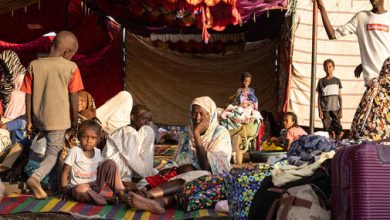
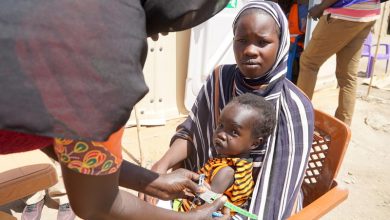
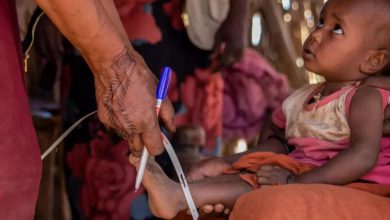
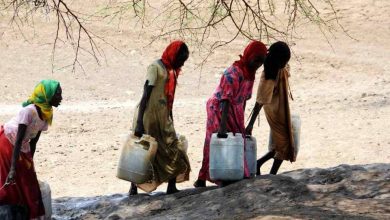
He adds that “the people fleeing arrived barefoot or on donkeys, without food, and the children clearly malnourished… The scenes were extremely harsh.”
Adam believes that the army and the Janjaweed militia are “two sides of the same coin.” The roles may have changed, he says, “but the Sudanese people are still the victims.”
In the current conflict, the army is accused of indiscriminate airstrikes and the use of chemical weapons, while the RSF is accused of mass killings, rape, and looting.
From Darfur to Kordofan
After the fall of El-Fasher, all five Darfur state capitals are now under RSF control — a situation that pushes Sudan toward a de facto division between the army in the north and east, and the RSF in Darfur and parts of the south.
Observers and international organizations warn that the fighting could spread into cities of Kordofan, especially the Nuba Mountains, home to predominantly African Christian communities.
“Kordofan’s situation historically resembles Darfur’s exactly,” says Koman Saeed, who lives in Uganda and spoke to AFP.
Saeed warns of a new massacre “like what happened in El-Fasher” if the RSF takes control of Dilling and Kadugli in South Kordofan, both currently besieged while still under partial army presence.
In Darfur, where the RSF has formed a parallel administration, residents say fear now dominates their daily lives.
The RSF is accused of killing up to 15,000 civilians from the Masalit tribe in El-Geneina, capital of West Darfur, in late 2023.
Omar, a member of the Masalit who remains in contact with friends in Nyala and other towns, says they “live in constant fear of being targeted.”