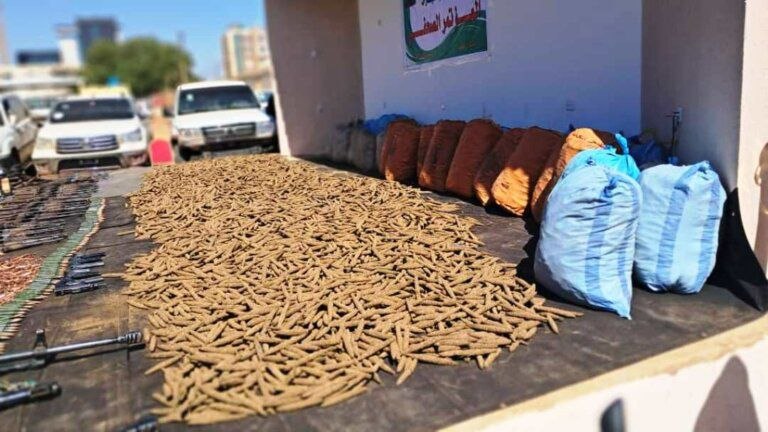
Amid the ongoing war between the Sudanese army and the Rapid Support Forces (RSF) since April 2023, drug trafficking and smuggling have flourished as security and economic conditions deteriorated—particularly in the heart of Khartoum, in Darfur, and in the eastern states of Kassala, Gedaref, and the Red Sea. Drugs are now overwhelming Sudanese communities and devastating young people through rising addiction.
Drug sales take place openly in streets, public areas, markets, and cafés without oversight, silently infiltrating homes as distribution networks expand, including individuals in military uniforms who are part of drug-trafficking networks operating through smuggling routes such as Al-Dabba in northern Sudan and the border triangle linking Libya, Egypt, and western Sudan.
Following the recapture of Khartoum in late March 2024, police reports revealed the expansion of cocaine, heroin, and chemically manufactured narcotic pills, as well as bango, hashish, and various intoxicants. Authorities also uncovered drug farms, homes storing tons of narcotics, and factories producing drugs like crystal meth (“ice”) and Captagon—confirming that this is no longer a passing trade but an organized economic activity fueling the ongoing conflict.
Despite the grim reality, community initiatives have begun confronting the crisis in coordination with relevant authorities. However, these efforts face major obstacles, including lack of funding and shortages of mental-health specialists needed for addiction treatment and counseling.
A Void and Rapid Changes
Samu’el Shawish, a young man from Omdurman, said:
“War has drastically changed young people’s lives—unemployment and the huge void created by displacement have pushed many into drug use. Drugs have become easy to access, but escaping them is nearly impossible.”
He added that certain hotspots in western Omdurman are well-known to drug enforcement units; despite repeated crackdowns, the situation remains unchanged, as traffickers operate freely through networks targeting youth gatherings.
“It’s tragic,” he added. “Drugs have infiltrated homes and become a silent killer tearing Sudanese families apart due to aggressive promotion in schools, universities, markets, and cafés. Crime has surged—some people have been found hanged in their homes or killed during group drug use. These incidents are not isolated but reflect a frightening reality of rising drug abuse in Sudan, despite the relative calm after the war. The country still suffers from security, economic, and psychological collapse.”
He stressed the need for intensive campaigns as police resume operations, warning that the growing spread of narcotics threatens the country’s future.
Smuggling Routes
Retired officer Al-Zubeir Abdel-Wahid explained:
“Drug trafficking expanded widely during the war in Khartoum, River Nile State, Kassala, Gedaref, and the Red Sea. The latest major seizures were in White Nile, Gedaref, and the Red Sea.”
He said drugs enter Sudan through land, sea, and air smuggling routes—especially through porous borders that have enabled the sharp rise in illicit trade. Promotion now occurs openly as traffickers exploit the weakness of security agencies, including the Drug Enforcement Unit, during the war.
He added:
“Various armed groups—especially irregular forces—are involved in the drug trade and in facilitating its entry. RSF-controlled areas in Darfur have become hotspots for drug trafficking and for the cultivation of hashish and bango. Drugs also enter through Al-Dabba in the north and the border triangle linking Sudan, Libya, and Egypt, alongside narcotic pills like ice and crystal smuggled from neighboring countries.”
Abdel-Wahid emphasized that the absence of accountability during the war, due to the collapse of state institutions, is a main reason behind the expansion of drug trafficking. He stressed the need for continuous operations in army-controlled areas, warning that without such efforts, the drug crisis will continue to spiral out of control.
Community Response
Mu’awiya Fath Al-Rahman, a volunteer in a community initiative in White Nile State, said:
“States witnessing the largest spread of drug promotion have launched community initiatives to confront this threat by tracking dealers during sales and reporting them—many of whom are repeat offenders or escaped convicts.”
He added that these initiatives include awareness campaigns in schools, clubs, and markets, as the situation has become catastrophic. “There are children under 15 who are already addicted and receiving treatment from mental-health specialists,” he noted.
He highlighted plans for mobile campaigns—street theater, public exhibitions, and visits to rehabilitation centers—but said that funding shortages and a lack of specialized mental-health professionals due to mass migration remain major challenges.
A Suitable Environment
Social worker Ahlam Youssef stated that the war has torn apart Sudan’s social fabric and changed behaviors—especially among youth. “Mental health has deteriorated, with rising anxiety, depression, and PTSD, reaching severe levels in some cases.”
She said the expansion of the conflict created an ideal environment for drug promotion, putting an entire generation at risk. Youssef emphasized the need for social and psychological support centers to protect young people from falling into addiction, noting the absence of a dedicated addiction-treatment budget and reliance on international donor.
Strengthening Oversight
Economic researcher Abdel-Wahab Jum’a said:
“The economic collapse caused by the war has pushed many into drug trafficking as a quick source of wealth amid loss of regular income, hyperinflation, and currency collapse.”
He added that drug revenues are now used to support military operations, with indications of armed groups involved in trafficking to buy weapons, obtain foreign currency, or purchase gold—further destroying the national economy and deepening the war economy.
He stressed that solutions lie in strengthening border control to cut off smugglers, creating sustainable income opportunities for youth after the war, and implementing a comprehensive anti-drug strategy in army-controlled areas, including deterrence, prevention, and treatment.