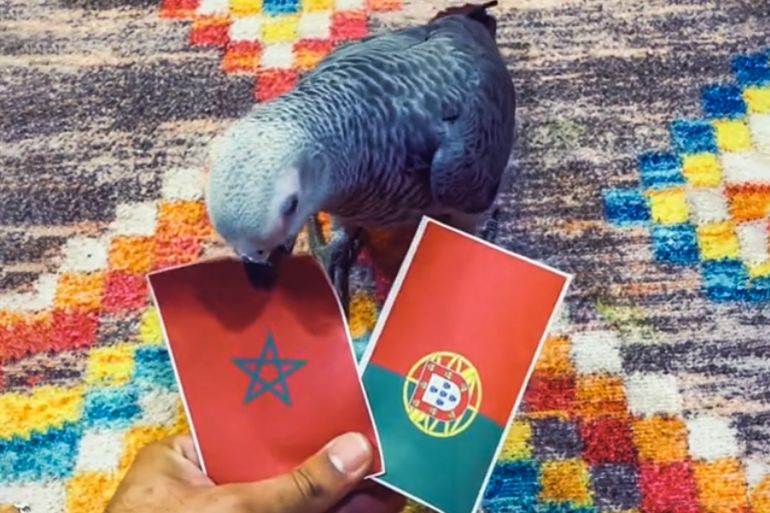
Football fans are still joking about the story of the Malian “seer” who promised supporters of the West African nation a victory in the 35th edition of the Africa Cup of Nations (AFCON) held in Morocco. The man was later arrested on fraud charges after collecting over €30,000 (roughly $35,000) in donations, claiming he needed the funds for rituals to secure the team’s victory. Instead, the team was knocked out in the quarter-finals.
The deep-seated belief in the spiritual powers claimed by this seer likely stems from a long history connecting football, the world’s most popular sport, with fortune-tellers and prognosticators. Some fans have even begun to treat these matters as certainty. While the Malian seer was a human pretender, the history of the game is full of animal kingdom “guessers” who gained fame for their predictions, including reptiles, cats, sea creatures, bears, and elephants.
Generally, the phenomenon is seen as lighthearted and entertaining, though sometimes baffling, as some of these creatures never missed a single prediction. However, in the case of the Malian story, the matter evolved into systematic crime and financial fraud. This exploitation relies on a pre-existing cultural “credit” that makes football fans susceptible to such behaviors. Even at the highest level, the World Cup, fans have grown accustomed to passionately following animal predictions. These animals become stars in their own right, and their choices are often viewed as a preemptive resolution of what will happen on the pitch. Conversely, a larger segment of fans views it as mere nonsense that hits the mark only by coincidence. Nevertheless, the wonder and viewership never cease; these rituals have become one of the most popular phenomena accompanying major tournaments, even spreading to other sports.
Accidental Predictions
The recent AFCON in Morocco may be one of the tournaments that most exposed the claims of so-called “evidence-free” predictions. The legend of “Nemos” the cat came to an end after it predicted an Ivory Coast victory over Egypt in the quarter-finals, a result some treated as a foregone conclusion. The reality on the ground was quite different: Egypt eliminated the Ivory Coast with a 3-2 victory. Despite this, and the crisis of the fraudulent Malian seer, the concept remains popular and is viewed as a “classic” of the game. Animal predictions are often officially recognized by some institutions.
For example, Germany established a museum in Oberhausen to chronicle the history of the famous octopus, “Paul.” The museum details Paul’s rise to stardom; he would be placed in an aquarium and asked to choose between two boxes marked with the flags of competing nations. Paul was renowned for an incredible career, correctly predicting every match he was tasked with during the 2010 World Cup in South Africa, including Spain’s final victory over the Netherlands. After his death, the aquarium funded a two-meter statue of an octopus clutching a football in his honor. Visitors can also view press clippings and visit a gift shop selling souvenirs of the “World Cup Miracle.” Paul’s fame was so great that officials trained a successor, “Paul II,” though he never reached the same level of stardom.
Who Decides the Winner?
“Cabecao” the turtle also gained fame during the 2014 World Cup in Brazil for several correct predictions. Other marine predictors included “Pelé” the fish, though he lacked the popularity of the 2010 octopus.
The criteria for selecting these “active” animals are often unknown, as coincidence usually leads one to this behavior. However, there appear to be indicators related to movement, understanding signals, and response to training. For instance, veterinarians at the Hermitage Museum in St. Petersburg explained that “Achilles” the deaf cat was chosen for the 2018 World Cup in Russia due to his high activity and intelligence. He would choose between two bowls of food decorated with national flags to make his pick.
That edition of the World Cup featured many unconventional seers. “Baxter” the robot was used; he made one lucky guess but failed several times thereafter and was dismissed. It seems mechanical systems have failed to master this form of entertainment. The tournament also featured a polar bear fond of playing with balls, whose predictions met with some success.
From Sports to Politics
This wasn’t the first time bears were involved. There was an ambitious attempt to involve “Ying Mei” the panda in the Brazil World Cup after some successful initial guesses. However, veterinarians found that the pressure of filming and repeated appearances negatively affected the panda—an endangered animal at the time, and the public was deprived of a new “game.”
The “food bowl” method remains a favorite for small animals, used by “Nemos” the cat during the current AFCON. Other less famous animals have appeared in various tournaments, including dogs, penguins, camels, and elephants (who point their trunks at a ball bearing a country’s symbol). Even pigs and dogs have been used during major football and tennis championships.
Despite a series of failures, the obsession continues to thrive on social media. The phenomenon has been popular for about 15 years and remains a point of public interest, whether for humor or genuine belief. While the actual results are decided by performance and goals on the pitch, the “soothsayer” ritual remains a popular accompaniment, largely because it sits apart from the serious, and often high-stakes world of sports betting.
Notably, this fascination has even moved into politics. Reports indicate that “Mystic Marcus” the pig predicted Donald Trump’s victory in his first presidential term, as well as the Brexit vote results six years ago.
مقالات ذات صلة