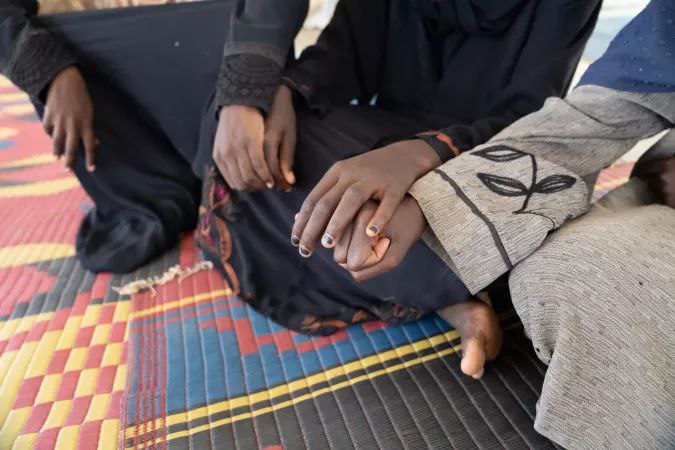
In a tragic incident that shook the city of El Obeid, the capital of North Kordofan state in western Sudan, leaving it in a state of shock and fear and sparking angry reactions across Sudanese society and social media, a six-year-old girl was subjected to rape at the hands of her Islamic Studies teacher at a primary school.
The details of the incident trace back to the end of the school day: “When the child returned home, she appeared exhausted and severely fatigued. Her parents rushed her to the hospital for examination. Medical tests revealed she had been subjected to brutal and violent rape. The child stated that the Islamic Studies teacher sat her on his lap, then fell silent and could not finish what happened as she entered a state of hysteria and burst into tears, saying the teacher threatened her and forced her not to speak about what occurred.”
While the family filed a criminal report against the teacher supported by medical evidence, the school administration attempted to cover up for him, fearing for its reputation and financial interests. The case also saw interventions to obstruct and delay legal proceedings by influential parties. However, after the news leaked to social media and sparked a wave of outrage, authorities moved to arrest the teacher, whose guilt was proven via DNA samples.
Regrettably, the sentence handed down in late January, sentencing the teacher to 10 years in prison, came as a shock to the victim’s family, activists, lawyers, and the Sudanese public, who followed the case closely as it shook the human conscience. This prompted the victim’s father to scream inside the courtroom: “I will take justice for my daughter with my own hands.”
Threats and Refusal
The case of the El Obeid girl is not an isolated incident; it is one of hundreds of rape cases involving Sudanese children. This has become a dangerous phenomenon exacerbated by the conflict between the Sudan Armed Forces (SAF) and the Rapid Support Forces (RSF) since it broke out in mid-April 2023.
In a displacement camp in Sennar city, Blue Nile State, Maryam Fadlallah sits in front of her tent, fighting back tears. She says: “There must be a review of the unjust and encouraging judicial ruling issued against those who raped my minor daughter, which sentenced the perpetrators, who were convicted after confessing to their heinous crime, to only three years in prison.”
Fadlallah added: “My daughter fell victim to three individuals who exploited their social and financial influence to escape the crime. They used every possible method to influence justice, in addition to continuous threats against my family to force us to drop the case, and they offered us sums of money amounting to approximately 200 billion Sudanese pounds ($332,502).”
She continued: “I held onto my daughter’s rights, did not submit to threats, and strongly rejected all forms of compromise. I refused to sell the case so as not to open the door to the violation of other girls’ honor.”
The displaced mother noted that “the punishment does not fit the horror of the crime and does not achieve the required deterrence; rather, it encourages impunity. Justice, by implementing this light sentence, did not vindicate my daughter and will not protect Sudanese communities amidst the chaos created by the war.”
Threats at Gunpoint
Mohamed Abdullah, displaced from Khartoum, said: “Children and women are being targeted without protection. Tragically, we were not spared even in a city that was supposed to be our safe haven. One of my daughters was raped when armed men with knives and firearms stormed our home. They threatened to kill us if we moved, chose my youngest daughter, and took turns raping her before our eyes as she cried for help. Her mother suffered a severe psychological breakdown.”
Abdullah continued: “I will not remain silent out of fear of ‘shame’ as is common in Sudanese society. I filed a report at the police station. Despite their confession, the judiciary did not do us justice. I expected a sentence of death or life imprisonment, but we were shocked by a light sentence of at most two years. It is heartbreaking.”
Deterring Perpetrators
In this context, Al-Sadiq Ali Hassan, Acting Chairman of the Board of Trustees of the Darfur Bar Association, confirmed that the absence of deterrent punishment contributes to the persistence of rape crimes against minors during the ongoing war. He noted gaps in the Sudanese Penal Code regarding sexual violence crimes other than rape (often classified as “indecent acts”), where the maximum sentence is two years.
Hassan added: “Child rape crimes require the maximum penalties to achieve justice. The recent light sentences are a sign of leniency by the courts and a trivialization of a grave crime.”
A Lost Childhood
Saleh Ali, an activist and child rights defender, pointed out that in the context of the prolonged Sudanese war, rape has become a tragic reality used as a weapon. He emphasized that those proven guilty of child rape should face the death penalty by hanging.
He noted the tragedy of minors who become pregnant through rape, facing social stigma for a situation forced upon them. He blamed the patriarchal system for deepening the disaster and praised the mothers who are now breaking the silence despite financial enticements to drop cases.
Raising Awareness
Social and psychological specialist Thuraya Ibrahim stated that rape crimes have reached a level that leaves families in constant terror. She cited historical cases, such as a religious teacher in El Fasher accused of raping 10 children, noting that these cases have increased alarmingly during the current conflict.
She stressed the need for strict vetting and conditions when hiring teachers, especially for primary levels, and called for heightened supervision in displacement centers.
Legal Complications
In a related context, Salima Isaac, State Minister for Social Development and Human Resources, expressed her astonishment at the non-deterrent sentences recently issued against perpetrators of child rape—whether physical or sexual—noting that such leniency encourages the persistence and spread of this dangerous phenomenon.
Isaac added: “The failure to issue deterrent sentences and the prevalence of impunity lead to further violations against children of both genders. There are 221 documented cases of rape involving children under the age of 15, including girls as young as one year old. Despite the extensive interest in monitoring these violations and sharing reports on them, post-assault care remains absent. The horrors of systematic sexual violence committed by members of the ‘Rapid Support Forces’ and gangs spawned by the conflict continue to increase. Every day, we encounter a rape incident due to the ongoing war, coupled with impunity or the issuance of reduced sentences.”
Isaac pointed out that “there is a sensitivity in dealing with cases of rape and sexual violence due to social heritage and legal and medical complications. Despite awareness among families, the community’s culture, customs, and traditions remain an obstacle; some conceal the matter and force themselves to bear the consequences alone. Therefore, it is essential to emphasize the necessity of reporting such incidents immediately after they occur.”
The State Minister warned that “it is necessary to have specialized care homes for children born of rape, so they do not grow up to become perpetrators of violence and crime themselves, turning their situation into an open-ended moral and humanitarian dilemma.”
مقالات ذات صلة
-
-

-
-