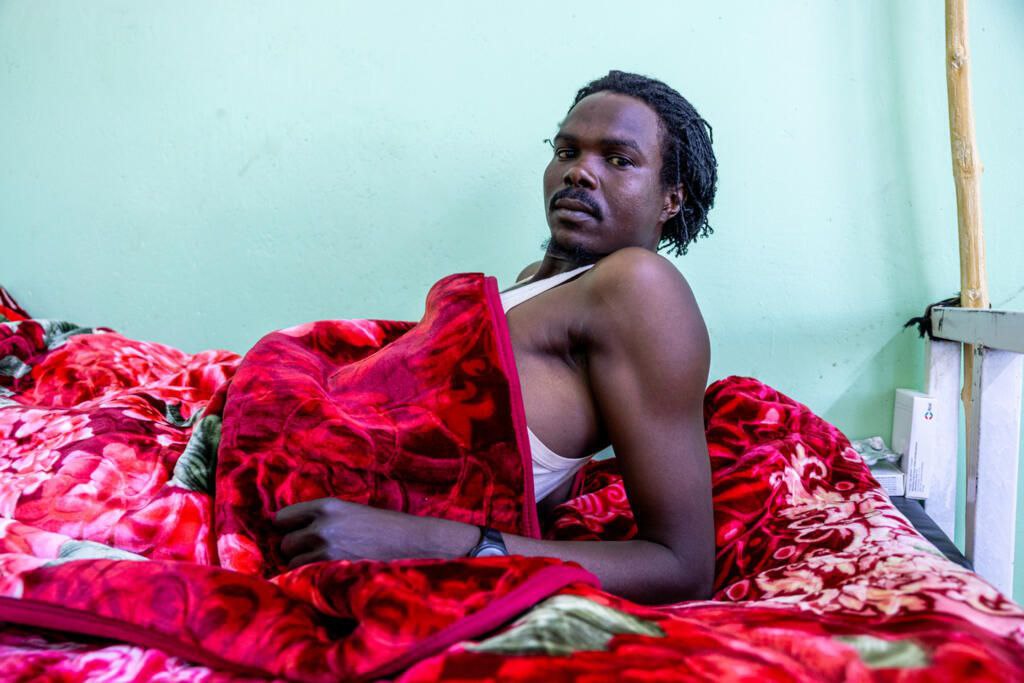
In the town of Tiné in eastern Chad, three paramedics in a hospital courtyard, armed with bandages, scissors, and compresses, surround Mohamed Hamed Abakar, who was injured in a drone attack in neighboring Sudan.
He is one of many Sudanese who have crossed the border carrying injuries from explosive-laden drone attacks, a weapon widely used in the Sudanese conflict that has been ongoing since April 2023. The medics removed a metal shrapnel shard, five millimeters in diameter, from his swollen skull.
“I was attacked by a drone near Um Baru in Sudan three days ago,” the 33-year-old says in a faltering voice. A refugee in Chad since the start of the war, he explains he was making a round trip to Sudan to deliver flour and sugar to his family.
He was traveling at night in the back of a pickup truck when the drone targeted the vehicle. He was the sole survivor; three passengers, two men and a woman, died in the blast. His traveling companion, who sat beside him in the back, died the following morning from his wounds after medics transported him to the Chadian border, 150 kilometers away.
According to the United Nations, the war between the Sudanese Army and the Rapid Support Forces (RSF) has killed tens of thousands and displaced more than 13 million people.
The Sole Survivor
Tiné Hospital sits on a hill overlooking a dry riverbed that separates Chad and Sudan, standing on the front lines of receiving the wounded.
“Since the fall of El Fasher at the end of October, we have treated about a thousand Sudanese,” said Awadallah Yassin Mohamed, a healthcare volunteer from the neighboring Darfur region and a refugee in Tiné for a year and a half.
Scrolling through photos on his phone of charred bodies at the hospital where he worked before fleeing, he added: “In Darfur, many hospitals, health centers, and even pharmacies were destroyed during the fighting.” The man, in his forties, noted that “most victims arriving in Chad suffer from fractures caused by drone strikes.”
Since January, the wounded have been pouring in from border areas attacked by the RSF. This is the case for Abakar Abdullah Qahwaya and Mohamed Abakar Hamdan. The two 27-year-olds identify as fighters in the Sudan Liberation Army, led by Darfur Governor Minni Minawi, who is allied with the Sudanese Army.
They were hospitalized two weeks ago after being wounded during clashes with the RSF in the Sudanese town of Jargira, located about 50 kilometers south of Tiné. “We left our weapons and entered Chad to receive treatment,” says Abakar Abdullah Qahwaya, who was wounded in the abdomen.
“As soon as we are able to fight again, we will return to Sudan,” says Mohamed Abakar Hamdan, his right leg wrapped in a bandage.
Awadallah Yassin Mohamed emphasizes that the hospital accepts all wounded, civilians and fighters alike, without discrimination. However, he points out that the facility lacks “paramedics, and those present are not sufficiently trained to treat all the wounded,” showing a photo of a man disfigured by a drone attack who had to be evacuated to Khartoum due to a lack of local resources.
Beating and Rape
Beyond physical injuries, the psychological suffering of the refugees presents a major challenge.
Kindi Hassan, a mental health officer for the International Rescue Committee (IRC) at the Goudrane camp, home to about 60,000 refugees—notes that “the lack of resources and opportunities in the camps increases their vulnerability.”
Kindi accompanied Asma (a pseudonym), 30, a survivor of an RSF attack in April on the Zamzam camp in North Darfur. Weeping, the young woman recounts the day she spent hiding in a shelter dug under her house before fleeing the camp, leaving behind the bodies of 11 family members killed in the shelling.
Wiping her tears with her yellow hijab, she says: “Soldiers detained me and three of my friends while we were fleeing. They beat us with rifle butts until we couldn’t walk, then they took turns raping us until morning.”
Asma is currently taking medication to help dispel the images that haunt her at night. “Mental health is considered a stigma, and most cases of post-traumatic stress remain secret,” Kindi Hassan explains. “Refugees wait a long time before speaking about their trauma, and our response is insufficient to meet the massive needs.”
Four NGOs provide mental health care to conflict victims in the camp, including the IRC, which has assisted about 800 people in one year. Kindi Hassan stresses that without additional resources, the situation for refugees in Chadian camps will continue to worsen, noting “an increase in suicidal ideation.”
She warns: “Some people go as far as poisoning or hanging themselves to escape their ordeal.”
مقالات ذات صلة
-
-

-
-