Sudanese Welcome Ramadan Amidst Crises: The Return of Street Iftars and Musaharati
Mashawir – Report by Minhaj Hamdi
The month of Ramadan arrived for Sudanese people this year amidst worsening economic conditions and continuous crises, particularly electricity and water outages. Additionally, prices of food commodities have risen to record levels, exceeding the ability of thousands of families to secure their daily needs.
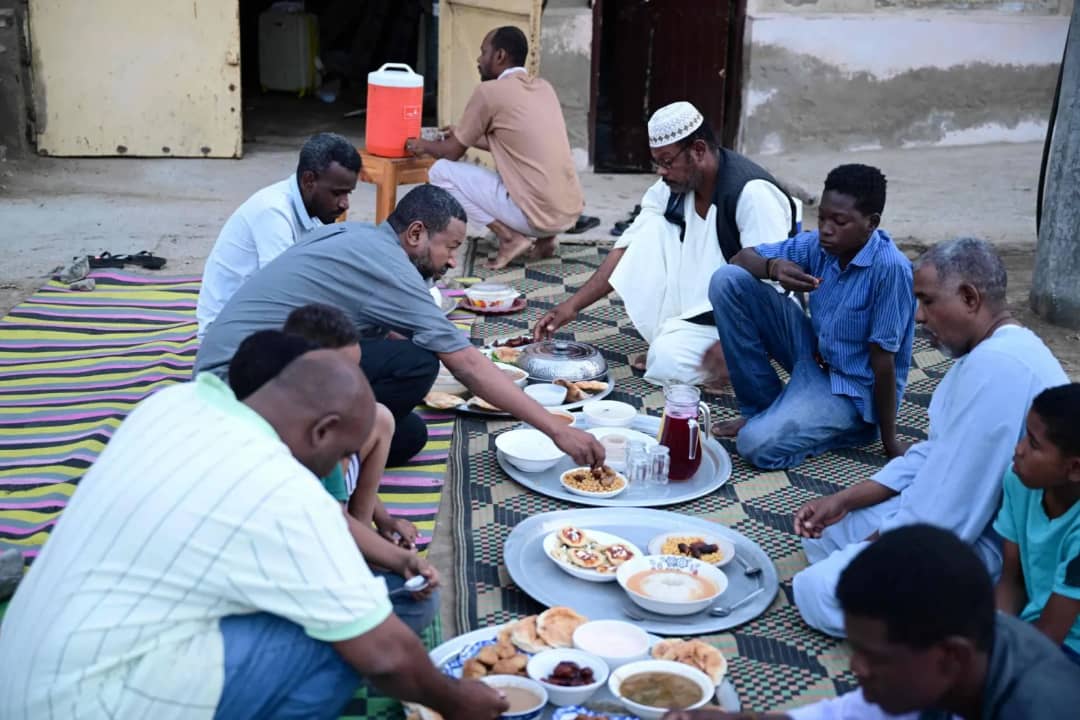
After more than two and a half years, residents of the capital, Khartoum, have reclaimed their deep-rooted Ramadan rituals and traditions. This includes gathering to break the fast (Iftar) in groups in neighborhood streets, squares, and open plazas to strengthen the spirit of mercy and social solidarity, alongside the return of the “Musaharati” (the dawn caller).
High Prices and Difficult Conditions
Halima Izz al-Din, a housewife living in the Al-Thawrat area of Omdurman, told the Mashaweer platform: “The majority of families have become unable to buy Ramadan supplies because financial savings have run out and salaries haven’t been paid, in addition to the lack of job opportunities for many heads of households.”
She added: “The month of Ramadan requires a large budget given the daily needs for Iftar and dinner, as well as the necessity of providing meals for children. Therefore, the situation has become extremely complicated.”
Izz al-Din explained that food prices have risen by 300 percent, doubling the suffering of Sudanese people in Khartoum and the states. Traders have exploited the situation, raising the prices of sugar, oil, onions, juices, and meat to unprecedented levels.
Electricity Crises
In a related context, Moammar al-Sharif, who lives in the Al-Kalakla area, pointed out that “what worries citizens most during Ramadan is the electricity cuts for long hours, while temperatures rise to over 40 degrees Celsius.”
Speaking to Mashaweer, he noted: “The outages continue morning and evening without regard for the suffering of people during Ramadan, especially with the high temperatures and the spread of mosquitoes.”
Al-Sharif mentioned that “capable families have resorted to buying ice daily; however, providing large quantities of ice every day is a financially exhausting process given the economic crisis.”
Water Scarcity
On the same note, Jaber Al-Tom, who lives in Port Sudan, explained that “residents of the city are suffering doubly due to the scarcity of drinking water during Ramadan, especially in the neighborhoods. Water supplies have stopped in many areas, which has exacerbated the suffering of citizens.”
Al-Tom told Mashaweer that “thousands have been forced to buy water from horse-drawn cart owners to fill the gap and solve the crisis despite the high prices.”
He continued: “Hundreds gather daily at water distribution points because pumping stations have been affected by power outages, at a time when authorities are unable to provide drinking water.”
The Musaharati, the ‘Dhara,’ and Roadside Iftars
In the Sudanese capital—across its three cities of Khartoum, Omdurman, and Bahri, communal Ramadan Iftars in the streets and squares have returned after a three-year absence. This is also occurring in the streets of towns and regions in Al-Jazirah and Sennar states.
In recent days, dozens have been active in reviving the custom of stopping travelers on roads in villages and localities to invite them to break their fast.
In the neighborhoods of Khartoum, Bahri, and Omdurman, the “Musaharati” has returned to the streets to wake people up for the pre-dawn meal (Suhur), bringing back the drums and chants that had gone silent due to the repercussions of the war.