Until recently, US President Donald Trump continued to emphasize that his administration was very close to ending the war that has been raging in Sudan between the army and the Rapid Support Forces (RSF) for nearly three years, noting that this war receives special attention within his political and diplomatic movements.
However, the reality of the situation indicates that the war between the two Sudanese parties is still burning, especially in the Darfur and Kordofan regions, with no signs of its cessation appearing on the horizon. Meanwhile, the verbal war between the leaders of the two sides is intensifying, which means that a military resolution is the only way out to end it. This raises a question: where did the American solution promised by Trump go? And what are the expected scenarios for this war?
A Strong Mediator
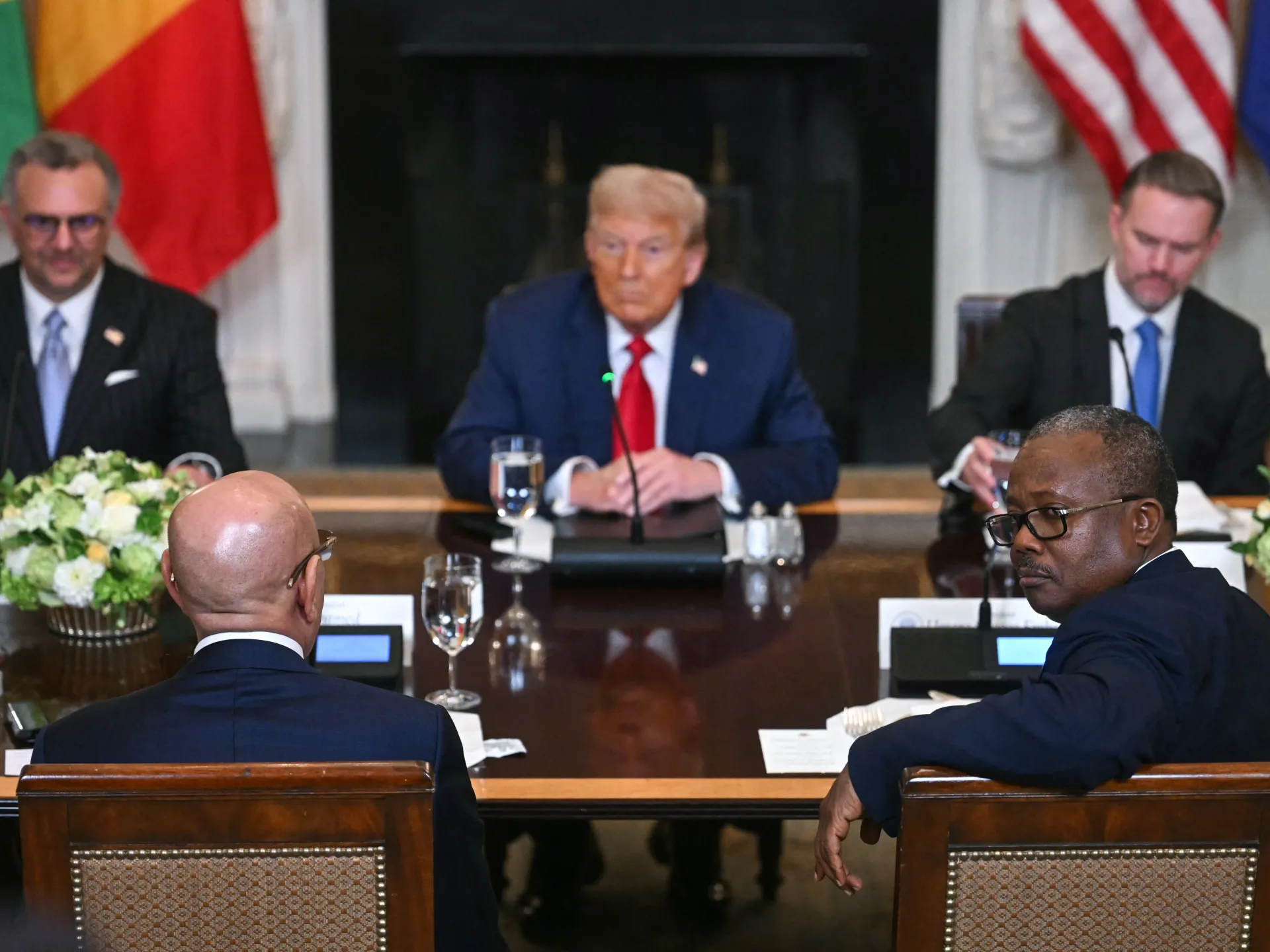
Mohammed Torsheen, a researcher in African affairs, believes that Donald Trump’s statements and those of the US administration in general regarding the Sudanese issue are somewhat positive. They come within the framework of Washington’s attempt to be present in the Sudanese file, which the US President expressed clearly and transparently when asked about the Sudan war, saying he knew nothing about what was happening in that country. This matter was clear in Saudi Crown Prince Mohammed bin Salman’s request to the US President to do something decisive to stop what is happening in Sudan during their recent meeting in Washington; therefore, these are attempts that would make Saudi Arabia present in this direction.
Torsheen continued: But I believe that Trump has not made any serious effort that would contribute in one way or another to moving negotiations related to stopping the Sudan war. In my opinion, the external factor or dimension is what directly controls the paths of the war and internal fighting between the army and the RSF.
Torsheen added: It is certain that if the United States and all international partners succeed in stopping the external dimension of the war, the factors at the internal level will change significantly. For example, there are Security Council resolutions regarding the arms embargo on the Darfur region that have not been implemented yet, which confirms that Washington is not very interested in the Sudan file. Without a doubt, when the external element is neutralized, there will be major shifts in this war, especially in terms of reaching an agreement or stopping this war entirely.
He added: There are external parties that have continued to provide both sides of the war (the army and the RSF) with a lot of support and guarantees, assuring them that they will not be hit by US sanctions and so on. This makes both sides seek in one way or another to achieve this—meaning moving forward in the war process and achieving victory, considering that it might be the way out. Perhaps the US administration is also seeking this direction to achieve interests or an approach to keep the RSF in the scene. Therefore, I do not believe that Donald Trump will be able, given regional and international challenges, to pay attention to the issue of Sudan because it is not influential or effective regarding the threat to American interests.
He pointed out that the talk about the Sudan war ending in a military victory through crushing the other side, eliminating it, and killing all its members will not happen. Military victory is always based on weakening the other side to a stage that forces it to make greater concessions in the negotiation process, and then reaching a final agreement. If this part is not available, the issue of reaching understandings will be extremely complex given the balance of power between the two parties.
The researcher in African affairs concluded by saying: Reaching understandings requires a strong international partner or mediator capable of pressuring both parties. This matter is only available in Washington, which seems uninterested in this conflict. Rather, there are parties like the Emirates that have a very large influence on decision-making centers in the United States. Therefore, I do not think the latter will have an effective role in this context that leads to achieving a settlement in Sudan. Consequently, unfortunately, the course of operations is what will be a decisive element in the future of the conflict in Sudan.
Divergence of Positions
In this context, Rashid Mohammed Ali, a specialist in political science and international relations at Sudanese universities, points out that Donald Trump’s interest in ending the war in Sudan is based on two dimensions. The first is achieving a certain level of American interests that ensures strong indicators for the US administration through which it can move in the regional sphere with the presence of the RSF as militias to be used. The second dimension is that in the event of achieving peace in the country, the RSF would be transformed from militias into a political organization so that it has a degree of acceptance, which is what the US administration seeks by legalizing the status of these militias, especially after the Iranian crisis resurfaced.
He added: But regarding matters related to the trend towards ending the Sudan war, it is something agreed upon between the US administration and the Emirates—the main supporter of the RSF logistically, securely, militarily, and with intelligence—while the positions of Riyadh and Abu Dhabi diverge regarding the Sudanese war, as Saudi Arabia’s position is that the region should be free of wars and conflicts.
Rashid Mohammed Ali continued: Regarding the expected scenarios, I believe that in light of the escalating sharp tone toward the attack on Iran, internal wars will not be remembered because a war with Tehran would be a regional and international confrontation involving the use of advanced technical and modern weapons. Therefore, in light of these major threats in the regional sphere, the Sudan war cannot be looked at. Otherwise, it will deal with the hypothetical logic imposed by Saudi Arabia on President Trump’s administration that the Sudanese conflict must be ended first and then move to deal with Iran so that the region is not in a high state of turmoil and wars.
The specialist in political science and international relations expected the end of the Sudan war during next April, based on a reading and strategic indicators linked to the Trump administration’s management of Middle East files.
False Promises
For her part, Tamadur Al-Tayeb, a professor of international relations at the Center for Diplomatic Studies at the University of Khartoum, believes that no one can predict the seriousness of US President Donald Trump in proposing solutions to stop the war in Sudan, especially at the current time. According to her reading of the international and regional scene, she finds that he has many complex files that make the issue of Sudan far from his priorities.
Al-Tayeb added: Trump pretends that he has the key to solving any problem in the world. At the same time, he is very keen on American interests around the world, but the issue of implementation always involves some kind of delay or a form of false promises. He does not provide anything until he knows that what he provides will bring him the greatest benefit at a time he desires.
The professor of international relations continued: But the issue of ending the war and conflict in Sudan, in my estimation, is something Trump handles in a superficial and non-serious way because it is not among his priorities yet. He has other priorities that he is more interested in at the current time than his interest in the Sudan war.
مقالات ذات صلة
-

-

-

-