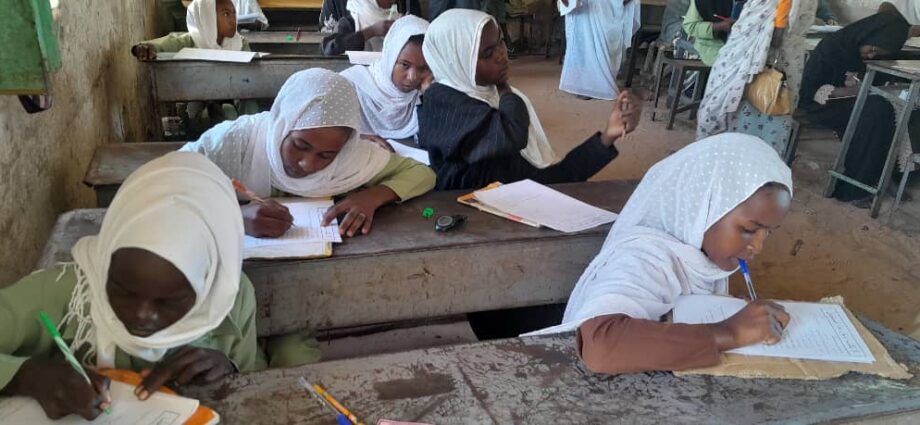
The action taken by the parallel government affiliated with the “Tasees” alliance to form a technical committee to supervise this year’s secondary certificate exams—in preparation for organizing them in Rapid Support Forces (RSF) controlled areas in western Sudan—has sparked significant controversy and criticism regarding the feasibility of such a move under current circumstances, as well as serious fears of the political and geographical division of the country.
Educational bodies specializing in education affairs, led by the Sudanese Teachers’ Committee, warned against this step. They consider that the multiplicity of decision-making centers regarding the secondary certificate exams, and linking them to military control zones, practically opens the door to a divided educational reality, signaling a de facto secession of the Sudanese state even if it is not officially declared.
Insistence and Arrangements
For its part, the parallel government in RSF-controlled areas formed a technical committee to supervise this year’s secondary certificate exams, a week after announcing the completion of technical, administrative, and security arrangements for the tests. The Ministry of Education in the “Tasees” government issued a decision to develop a comprehensive plan for the exams that accommodates students who have been unable to sit for tests since the outbreak of the war, and to prepare arrangements to address the loss of academic achievement resulting from the suspension of studies, as well as supervising the preparation of exams for the current academic year, evaluating results, and submitting recommendations to specialized authorities.
The decision, signed by Minister of Education Koko Mohammed Jagdoul, explained that “the formation of the committee comes in response to the security and logistical challenges that have hindered the path of general education, and to address urgent issues included in the Peace Government’s program, foremost of which is the entitlement to secondary certificate examinations.”
According to the parallel government, the committee’s tasks included ensuring the necessary funding for work requirements related to preparation and implementation, creating a suitable environment to enable students to take exams in safe conditions, and ensuring the confidentiality of the exams and transparency in the grading and results announcement processes, in addition to coordinating with relevant authorities to overcome administrative, logistical, financial, and security obstacles accompanying the exam process under the country’s current conditions.
Warnings and Fears
In this context, the Sudanese Teachers’ Committee reported that it had “followed the decision of the de facto government in Nyala regarding the formation of a supervisory committee for secondary certificate exams, which reinforces what we warned about regarding the danger of turning education into a tool to entrench geographical and political division.” It added in a statement that “the conflict between the Sudanese government and the parallel government, and each party’s attempt to establish its position as a fully empowered government within its scope of control through the gateway of secondary certificate exams, translates into the fears that the committee has been warning about for some time.” It pointed out that “the Sudanese secondary certificate is not a local administrative procedure, but rather a national sovereign entitlement that represents a symbol of the unity of the state and its educational institutions.”
The committee warned of the danger of the parallel government formed by the “Tasees” alliance proceeding with the exams in RSF control areas. It noted that “the multiplicity of decision-making centers in this file indicates a practical separation,” and renewed its call for the formation of an independent and neutral national committee comprising educational experts recognized for their competence to coordinate the holding of exams away from political and military polarization.
An Unprecedented Step
In the same context, educational specialist Saeed Bishara explained that “organizing exams in areas subject to the control of each party to the war is a precedent that Sudan has never witnessed before,” noting that this step falls within policies that may contribute to consolidating the division of the country.
He added that the armed conflict led to the deepening of societal and ethnic divisions, which later turned into administrative and geographical divisions that even affected the national secondary certificate exams, which were previously one of the symbols of national unity, as they used to gather Sudanese students from various regions, inside and outside the country, at a single age stage.
He pointed out that “there are obstacles and complications preventing the organization of exams in RSF control areas, including the deterioration of the security situation, which brings to mind fears of repeating precedents of exam leaks or burnings due to security complications, as well as the continuation of battles and shelling without even a humanitarian truce or a temporary cessation of fighting.”
The specialist noted that “thousands of students are not ready to sit for exams as a result of their irregular schooling for more than two and a half years, and hundreds of families face difficulties in securing their arrival at exam centers in the absence of safe corridors, especially after frequent reports of incidents of interception and arrest of citizens on the roads and inside cities.”
He called for urgent measures to protect the rights of students in line with international human rights standards and the adoption of solutions that take into account the circumstances preventing students from reaching exam centers, creating a reality that deepens the gap in educational opportunities and enshrines injustice.
Achieving Justice
On the other hand, retired educational supervisor Adel Jaber considered that “students in the five Darfur states and three of the Kordofan states paid a heavy price for the armed conflict, especially after more than 500,000 students were deprived of sitting for exams last year as a result of the Sudanese government’s insistence on holding secondary certificate exams in Sudanese army control areas to the exclusion of other states.”
He stressed the necessity for students in Darfur and Kordofan states to take the exams this year, especially those who have been unable to sit for the secondary certificate exams since the outbreak of the war, to achieve justice and address the crisis of accumulated batches of students.
Jaber mocked claims that organizing exams in RSF control areas would lead to the division of the country, stating that “the Sudanese government toyed with the fates of thousands of students in Darfur and Kordofan during the past two years, deprived them of sitting for exams, practiced discrimination, and encouraged a state of societal division among the Sudanese; therefore, the students’ future must be considered rather than linking the secondary certificate exam file to military control zones.”
Lack of Concern
For his part, retired teacher Al-Tayeb Al-Hadi opined that “the parallel government led by the ‘Tasees’ alliance is not concerned about the students’ future or the continuation of the educational process, evidenced by preventing students in its areas of control from heading to exam centers during the past two years.”
Al-Hadi noted that “it is not unlikely that the exams the parallel government intends to hold will be simplified and easy, or there may be intervention to improve results in line with the surrounding situation and conditions, but this may cause the future emergence of an immature generation of learners.”
The retired teacher attacked the RSF for preventing students from Darfur and Kordofan from traveling to take exams, asking, “If concern for students is the motive, then why prevent student travel and not facilitate their going to exam areas?”
A New Cycle
Meanwhile, the Sudanese government announced its intention to organize secondary certificate exams next April, marking the third cycle of exams held since the outbreak of the war.
Students from Darfur complained of difficulties hindering access to exam centers in areas under Sudanese army control, including insecurity on the roads and fears of arrest on the pretext of cooperating with the RSF.
The RSF has habitually arrested students leaving its control areas in Darfur and Kordofan to take secondary certificate exams, with some being released after paying a ransom, while others are detained in centers belonging to the group.
Weeks before the outbreak of the war in mid-April 2023, the academic year was disrupted, and more than 570,000 students were unable to sit for secondary certificate exams, followed by new subsequent batches of students.
مقالات ذات صلة
-

-
-
-