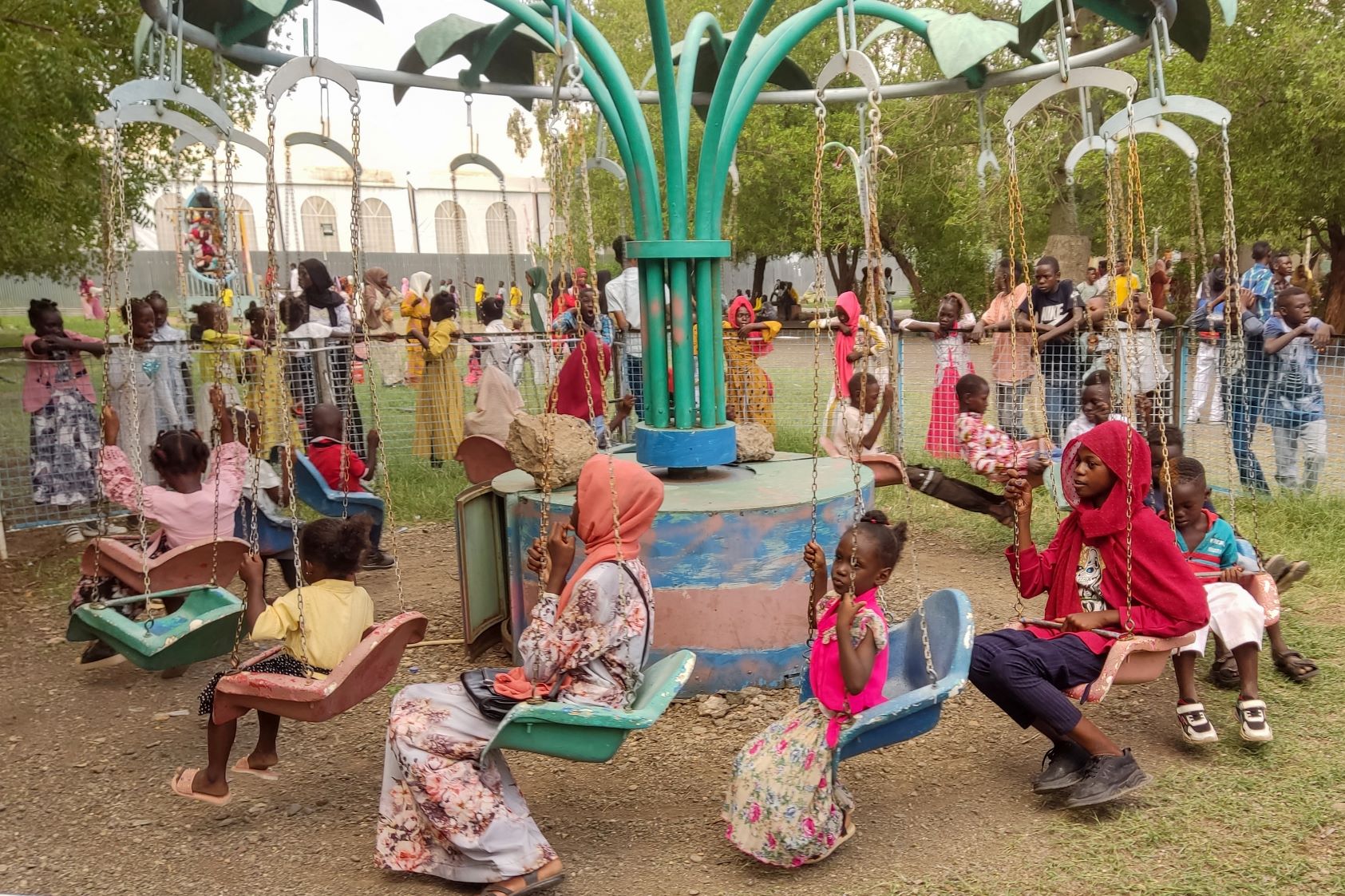
Fatima Abdullah, a displaced Sudanese woman, never imagined a day would come when she would have to convince her children that a few possessions—even second-hand clothes—would be enough to complete their Eid joy.
Fatima fled with her five children from their home in Omdurman two weeks after fighting broke out between the army and the Rapid Support Forces (RSF) in mid-April 2023. She found herself in a shelter in Atbara, River Nile State, which lacks the basic necessities of life, completely changing the nature of Eid for her children.
With a voice heavy with sadness and patience, Abdullah says, “Every year, my children used to welcome Eid by buying new clothes and toys, but the war changed their lifestyle and stripped them of the pleasure of joy. Sometimes we don’t even find enough to buy basic needs.”
She adds, “My children spend most of their time inside the shelter, which has no places for play or study. I try to ease the harshness of the circumstances as much as possible, including the fact that we cannot return home for now because it was leveled by indiscriminate shelling between the two parties to the conflict.”
Fatima’s story embodies a side of the reality for thousands of Sudanese families whose lives have been overturned by a war that has forced millions to be displaced internally or seek refuge in neighboring countries.
Children are among those most affected by the conflict, as they have been exposed to violence, deprivation of education and healthcare, and recruitment by armed groups, while widespread crimes of sexual violence have been committed against them.
Estimates from UNICEF indicate that millions of children in Sudan have been directly affected by the war, whether through displacement or the loss of basic services like education and healthcare. The organization warns that the continued conflict and deteriorating humanitarian conditions threaten the future of an entire generation of children.
In normal circumstances, Eid al-Fitr for many Sudanese children is linked to specific rituals and traditions, most importantly the acquisition of new clothes and visiting neighbors and families. However, this atmosphere has vanished for many of these children, especially those still in shelters or areas lacking minimum services.
Incomplete Joy
Noha Abdel Wahab, a mother of three living in Port Sudan in the east of the country, says, “My children face difficulties adapting to their new lives because of our inability to meet their Eid requirements, especially given the unprecedented rise in prices, particularly for children’s clothing. This has made their Eid joy incomplete.”
She continued, “Before the war, we made sure to buy new clothes for our children during holidays. They used to wait for these occasions with indescribable joy and happiness because they were linked to an atmosphere of delight. But all that has become just memories and a past they long to return to quickly.”
A Mere Luxury
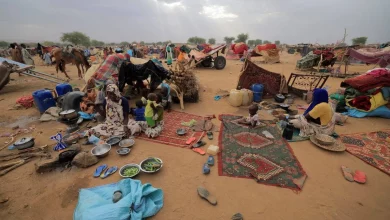
In a shelter in the Tawila area of Darfur, Mohammed Abdel Rahman, a father of four, explained that “providing food and drink, especially for those living in camps, is considered a luxury, let alone buying new clothes, toys, baked goods, and sweets for the occasion of Eid.”
He continued, “My children are constantly asking why there isn’t enough food like before. This means the war has changed their concepts; even at the level of children, thinking has become focused on survival.”
Abdel Rahman added, “There are no signs of Eid in the shelters given the harsh conditions the displaced live in, such as acute shortages of basic services, especially as children’s suffering worsens day by day with humanitarian aid arriving intermittently.”
Heavy Shadows
In this context, Abdel Kader Abu, Secretary-General of the National Council for Child Welfare in Sudan, said, “Children in Sudan are facing extremely complex humanitarian situations due to the war that has been ongoing for nearly three years, especially in RSF-controlled areas which suffer from increased violations and the disruption of medical and food supplies.”
He explained that “road closures and the disruption of supply chains between states have led to a shortage of essential services, exacerbating family suffering, which is directly reflected in the children’s situation.”
Abu pointed out that “the effects of the devastating war for about three years have worsened children’s suffering, as the percentage of those affected by health, food, and educational crises reached 85 percent in several states, whether in safe areas or those affected by conflict.”
He noted that “the war has cast heavy shadows on childhood in Sudan, as the council monitored a significant increase in school dropout rates, with the educational loss reaching about 3 million children. More than 1,013,000 deaths were recorded among children due to malnutrition, in addition to about 1,000 deaths due to hunger, while the number of missing children reached 700.”
He mentioned that “about a million children were killed as a result of participating in the fighting, with the number of wounded reaching about 315. The council also monitored the recruitment of about 1,106,000 children in RSF-controlled areas. Furthermore, the war contributed to a large wave of displacement among children, estimated at about 940,000 displaced children inside and outside the country, while about 313,000 children were separated from their families during displacement.”
The Secretary-General concluded by saying that the council is working with partners to address the situation of children lacking family care and trying to integrate them into society, in addition to monitoring the condition of children in areas reclaimed by the army, as well as implementing health support programs for children.
A Sense of Isolation
Najla Abdel Mahmoud, a specialist in social affairs, explained that “war and displacement leave deep psychological and social effects on children, especially on official occasions like Ramadan and Eid.”
Abdel Mahmoud continued, “Eid is linked to customs and social gatherings that give children a sense of joy, such as playing and family gatherings. However, war and displacement have deprived many children of this pleasure.”
She pointed out that “the loss of home, school, and a familiar educational environment may create a sense of isolation and instability in children, which then affects their psychological and social development in the long term.”
The social specialist noted that “the family and society have an important role in mitigating these effects by maintaining traditions followed during Eid and creating a safe environment for children as much as possible, even under war and displacement. But Eid remains completely different for the majority of children than what they knew before. Signs of joy have disappeared amidst the exorbitant prices that came with the outbreak of war in the Middle East, coinciding with the ongoing conflict in Sudan, alongside the loss of income sources and the exhaustion of savings, replaced by a life full of suffering.”
Painful Paradoxes
In a related context, Adam Regal, spokesperson for the General Coordination for Displaced Persons and Refugees, says, “During Eid, painful paradoxes manifest in the lives of citizens in general who have been affected by the conflict, especially the displaced and specifically children. The occasion of Eid is supposed to be a time for joy and celebration, but it comes amid difficult humanitarian conditions, making Eid a test of patience and resilience.”
Regal added, “For the displaced, Eid is not limited to performing religious rituals; it is a reminder of the homes they were forced to leave and the social ties torn apart by war. Many recall images from the past—the sounds of Takbir in mosques, exchanging visits, buying new clothes for children, sweets, and the smell of baked goods. However, living in camps has turned these images into a painful nostalgia, especially with the absence of traditional Eid celebrations and the dominance of fears over securing food and shelter.”
He added, “Communities suffer from acute food shortages, as food rations are insufficient to meet basic needs, as well as a lack of drinking water and health services. Additionally, many families have lost their breadwinners, increasing children’s suffering.”
He went on to say, “Despite these difficult conditions, the displaced in Darfur try to create simple moments of joy by preparing meals limited to tea and bread on Eid morning and exchanging visits with their children inside the camps, in an attempt to instill the spirit of Eid in the children’s hearts. Despite being deprived of new clothes, the young ones find solace in playing in front of the tents, which eases the weight of their reality.”
The spokesperson pointed out that “this year’s Eid exacerbates feelings of loss and isolation due to the continuation of the war, but it opens a door for hope and clinging to the idea that these conditions are temporary and that they will return to their homes one day. The spirit, however fragile, gives them the strength to survive.”