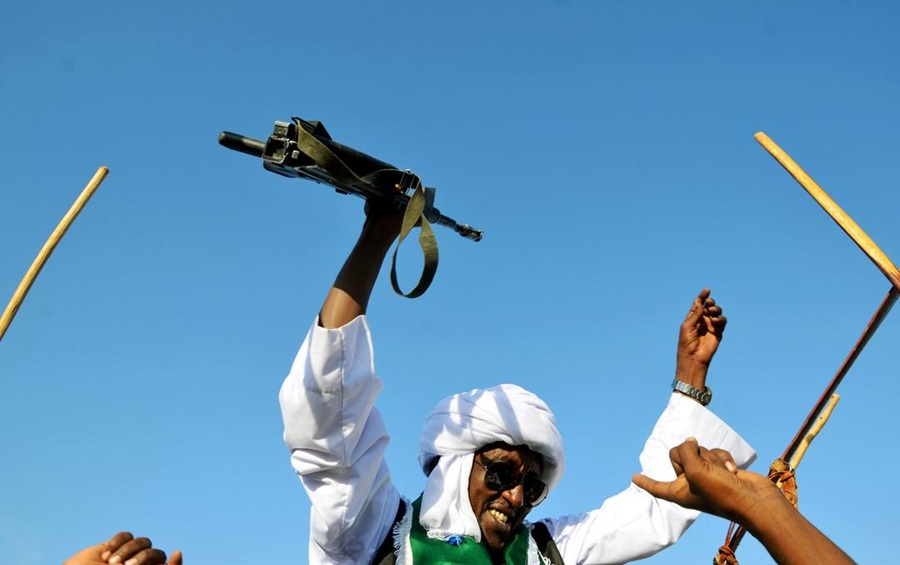
With the growing state of insecurity in several parts of Sudan, especially in the capital Khartoum, owning weapons has become common—and even necessary—for protecting one’s life, honor, and property. This comes amid their widespread proliferation since the outbreak of war between the Sudanese army and the Rapid Support Forces in mid-April 2023. Weapons are being acquired through direct deals and informal sales networks that have created an open market now beyond control due to the chaos of war.
Observers note that civilians’ acquisition of weapons represents a major social shift linked to the war, particularly in how security is perceived. Homes are no longer seen as safe havens, but rather spaces filled with anxiety and fear.
Pre-war estimates suggested that between 3 to 5 million weapons were outside state control. However, these figures are no longer realistic following the looting of military depots and police stations, and the opening of new cross-border arms supply routes. Unofficial estimates now exceed 8 million unlicensed weapons.
Easy Deals
In the Haj Yousif suburb of Khartoum North, citizen Al-Tayeb Badawi said:
“My acquisition of a weapon happened casually as an easy deal amid the chaos of war. I encountered a Rapid Support Forces soldier during their withdrawal from Khartoum, particularly from East Nile. The soldier offered to sell me his weapon for a small amount—15,000 Sudanese pounds (about $7). Without hesitation, I agreed, as I urgently needed a weapon due to armed home invasions in broad daylight and violent robberies on the streets, which often end in قتل if resisted.”
Badawi added:
“Having a weapon at home has become a necessity in daily life as a precautionary measure for self-defense, especially for those who were trapped for months during the war and suffered greatly from armed gangs.”
He continued:
“Despite this necessity, there are real dangers—especially if there are children in the house. The weapon must be hidden, which is exactly what I did.”
He also noted:
“The spread of gangs has changed our sense of security. We no longer feel safe, even with crowded neighborhoods and the return of police stations. I wouldn’t rule out having to use the weapon at any time. Its presence at home gives me a sense of being able to protect my family. Given the unstable security situation, keeping a weapon feels justified.”
A Frightening Reality
Meanwhile, Mohammed Talha, a resident of the city of Shendi in River Nile State, said:
“Although cities in River Nile State have not witnessed direct fighting, they suffer from a frightening level of insecurity and widespread killings. This led me to buy a weapon, which now accompanies me both at home and at work.”
He added:
“Through a mutual friend, I met an arms dealer. Sales don’t happen in open markets but secretly, as the trade has become widespread and out of state control. Weapons now enter normally through cross-border smuggling.”
Talha explained that owning a weapon was never a priority before the war, but horrific crimes and killings—even in areas not directly affected by fighting—completely changed his perspective.
“I had no choice but to protect myself and my family.”
He noted that buying weapons is expensive and prices are non-negotiable, yet ownership has become widespread across different age groups and professions, all driven by the search for safety.
He also stressed that these purchases are not conducted within a legal framework but have become normalized under current conditions, with self-protection becoming the only option for many families.
Social Transformations
Social researcher Ayoub Abdel Latif said:
“The shift toward civilians keeping weapons at home reflects a complex social transformation. Despite knowing it is illegal, it has become normalized, indicating a dangerous shift in responsibility for security—from the state to individuals.”
He added:
“This is not rooted in a firm belief in arming oneself, but rather a direct response to an environment dominated by fear and uncertainty.”
He continued:
“The arms market has gone out of control due to widespread civilian access, driven by security failures and the belief that weapons provide a sense of safety and control. However, this carries serious long-term risks.”
He explained that such individual measures are expected in times of war, as security vacuums push people to seek immediate alternatives for protection.
“This is a reaction driven by fear, not a rational solution.”
He warned that while many see weapons as an effective deterrent, they also create internal contradictions—offering superficial reassurance while increasing risks of accidental harm, especially in family disputes.
He added that if insecurity continues, weapon ownership could become a permanent social norm, but reducing it would require strict disarmament policies and rebuilding trust within society.
He emphasized the need for community-led awareness campaigns about the dangers of weapons, safe storage practices, and challenging the idea that owning weapons is necessary—especially given the risks to children, including normalization of violence and long-term psychological effects such as anxiety.
Legal Gap
Sudanese lawyer Abdelrahim Mohammed stated:
“The outbreak of war created a legal vacuum. Normally, weapon ownership is regulated by licensing conditions such as age, criminal record, and medical and psychological checks. However, these requirements collapsed under the pressure of war, as state institutions ceased functioning. Obtaining or renewing licenses became impossible, making unregulated weapon ownership seem justified under self-defense.”
He added:
“The expansion of weapon ownership has reshaped social structures. Weapons are no longer just tools of defense—they have become factors in everyday conflicts, where minor disputes can escalate into armed confrontations. Household accidents have also increased, particularly involving children.”
He concluded:
“The greatest danger is not the weapons themselves, but the mental and behavioral transformations that occur when citizens lose trust in the state’s ability to protect them. At that point, weapons become the default source of security.”
He noted that Sudan has a theoretical Disarmament, Demobilization, and Reintegration (DDR) framework, but it remains suspended pending political and security stability. Meanwhile, the country faces growing challenges in dealing with an armed civilian population outside official structures.
He outlined possible solutions, including voluntary disarmament programs with incentives, or stricter enforcement measures such as compulsory collection and legal penalties—alongside rebuilding trust between the state and society.
He concluded by stressing that the arms market has outpaced the state, and the real challenge lies not only in reactivating laws, but in redefining the relationship between citizens and security institutions so that weapons return to their proper place.
مقالات ذات صلة
-

-
-
-