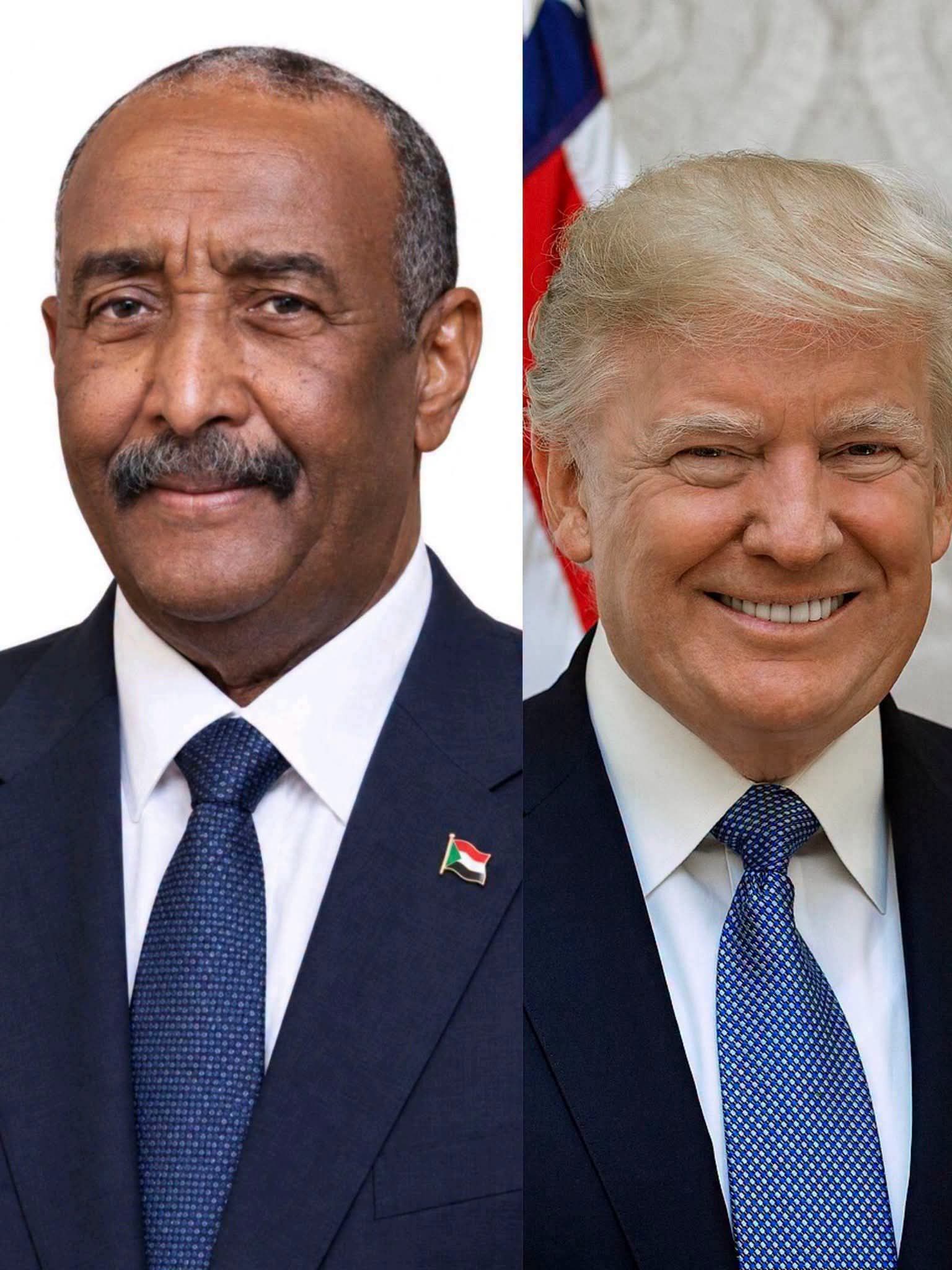
Does al-Burhan’s Letter to Trump Open the Way for a Truce in Sudan?
Report – Ahmed Younes
The letter sent by Sudanese Sovereignty Council Chairman and army chief Abdel Fattah al-Burhan to US President Donald Trump has raised questions about the prospects of advancing Washington’s proposal for a humanitarian truce in Sudan. It remains unclear whether Burhan’s declared commitment to US-led peace efforts reflects a willingness to resolve disagreements over the proposal or simply restates his previous position in more conciliatory language.
On Thursday, Burhan announced in a post on the social media platform X that he had sent a letter to Trump affirming his government’s commitment to US-sponsored peace efforts and its readiness to cooperate with all parties to reach a settlement that safeguards Sudan’s sovereignty, unity, territorial integrity and the dignity of its people.
However, the letter did not explicitly accept the proposed 90-day truce put forward by Washington, nor did it address the arrangements for implementing it or the guarantees required to ensure its success. The US initiative calls for a humanitarian truce between the two sides without preconditions, allowing aid to reach affected populations and paving the way for a broader negotiation process.
The US initiative forms part of an effort led by the Quad, comprising the United States, Saudi Arabia, the United Arab Emirates and Egypt, to move beyond declarations of support for peace towards practical agreements to reduce fighting, secure humanitarian assistance and pave the way for a Sudanese-led political process.
On 30 September, Burhan’s adviser for political affairs and international relations, Amjad Farid, told Reuters that his government had proposed amendments to the US initiative. These included the withdrawal of Rapid Support Forces (RSF) from urban areas under international monitoring.
Farid also expressed concern that the proposed formula could entrench the country’s division and allow the paramilitary forces to remain an influential actor in Sudan’s political future.
Diverging Positions
Dr Yasser Nour El-Din, a Sudanese writer and researcher based in Canada, argued in an analysis he published that Burhan’s letter repackages his previous demands in the language of partnership with Washington without explicitly accepting the truce.
He believes the letter reframes those demands as proposed arrangements for implementing a cessation of hostilities rather than as preconditions, potentially opening the door to negotiations within the framework of the US initiative.
Nour El-Din calls for shifting the question from “Does the government accept the truce?” to “How can a truce that has a realistic chance of success be designed?”
He argues that the letter’s significance will depend on whether Washington is prepared to treat it as an offer to negotiate rather than merely a restatement of previous positions.
In a more pessimistic American assessment, Cameron Hudson, a senior fellow in the Africa Programme at the Center for Strategic and International Studies in Washington and a former US National Security Council official, described Burhan’s decision to address Trump directly as a “bad sign.”
In a post on X, Hudson said that a communication channel already existed between Burhan and Massad Boulos, the US president’s adviser. He argued that bypassing that channel came in the wake of the UN visa crisis and what he described as unsuccessful pressure exerted by Boulos on the Sudanese army.
Hudson added that the move was not surprising but raised questions about the level of trust and communication between Khartoum and the US administration.
Political analyst Mohammed Latif, meanwhile, views the letter in the context of mounting domestic and international pressure on Burhan. These pressures include criticism of the government’s record in protecting civilians, what Latif describes as “Egyptian aggression,” a tougher US position and pressure linked to allegations of chemical weapons use, as well as Burhan’s relationship with Islamist forces.
Latif told Asharq Al-Awsat that “all these factors are placing suffocating pressure on Burhan.” However, he ruled out the possibility that the letter represented a decisive shift in his position.
“I cannot imagine Burhan suddenly moving from the camp of war to the camp of peace,” he said, suggesting that the letter’s objective may be to ease US pressure, overcome the domestic crisis and buy time while waiting for developments that could shift the balance of power in his favour.