Winter Adds to the Suffering of Displaced People in Sudan’s Conflict Zones
Mashawir – Report by: Minhaj Hamdi
At the Unified Displacement Centre in El Obeid, the capital of North Kordofan State, hundreds of people fleeing the horrors of fighting gather around traditional fire stoves fuelled by firewood and charcoal. They light fires to protect themselves from the bitter cold despite the potential dangers, particularly at night when families rest while fires remain burning in the presence of children and elderly people.
The situation of displaced people in Blue Nile and the Darfur region is not significantly different from that of hundreds of thousands in Kordofan, particularly with the arrival of winter. During this season, daily needs for food, medicine, and heating supplies increase, further intensifying the humanitarian suffering of millions of Sudanese who have been forced to flee their homes in search of safety and stability.
According to meteorological specialists in Sudan, this year’s winter is expected to be colder and last for four months, beginning in November and extending until mid-March next year. During this period, thousands of displaced people face multiple crises, including securing adequate food supplies, medicines, and blankets to protect against the severe cold, particularly for children and the elderly.
Worsening Conditions
In this context, Mujahid Al-Tayeb, who lives in the Khor Tagat camp in El Obeid, said: “Although the severe cold has not yet begun, the arrival of winter contributes to deteriorating health conditions and an increase in disease rates, particularly common colds and respiratory infections. This requires a continuous supply of medicines, in addition to preparing extra meals for children and elderly people and purchasing new winter clothes to cope with successive cold waves.”
Speaking to Mashawir, he added: “Most people arriving from South and West Kordofan due to the escalating fighting do not have the financial resources to meet their winter needs. This is unlike normal circumstances, when people can manage their affairs relatively easily. Consequently, many people’s reliance on their individual efforts to secure basic living and healthcare needs will come to an end once their money runs out, which could happen in less than a month. This makes urgent intervention by the authorities and humanitarian organisations essential to address these crises.”
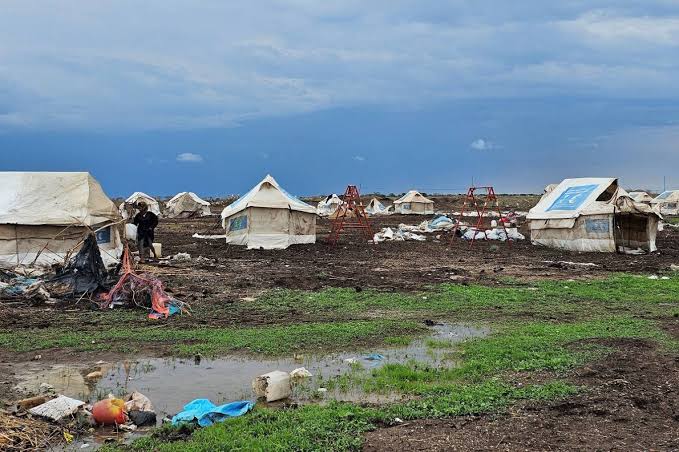
Al-Tayeb explained that the shelters accommodating thousands of displaced people are currently unsuitable for living because they cannot withstand harsh weather conditions. Cold air easily penetrates the structures, forcing many displaced people to sleep on pavements and huddle against walls because they lack mattresses and supportive, comfortable pillows to protect them from the cold.
Difficult Living Conditions
For his part, Jadallah Hassan, who was displaced from Um Baru locality to the town of Tawila in North Darfur State, said: “Most displaced people are living in grass-thatched houses and shelters made of tree branches under extremely difficult conditions, particularly after a cold wave hit several towns and areas across the region. This is compounded by the lack of healthcare and the absence of assistance from international organisations.”
Speaking to Mashawir, he pointed out that the cold had forced families to search for ways to adapt to the prevailing conditions. Most of the grass-thatched shelters have been patched with pieces of old clothing and sacks after being damaged by cold weather and strong winds.
Hassan noted that winter further worsens health conditions and contributes to increasing rates of illness, particularly common colds and respiratory infections. This makes a continuous supply of medicines necessary, alongside additional meals for children and elderly people and the purchase of new winter clothing to withstand the cold waves.
Volunteer Initiatives
Meanwhile, several initiatives have been launched on social media to raise funds for purchasing blankets, food supplies, and medicines to distribute among displaced people in shelters across Kordofan, Darfur, and Blue Nile.
The campaigns have also appealed to families and individuals to collect their old winter clothes and hand them over to volunteers for distribution. These initiatives have received considerable public engagement, with several artists and football stars joining the support efforts.
Souad Jaafar, a member of the “Nidafeehim” (Let’s Keep Them Warm) initiative, told Mashawir: “We have been promoting the campaign on social media to raise funds for purchasing blankets and clothing for children and elderly people, particularly because they are the groups most vulnerable to illness during winter, in addition to the difficult circumstances facing most of their families in displacement centres.”
She added that the response had been encouraging, with the volunteer team successfully distributing second-hand winter clothing, blankets, food supplies, and some financial assistance. Volunteer doctors have also joined the initiative to conduct medical examinations and provide treatment at displacement shelters.
Jaafar stressed that the number of displaced people is extremely high and requires intensified efforts by the government and regional organisations to provide all the necessary assistance.
She appealed to businesspeople, artists, football stars, and pharmacy owners to provide urgent support to prevent the suffering of people fleeing the horrors of war from worsening and to protect them from the growing threat of disease.
Lack of Food
In a related development, Imad Hashim, who lives in a displacement gathering area at Al-Karama Camp in Damazin, said: “My family lives in a tent measuring no more than three square metres, made from a mixture of worn-out fabrics, mats, firewood, and some straw. We leave the tent for the women and children during the night to protect them from the cold, while we men and young people gather outside and light wood fires to keep warm.”
Speaking to Mashawir, Hashim explained that winter days are always long, marked by anxiety and boredom, while sadness is visible in the eyes of children. “We have learned to economise on everything. We divide the children’s medication into smaller doses and survive on the bare minimum of whatever food is available.”
He pointed out that most displaced people have lost their sources of income due to the lack of employment opportunities and the depletion of their savings. Humanitarian assistance is virtually nonexistent, while access to food, water, and healthcare services remains extremely difficult.