Migration of Colours: Uganda Becomes an Open Studio for Sudanese Refugee Artists
Kampala – Report: Mashawir Team
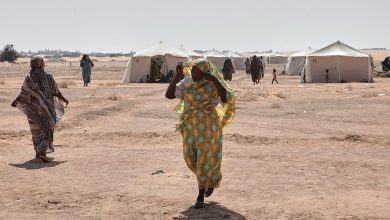
Along the road from northern Uganda to Kampala, displacement cannot be measured in kilometres alone. As of October 2026, Uganda was hosting 97,676 Sudanese refugees and asylum seekers, more than 94,000 of whom arrived following the outbreak of war in April 2023. They are distributed across northern settlements, most notably Kiryandongo, where they account for 47.5% of the population, as well as Nyumanzi, Adjumani and Arua, and Greater Kampala and Entebbe, which host 13% of them.
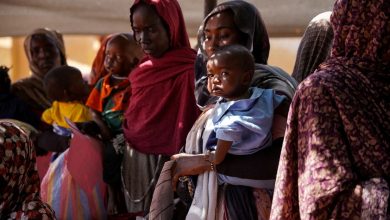
The struggle for survival has taken on increasingly harsh dimensions. The funding gap stands at 88%, food rations have been reduced, and approximately 17,000 refugees in the north depend on 20 community kitchens, amid shortages of medicines and the vulnerability of shelters to heavy rains. Among them are artists confronting a question that goes beyond securing a livelihood: where does colour seek refuge when its creators are forced into exile?
Colours Crossing Borders
Displaced people crossed Sudanese cities carrying with them a visual memory that survived a war which affected museums, art galleries and the Faculty of Fine Arts in Khartoum, all of which suffered looting and destruction. In the diaspora, displacement has evolved into a “migration of colours”, carrying the visual artist’s perspective from the landscapes of the Two Niles and ochre earth to the tropical highlands, in an effort to resist erasure.
This migration has found a supportive environment. Uganda’s relatively flexible refugee policy allows freedom of movement and access to work. Its artistic infrastructure includes the Margaret Trowell School of Industrial and Fine Arts at Makerere University, the 32° East art centre, Afriart Galleries and its SILHOUETTE project, Umoja and Zensun centres, the Goethe-Institut, as well as protection and residency programmes provided by UNESCO and Art for Hope Foundation.
Visual artist and university lecturer Tarek Osman told Mashawir that this environment offers opportunities to engage with diverse artistic movements, despite limited accommodation and shortages of artistic materials.
Creating from the Remnants
Faced with rising material costs and a weak art-collecting market, artists have developed a survival economy and established collective studios in accommodation centres.
One notable initiative is the “Here There Are Dreams” collective, which brought together Jalal Yousif (Gouli), Ouhaj, Mohamed Ahmed Ali, Mohamed Fadl, Mohamed Mustafa and Saleh Abdo. They used discarded wood, cardboard, recycled fabrics and earth pigments to preserve memory through art.
Solidarity also extended to the “Share for Good” event in May 2026, organised to support medical treatment for patients, the Future Stars Centre festival, and psychological expression workshops in refugee camps in collaboration with Artolution.
Their presence has also extended into the national cultural sphere through online exhibitions, most notably the monthly “Days of War” exhibition, sponsored by Reminiscence Gallery. It brings together approximately 100 artworks by artists inside Sudan and across the diaspora, conveying the suffering of the Sudanese people to the wider world.
Artist Amani Omar told Mashawir that these initiatives and exhibitions enable artists to continue working despite limited resources while maintaining their connection to the issues facing their homeland. For her, creating art with whatever materials are available is a daily act of resistance against disconnection and an opportunity to engage with the Ugandan context.
Three Artistic Directions
Between 2024 and 2026, three major artistic directions emerged.
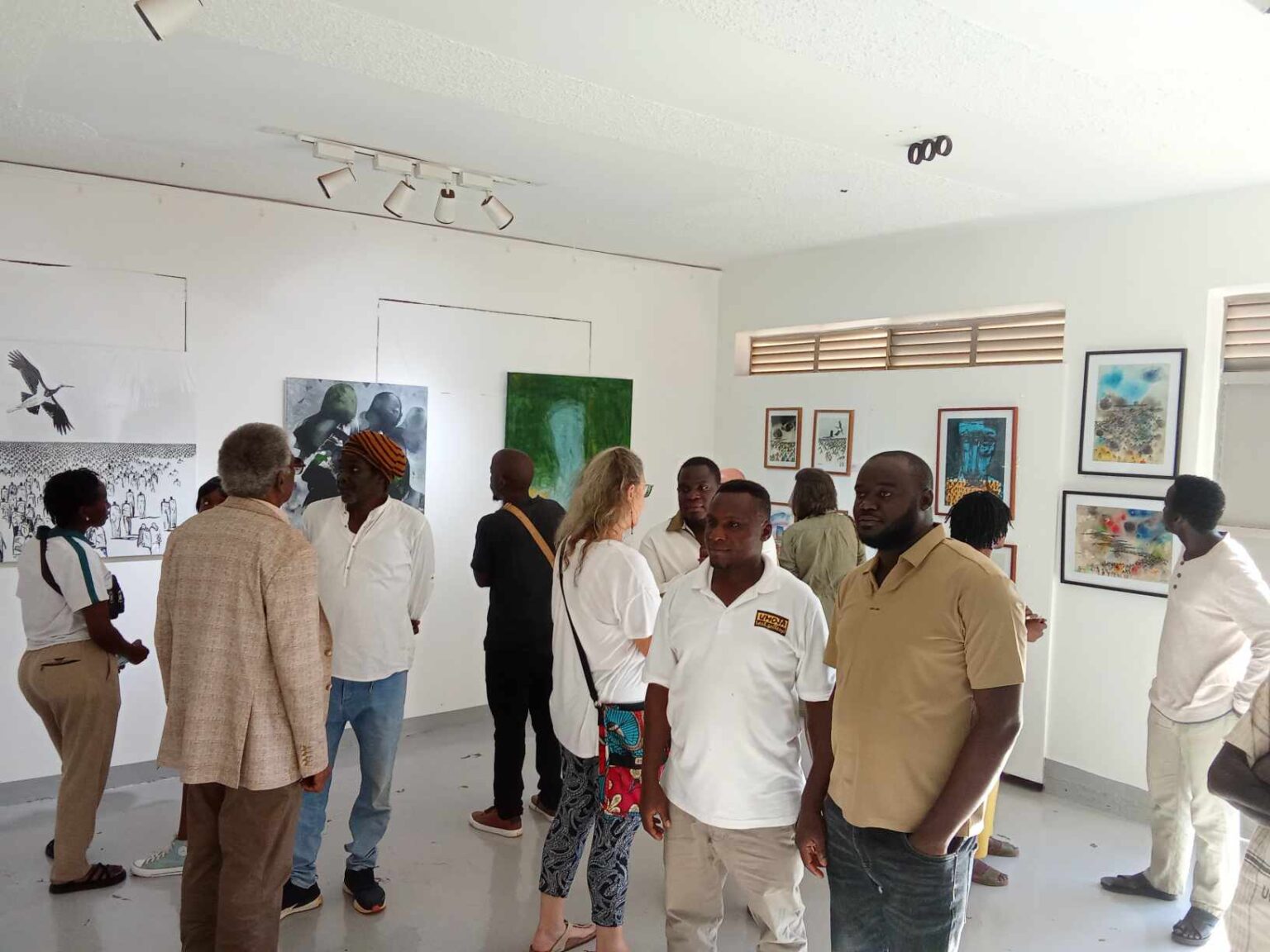
The first focused on reclaiming civilisational memory. Veteran artists, including Al-Tayeb Daw Al-Bait, Abu Sharia Ahmed, Fadil Ahmed, Nasr al-Din Al-Douma, Jalal and Amir Yousif, Mohamed Ahmed Abdelrasoul and Salah Al-Douma, revisited Sudan’s heritage through the exhibitions “Kushite Stories” at Umoja Gallery and “Stories from Sudan” at Makerere University.
Al-Tayeb Daw Al-Bait explained that their message was to “reinterpret history and affirm that Sudan is a country of advanced civilisations, unlike the killing and displacement taking place today.”
Fadil Ahmed, meanwhile, said they had chosen to “hold on to hope and aesthetic transformation” rather than respond through direct confrontation.
The second direction centred on experimentation and women’s memory. Works by Mona Taha, including “A Walk in Makindye”, and Amani Azhari’s “Water Forms” and “First Glance”, alongside works by Hamza Tirab and Tanzil Abdullah Adam, explored women’s issues, intimate memory and everyday life in Kampala.
Public art also brought these experiences into streets and accommodation centres through murals and photography, as demonstrated by “Scattered Memory” at the Goethe-Institut and Mohamed Al-Taj’s exhibition at 32° East.
Hamza Haroun, creator of the murals “Darlin” and “Art for Peace”, said the works “promote awareness of conflict and feelings of coexistence.”
In another achievement, six Sudanese refugee photographers won six of the nine awards in a Ugandan photography competition.
32° East, which launched the “Landing Residency” programme, explained that the studio provides artists with “a powerful space to reclaim their agency and capacity to act, tell stories and reclaim control of the narrative.”
Umoja Gallery described the works in “Kushite Stories” as opening “a window into the soul of a nation shaped by both ancient greatness and modern upheavals”, offering a visual interpretation of the pain of displacement, the scars of conflict and the strength to overcome adversity.
From Exile to the Archive
The growing presence of visual artists has coincided with musical performances and intellectual discussions in Kampala, presenting Sudanese refugees as cultural partners who enrich East African culture.
While these artistic experiences help rescue visual memory from disappearing, they also highlight the responsibility of cultural institutions to document and digitally archive this work, paving the way for its eventual return to Sudan’s museums and art faculties.
In this way, the migrating colours may one day return home, carrying with them everything they witnessed along the journey.