Having lost their warm homes in Sudan due to the war that erupted in April 2023, Sudanese refugees living in tents at Kiryandongo Refugee Settlement are now facing increasingly difficult conditions. Thousands are enduring severe humanitarian hardships after floodwaters inundated their shelters, further worsening an already desperate situation.
The crisis has been compounded by shortages of food, medicine and healthcare services, as international organizations have scaled back their assistance and services due to funding shortfalls.
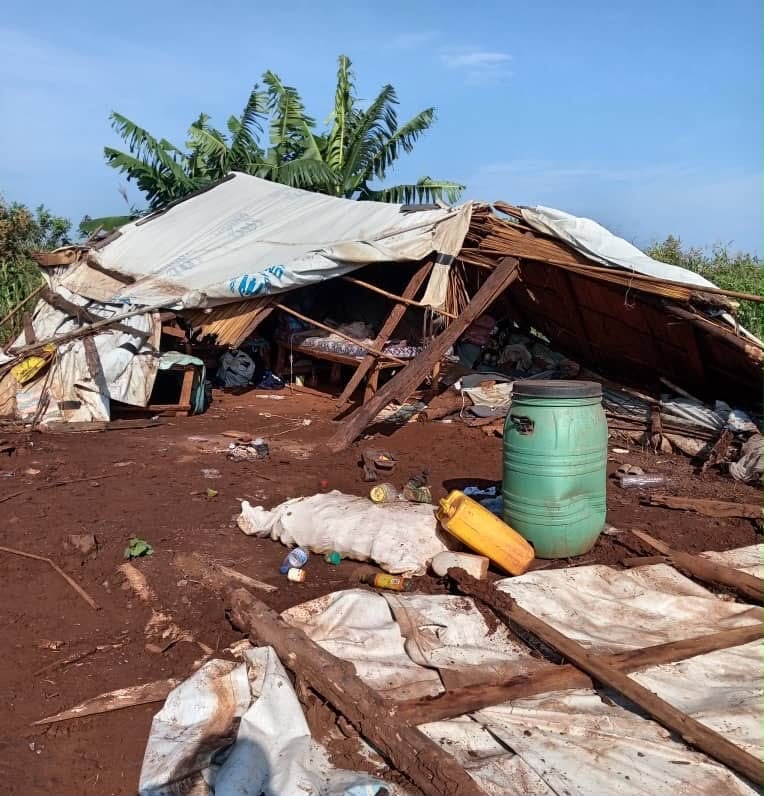
Recent rainstorms tore down the makeshift shelters and tents of families who had fled the ongoing war. Dozens of families remain exposed to the elements because of the lack of adequate accommodation facilities, while their daily needs for food and materials to keep warm remain unmet.
Extensive Damage
In this regard, Bashir Hassan, a volunteer at Kiryandongo Refugee Settlement, told Mashawir that the storm had caused widespread damage to temporary shelters, most of which are constructed using plastic tarpaulins and wooden poles, leaving them unable to withstand the strong winds.
He added that the winds had ripped off and torn the tarpaulins, causing large sections of shelter structures to collapse. As a result, thousands of families, including children, women, elderly people and patients, were left without protection from the harsh weather conditions.
Hassan explained that the damage was not limited to shelters but also affected essential household supplies and personal belongings, further worsening living conditions and increasing humanitarian needs.
He noted that Sudanese refugees were among those most severely affected by the storm compared with some other nationalities living in the settlement.
Hunger and Disease
Meanwhile, Najla Faisal, a resident of Cluster B in Kiryandongo Refugee Settlement, said heavy rainfall had continued for a week, warning that the expected increase in rainfall could put everything at risk.
She explained that most shelters could no longer withstand additional rainwater, as many were made of burlap sacks, fabric, plastic tarpaulins and tents that had become worn out and torn after strong winds uprooted some of them.
Speaking to Mashawir, she said Sudanese refugees were living in extremely difficult humanitarian conditions, with cases of malnutrition reported among children and pregnant women. Breastfeeding mothers and people suffering from chronic illnesses were also struggling due to the lack of access to healthcare.
Faisal pointed out that food supplies and medical assistance were among their most urgent needs. Some families had exhausted their financial savings and could no longer afford meals for their children or purchase essential medicines.
Growing Concerns
Hossam Abdullah also expressed concern over the impact of the rainy season on people fleeing the horrors of war, particularly families now living in the open under extremely difficult health and humanitarian conditions.
Speaking to Mashawir, he explained that the number of displaced families without proper shelter was increasing daily. Many were taking refuge under plastic sheets and old tents, living in constant fear as dark clouds gathered overhead, while also enduring intense heat and severe shortages of food and medicine.
Abdullah warned that most families were relying on their own limited resources to meet their basic food and healthcare needs, but these resources were expected to run out in less than a month. He therefore called for urgent intervention by humanitarian organizations to provide essential assistance.
Lack of Shelter
Another resident of Kiryandongo Refugee Settlement described the situation as catastrophic, saying that rainwater and flooding had swept away what little shelter remained, leaving many tents completely unfit for use.
The resident told Mashawir that families had spent the night in the open, with households sharing whatever tents remained standing amid fears of further damage and losses.
Sudanese refugees continue to face a severe shortage of humanitarian assistance, amid appeals from local relief organizations for urgent support to provide food supplies and medicines, particularly given the presence of thousands of refugees in the settlement.