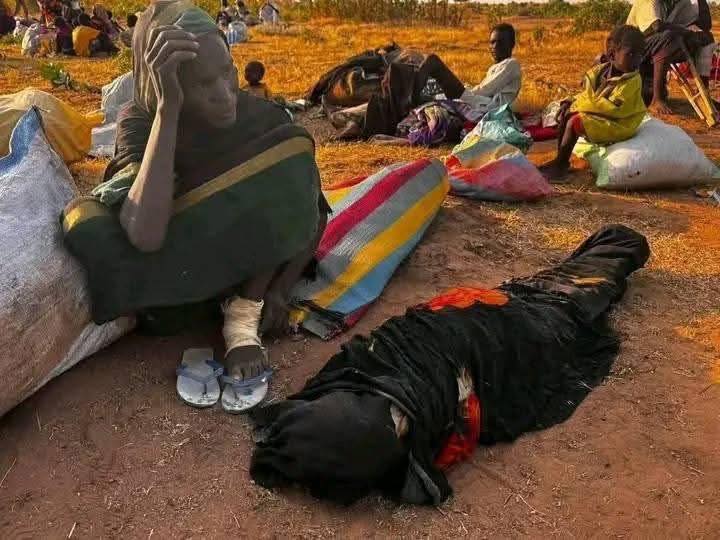
Amid the darkness of fires and the remains of the walls of a destroyed home in the city of Dilling, Khadija Abdel Karim sits among the rubble of what was once a house full of life.
She gently touches burns that have disfigured her right hand and parts of her face—burns that tell the story of shelling that has devastated the second-largest city in South Kordofan State.
The shells did not only destroy the walls of Khadija’s home but also claimed the lives of her three grandchildren in a single moment that turned their shelter into ruins. The grieving grandmother has now joined a long list of civilian victims who have fallen in a conflict that does not distinguish between a military barracks and a children’s bedroom.
Fears and Dangers
Khadija gazes sorrowfully at the city’s horizon, where the smoke of artillery never fades, haunted by fears of the tragedy repeating itself—a fate threatening thousands of civilians trapped in Dilling amid a wave of intense artillery shelling carried out by the Rapid Support Forces and their ally, the Sudan People’s Liberation Movement–North.
“I could hear their voices as they burned”
Khadija looks toward the city skyline, gripped by growing fear that the tragedy she endured could happen again, as thousands of civilians remain inside the city.
She told the BBC:
“I was sitting in the outdoor shelter when suddenly I heard an explosion. I ran to my grandchildren’s room to get them out, but the fire was too strong, and I couldn’t save any of them… I could hear their voices as they burned.”
Dilling has been subjected to repeated artillery shelling, amid accusations that the Rapid Support Forces, allied with the Sudan People’s Liberation Movement–North, are targeting residential neighborhoods.
Killed and Injured
According to medical and local sources, 14 people were killed over two days, including 7 children and two women, while 23 others were injured, amid humanitarian and health conditions described as “extremely complex,” due to a shortage of medical staff and limited supplies.
“Adam Khamis,” one of the survivors, recounted that a shell struck his family’s home, killing his sister and injuring five other family members.
Serious Violations
He said:
“We were displaced from the Farish area to the Aqouz neighborhood because of the fighting. After the shell hit our house, we found my sister on the ground… I couldn’t carry her due to my injury, so a neighbor buried her.”
Fears of Repeating the El Fasher Scenario
Writer and political analyst “Bahram Abdel Moneim” believes that the strategic importance of Dilling makes it a primary target for attacks.
He pointed out that the city’s geographic location connects it to vital areas, making control over it key to expansion in the Kordofan region.
He added:
“There is an attempt to replicate the El Fasher scenario through siege and heavy bombardment, including the use of drones, with the aim of exhausting the city and forcing residents to flee.”
He stressed that the deterioration of basic services, including the healthcare sector, has led to rising death tolls, calling for urgent humanitarian intervention and the imposition of a ceasefire to ease civilian suffering.
Siege and Food Crisis
Dilling has experienced a siege lasting more than two years imposed by the Rapid Support Forces and the SPLM-North, leading to severe shortages of food and services. In early 2026, the Sudanese army announced breaking the siege and reopening supply routes following military operations around the city, which partially alleviated the crisis despite ongoing clashes.
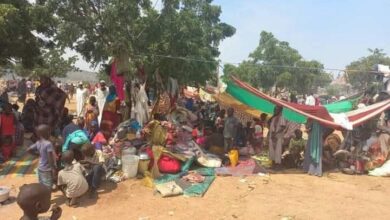
With the recent escalation of attacks, the city has witnessed a large wave of displacement, particularly from western neighborhoods that have turned into direct conflict zones.
Infrastructure and educational facilities have also been affected, with field testimonies reporting the burning of dozens of homes, as well as drone attacks targeting student housing complexes affiliated with the University of Dilling.
Ongoing Attack and Casualties
One resident, “Bakri Adam,” said that the most intense attack, which left dozens of casualties, began in the early morning hours of Saturday, March 28, 2026, from the western direction, with the attacking forces using heavy weapons and intensive artillery.
He added:
“The forces entered neighborhoods such as Jang and Al-Hilla Al-Jadida, heavily armed… Dilling has never witnessed an attack of this scale before.”
Another witness—who requested anonymity—stated that drones provided air cover for the advancing forces, while Katyusha rocket launchers were used to shell several neighborhoods, including Al-Safa, Al-Marwa, Aqouz, and Al-Nasr.
According to testimonies obtained by the BBC, the clashes continued until around 11:00 a.m., after which the attacking forces withdrew.