On Friday evening, in Cairo, a life spanning ninety years came to an end with the passing of Mohamed Osman Al-Mirghani. In Arabic, the word Khatim (seal) carries two closely related meanings: something used to authenticate or stamp an object, and something used to close it. The man lived both meanings: he preserved what he had inherited for decades, and eventually the circle closed around him after a prolonged absence. The leader has passed away, leaving behind a life story narrated through five seals.
The Seal of Lineage
Al-Mirghani was not born into an ordinary family, but into a legacy. The name Khatmiyya derives from Khatim, the title of his great-grandfather, Imam Mohamed Osman Al-Mirghani, who founded the Sufi order in the nineteenth century. The Imam came from a Meccan family descended from the Ashraf (descendants of Prophet Muhammad), whose roots traced back to the Hijaz following migrations through Turkestan and India.
The Imam studied Islamic jurisprudence, Hadith, Quranic interpretation and Arabic language. At an early age, he began teaching and reciting religious texts at the Grand Mosque in Mecca. He later received instruction in several Sufi orders before establishing his own, bringing together the spiritual practices of the Naqshbandi, Qadiri, Shadhili, Junaidi and Mirghani traditions.
He made travel and religious outreach central to his mission, touring vast areas of Sudan and East Africa, establishing mosques and educational centres, and leaving behind successors and disciples who carried his teachings to their communities.
The Imam built his order around remembrance of God (Dhikr), praise of the Prophet, and religious education. His sons and grandsons subsequently spread its religious centres, mosques and Quranic schools across eastern, northern and central Sudan, eventually extending its influence to Eritrea, Egypt and Ethiopia. Loyalty to the order became an inherited legacy passed down through generations.
In 1936, his grandson was born in Hilla Hamad, Khartoum North, to Sayyid Ali Al-Mirghani. He therefore inherited an established following, just as one inherits a family name.
The Seal of Inheritance
Sayyid Ali was a man who exercised authority from behind the scenes. He maintained the prestige of the religious establishment while holding the strings of politics without directly entering the political arena.
When he died in 1968, his son succeeded him as head of the Khatmiyya Sufi Order, but did not inherit his father’s preference for remaining behind the scenes. Instead, he entered the political arena, assuming the leadership of the Democratic Unionist Party (DUP) following the death of Al-Sharif Hussein Al-Hindi in 1982. Thus, he brought together the religious pulpit and the political platform in one hand.
Here began the paradox that would define his political career: he was a leader who never held an executive or government position throughout his life, while his younger brother, Ahmed, served as head of state between 1986 and 1989.
One brother held public office, while the other held none. Yet the latter’s influence was no less significant than that of the former, because what he commanded was neither granted nor withdrawn by the state: it was the trust of the people.
The Seal of Peace
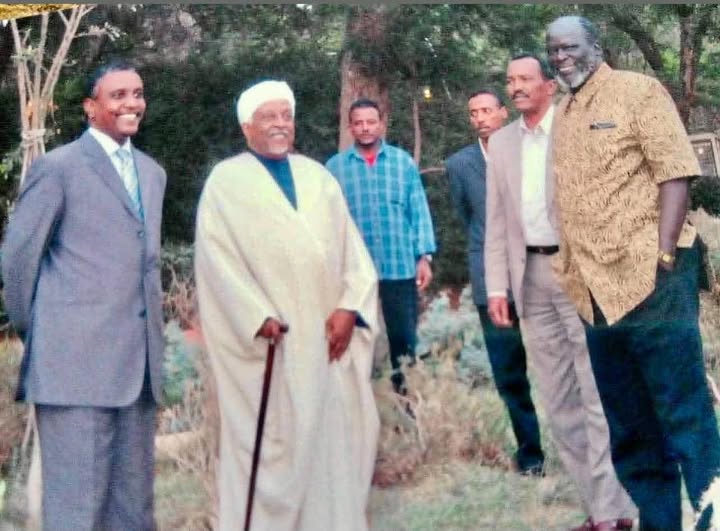
In November 1988, he took this political and popular influence to Addis Ababa, where he met Colonel John Garang, leader of the Sudan People’s Liberation Movement (SPLM). Together, they signed the Mirghani–Garang Agreement, which called for the suspension of the September Laws and the convening of a National Constitutional Conference aimed at bringing the civil war to an end.
The agreement was welcomed by broad segments of the Sudanese public in Khartoum, as though the country had finally caught its breath. However, disagreements within the ruling coalition obstructed its implementation, prompting the Democratic Unionist Party to withdraw from Sadiq Al-Mahdi’s government.
It was a seal placed on a document whose contents not all its stakeholders were willing to accept. A few months later, the coup of 30 June 1989 brought the entire democratic experiment to an end, while the agreement remained in the national memory as an idea whose time had not yet come.
The Seal of Exile
Following the coup, Al-Mirghani left Sudan, shifting his leadership role from inside the country to abroad.
He chaired the National Democratic Alliance (NDA), which brought together opposition forces and an armed movement under one umbrella. He pursued the struggle through political and diplomatic channels until the Cairo Agreement was signed in June 2005, paving the way for the opposition’s return to Sudan.
He subsequently settled in Cairo in 2013, launching reconciliation initiatives and seeking to reunite the divided ranks of the Democratic Unionist Party.
In November 2022, he made a brief return to Khartoum. A few months later, the April war erupted, forcing him back to Cairo, where he remained until his death.
In exile, his name often seemed more present than the man himself. His supporters called him Abu Al-Hurriya (Father of Freedom), viewing his preference for political settlements as a form of wisdom that kept channels of dialogue open. His critics, however, argued that his prolonged absence and centralised leadership had left the Democratic Unionist Party trapped in its internal divisions.
Between these contrasting assessments lies a political career spanning several decades, during which he witnessed independence, democracy, military coups, opposition politics and repeated attempts at peace.
The Seal of Departure
His office and the Khatmiyya Sufi Order announced his death on the evening of Friday, 13 November 2026, prompting a wave of condolence statements.
The Transitional Sovereignty Council described him as one of Sudan’s most prominent national and religious figures, recalling his agreement with John Garang.
The Khatmiyya Sufi Order mourned him following a lifetime of service to religion and the nation. Political parties and Sufi organisations described him as a historic leader of the original Democratic Unionist Party.
Egyptian Foreign Minister Badr Abdelatty also mourned him, describing him as a politician guided by wisdom who had worked to strengthen the bonds between the peoples of the Nile Valley.
His sons will receive condolences at Villa Taiba in Heliopolis, Cairo, on Sunday evening. His body is scheduled to be flown to Sudan on Monday morning, 16 November, for burial beside his father and brother at Sayyid Ali Mosque in Hilla Khougli, Khartoum North.
Today, Abu Hashem returns to his city, bringing to a close the circle that began ninety years ago.
But what weighs more heavily than the burial is what comes afterwards: Who will carry the seal after its bearer?
Will his two sons, Jaafar Al-Sadiq and Mohamed Al-Hassan, both of whom have emerged as prominent figures in the party’s leadership, inherit his position? Or will leadership be distributed between the institutions of the Sufi order and the political party?
These are questions for which there are no answers today, nor are they questions to be resolved on the day of burial.
Yet the followers of the Khatmiyya know that although the seal may be lifted from the hand that bears it, its imprint remains.