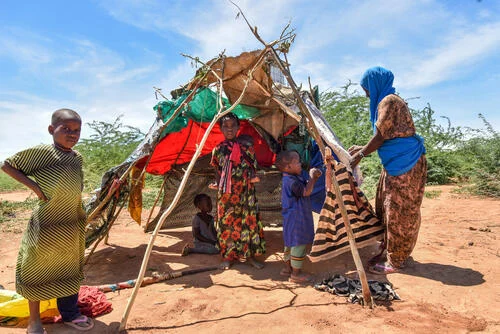
Sadiq’s suffering grows day by day after the war shattered his once stable family life, leaving him deeply traumatized and in urgent need of protection and support.
Since the outbreak of war in April 2023, the chaos and panic accompanying armed clashes have separated thousands of children from their parents. Suddenly, they found themselves alone in a harsh world, stripped of the safety and care that families provide.
Psychological Impact
Hadia Al-Shafie, who recently returned to Wad Madani, the capital of Al-Jazira State, says:
“Despite my happiness over the liberation of the state and the return of security, along with neighbors and relatives, my joy remains incomplete. My sorrow has doubled after losing my only son, who disappeared during our escape. We still don’t know where he is.”
She adds, “What happened to me reflects the reality of dozens of families who lost their children during displacement from Al-Jazira State to safer cities, after we experienced extreme fear following the region’s invasion in December 2023.”
Al-Shafie explains that she continues to suffer deep psychological pain that has affected her social interactions, leading her to isolate herself. “My mind constantly replays the moment my child vanished before my eyes in the crowd,” she says.
Social Isolation
In displacement centers in northern Sudan, volunteers have created child-friendly spaces for separated children, aiming to provide psychosocial support.
However, 12-year-old Ibtehal Musa, living in a camp in Al-Fadab area of Northern State, did not respond to drawing activities designed to help children overcome isolation. Instead, she kept asking about her parents and brother.
“My only concern now is to find my family. I hope they are safe and that we will reunite to start a new life,” she says.
Rising Risks
Amid these conditions, a report by the UN Refugee Agency revealed that 42,000 children have been separated from their families in Sudan and neighboring countries due to the conflict, including 5,000 inside Sudan.
The rest are distributed across neighboring countries: Chad hosts about 24,000 children, followed by Ethiopia with 7,000, while Egypt and South Sudan each host around 6,000. Uganda has recorded 398 cases, Libya 132, and the Central African Republic 129.
The report notes that protection services have reached approximately 329,000 children across the region, with the largest numbers in Chad (225,000), followed by South Sudan (41,000), and others in Egypt, Ethiopia, Libya, Uganda, the Central African Republic, and within Sudan.
It further states that around 21,000 children have benefited from “best interest procedures,” distributed across several countries, including 12,000 in Chad, 4,000 in Egypt, and 3,000 in Ethiopia.
Children face increasing dangers, including family breakdown, forced recruitment by armed groups, child labor, forced marriage, and psychological distress. Limited access to basic services and livelihoods, along with insecurity and movement restrictions, heightens the risk of human trafficking and exploitation.
Urgent Interventions
Child protection specialist Jehan Al-Nu’man explains that about 126 separated children have been identified in the Tawila area, aged between 3 and 17.
She notes that children aged 10 to 12 make up about 50% of the total, while those under 10 represent 30%, and ages 11 to 13 about 15%.
Most of these children lost or were separated from their families due to shelling, displacement, or forced migration. Many now live in shelters without direct family care.
Al-Nu’man stresses the need for urgent humanitarian intervention focused on family tracing and reunification, along with providing healthcare, psychological support, and education, in addition to documenting and monitoring cases within national and international protection programs.
Monitoring and Response
Abdelkader Abu, Secretary-General of Sudan’s National Council for Child Welfare, says the ongoing war has triggered massive displacement among children, with about 313,000 separated from their families.
He highlights a sharp rise in school dropouts, with around 3 million children out of school. Malnutrition has led to over one million child deaths, alongside about 1,000 deaths due to hunger. Additionally, 700 children are reported missing.
He also notes that many children have been drawn into the conflict, with large numbers recruited by armed groups. Efforts are ongoing to reintegrate children without family care into society and to provide health support programs.
Lack of Protection
Sanaa Makki, a volunteer working in displacement areas in North Darfur, says dozens of children have arrived without any documents. Some, especially those under five, cannot even recall their parents’ names.
She explains that many children are forced into informal labor in local markets without family or social protection, making them vulnerable to disappearance, economic exploitation, and abuse.
“There is increasing demand for children in activities such as organized begging, forced marriage, and sexual exploitation—factors that encourage trafficking networks to kidnap and smuggle them for profit,” she says.
Makki stresses that displaced children must be treated equally in access to food, clothing, and psychosocial support to help them overcome their harsh reality.
Meanwhile, UNICEF reports that grave violations against children in Sudan have increased by 1,000% during the war, urging the international community not to abandon millions of affected children and highlighting cases of child abduction.