The ongoing war in Sudan has not taken away young Afrah’s determination to continue her education or her dream of becoming a surgeon, despite a conflict that has deprived millions of children of schooling.
Even during the months she was forced to stop studying after her family was displaced by fighting between the Sudanese army and the Rapid Support Forces, the 13-year-old—now living in a camp near Port Sudan—says, “I kept reviewing my lessons again and again.”
With support from UNICEF and a local association, Afrah was able to resume her education.
Outside the Classroom
Afrah is just one of more than 25 million children and minors in Sudan—about half the population. Among them, 8 million are currently out of school, according to UNICEF.
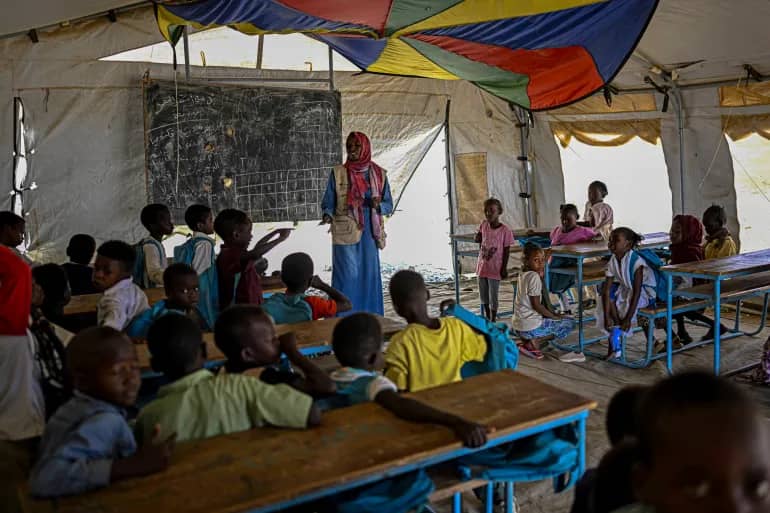
In a barren area of Al-Hayashan camp, rows of tents are arranged in a square, designed to resemble a school serving over a thousand students. Laughter breaks the silence as children play during breaks—many of whom have survived the horrors of war, hunger, and shelling.
Adaptation and Healing
Teachers say that the children’s early drawings were dominated by images of war—tanks, weapons, and scenes of death they witnessed while fleeing with their families.
Mira Nasr explained that children arrive fearful, exhausted, and isolated, but over time their drawings begin to change. “They start to adapt and process what they’ve been through,” she said.
Inside one tent, children repeat lessons on handwashing with a social worker, while in another, they recite poetry together. Nearby, a displaced teacher explains chemistry and physics as her three-year-old son clings to her clothes.
Nasr emphasized that “children’s futures are at stake, and education itself is a form of protection.” She added that even in displacement, school offers a sense of normalcy—allowing children to learn, play, and build friendships.
Painful Memories, Unbroken Will
A teacher, Awaatif Al-Ghali (48), recalls with bitterness the early days of displacement from North Darfur, when thousands of families wandered the roads with their children. “We were 60 teachers here, and we started working,” she said.
Teachers organized students by level, created schedules, and resumed lessons through revision sessions.
Another teacher, Suad Awadallah (52), who taught English for four decades in South Darfur before arriving in Port Sudan, said patience was essential in the beginning, when children sat on the ground with no resources.
Nasr noted that due to prolonged interruptions—ranging from months to years—some children have even forgotten how to read and write.
Despite this, their determination remains strong. Recently, the first group of students graduated from primary to intermediate school, a milestone Al-Ghali described with pride.
“Even when conditions were harsh—in the summer heat with insects everywhere—the children still wanted to learn,” she said. Before final exams, some students even followed teachers to their homes, pleading for extra revision lessons.
Among them is Fatima (16), who dreams of becoming a psychologist to help those affected by the war in Sudan.