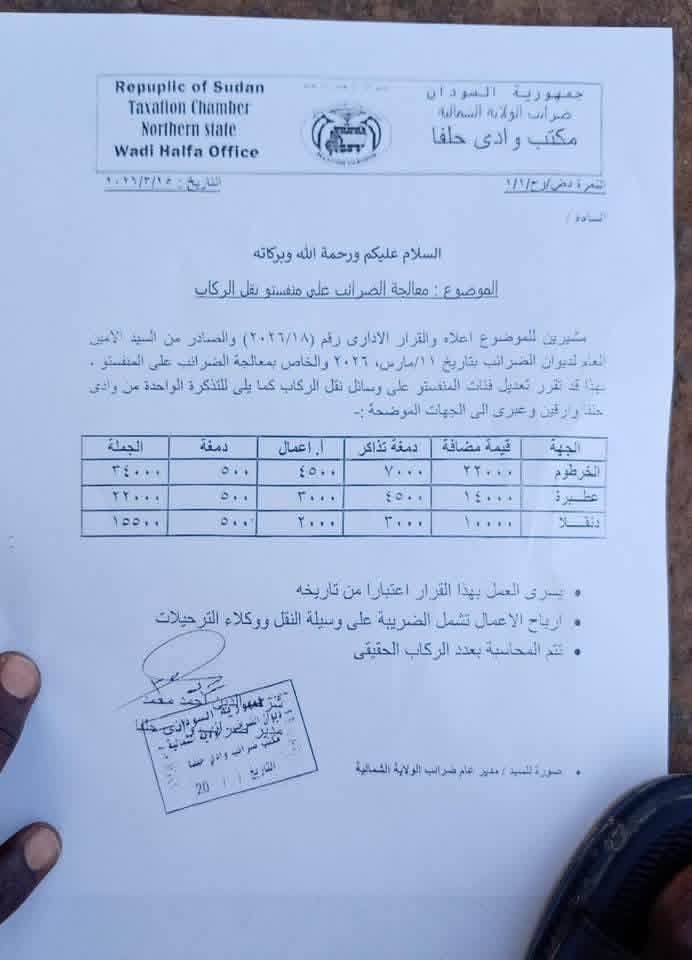
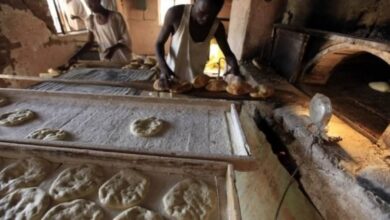
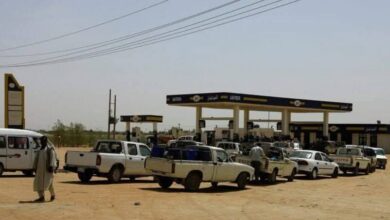
A series of sharp increases in taxes and various service fees imposed by government authorities in the cities of Shendi and Atbara in Sudan’s River Nile State has prompted traders and business owners to go on strike, with all markets closing their doors for the third consecutive day. The closures have brought buying and selling activity to an almost complete halt, further worsening living conditions for residents amid shortages of food commodities and soaring prices.
Traders have increasingly complained about the heavy levies imposed on commercial establishments, particularly as authorities rely on direct service fees and levies as a major source of revenue amid the disruption of production. Economists fear that intensified tax pressure could suffocate commercial activity, forcing businesses to close or raise prices, which in turn would have negative consequences for citizens.
A Dead End
In this context, Atbara market trader Ezz El-Din Fadl said they were “shocked by the new, excessive tax assessments, which do not correspond to the actual situation. Implementing them would effectively mean suspending their activities and abandoning their businesses because they would no longer be economically viable.”
He added that “traders resorted to the strike despite the losses and damage that stopping work would cause them, because it was the only way left for them to express their rejection, especially after negotiations between their Chamber of Commerce and the Taxation Authority reached a dead end.”
Fadl explained that “such fees were not subjected to any institutional procedures. It appears they were determined on the basis of calculations aimed primarily at increasing government revenues, at a time when many sources of revenue have dried up because of the war and the economic conditions it has created, including the disruption of trade, markets, and even people’s incomes.”
Exploitation and Pressure
For his part, Al-Sharif Al-Zaki, a trader in Shendi market, described the increases in taxes and service fees as “a clear exploitation of the difficult circumstances facing traders, who are already struggling, placing additional pressure on them in an attempt to generate revenues that the state’s financial institutions have failed to find through other means, instead turning to the pockets of already-stricken traders as the easiest option.”
He stressed that “the protests by the majority of traders are not directed against the principle of taxes and service fees itself, but rather against the methods of assessment and collection, which are not based on clear criteria that take into account the scale of commercial activity, actual income, and the stagnation in the markets.”
Al-Zaki called on the central government to intervene urgently and issue a decision to review the fees, which he said are incompatible with the exceptional and difficult humanitarian circumstances. He argued that these conditions require the state to provide assistance and support to ease the burden on both traders and citizens, describing this as the least the government can do for them during their current ordeal.
Government Measures
Meanwhile, Sudanese Finance Minister Jibril Ibrahim directed the Taxation Chamber to expand the tax base and bring new sectors under the tax umbrella, while stressing that tax rates should not be increased. He also called for the enforcement of laws and regulations to curb tax evasion and for stronger technical integration among government financial systems.
Jibril praised the performance of the Taxation Chamber and its assumption of an important share of the revenue burden under the current circumstances. He called for improving collection mechanisms and expanding the tax base horizontally rather than increasing tax rates.
For his part, Badr Al-Tamam Mohamed Saad, Secretary-General of the Taxation Chamber, confirmed that work was continuing to complete computerisation and digital transformation projects. He expected the electronic invoicing system to bring about a major transformation in the chamber’s operations, improve collection efficiency, and reduce tax evasion.
Public Outcry and Hardship
Amid these circumstances, citizens have condemned the decision to immediately implement the increases in taxes and service fees, particularly following the traders’ strike and the closure of commercial establishments, as well as the resulting shortages of food commodities and unprecedented price increases.
Citizen Sami Hussein expressed regret over the authorities’ decision to increase service fees and taxes and the consequences for citizens in several cities across the country. He described the measures as “a terrible and misplaced gift” that exceeds the capacity of thousands of people from a government that appears to give little consideration to citizens or their concerns.
He said, “This government is forgetting that the vast majority of people have been pushed into poverty by the continuing war. No one expected it to introduce a new project of impoverishment that reflects its inability and failure to develop genuine sources of revenue, instead of choosing easy solutions that force poor people to bear the cost.”
Hussein added, “It is unreasonable for this to happen in a country where the poverty rate ranges between 70 and 80 percent of the population and unemployment stands at 47 percent, while the state pursues policies that are profoundly inconsistent with the economic conditions people are experiencing.”
Additional Burdens
For his part, citizen Nasser Al-Maghrabi described the decision to increase taxes as wrong from economic, humanitarian, and moral perspectives. He said that, as a general principle, no fees or levies should be increased under conditions of war, suffering, and the severe hardships facing the population.
He pointed out that “the decision has negatively affected citizens, particularly with the closure of commercial establishments, shortages of goods, and unprecedented price increases,” noting that “poor households no longer have the ability even to meet their basic living needs, let alone bear additional costs and financial burdens.”
Al-Maghrabi continued, “Millions of citizens have seen their sources of livelihood decline since the outbreak of the war in Sudan, while their purchasing power has deteriorated. Markets have entered a state of stagnation, forcing many small traders to close their businesses and leave the economic and productive cycle because they can no longer afford the exorbitant costs.”
Urgent Solutions
Meanwhile, economic researcher Faisal Musa warned against the continuation of the government’s policy of repeated collections and increases in taxes and service fees through local authorities. He said such measures are choking commercial activity because of the financial drain, which can sometimes reach one-third of the value of the goods themselves, thereby contributing significantly to higher consumer prices.
Musa called on state governments to sit down with traders and negotiate in order to reach a mutually acceptable vision and practical solutions, so that economic activity is not undermined by declining revenues on the one hand and the fundamental disruption of business activity on the other.
The economic researcher said the decisions taken by authorities in Atbara and Shendi in River Nile State to increase taxes had placed a heavy burden on citizens, particularly poor and vulnerable groups. He warned that the measures would directly lead to higher prices, increased inflation, and rising poverty.
He continued, “This situation has triggered strikes in the markets of Atbara and Shendi,” expressing concern that the strike could spread to other cities, affecting commercial activity and citizens’ living conditions unless the government reconsiders its overall policies.