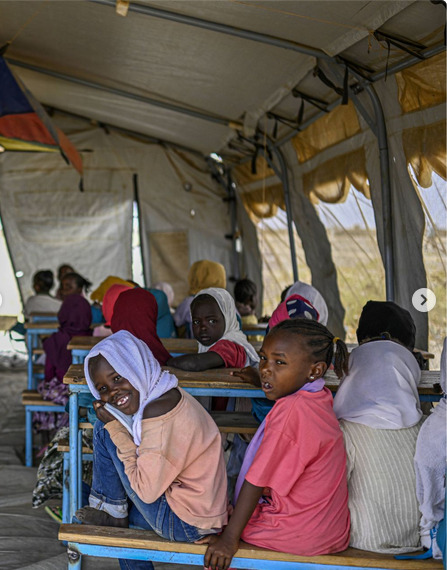
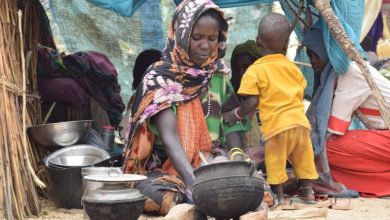
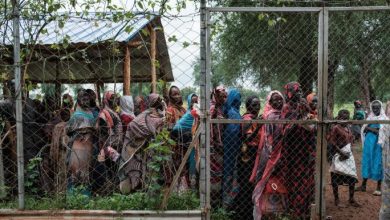
On a single iron bench in Farchana refugee camp, a son takes his seat in the morning, his mother follows in the evening, while adolescents attend in between, trying to reclaim the years stolen from them by war.
This is how school hours are shared at the refugee camp in Chad’s eastern Ouaddaï Province, approximately 50 kilometres from the Sudanese border. The arrangement is an attempt to make education accessible to as many refugee children as possible despite the limited number of classrooms.
This innovative system reflects the enormous pressure on educational services in Farchana (Farchana), one of the oldest and most prominent refugee settlements in eastern Chad. The number of newly arrived Sudanese refugees in the province has exceeded 980,000, while more than 60,000 people live in and around the camp, approximately 80 per cent of whom are women and children.
Alongside the struggle to secure food and water, children face another threat: losing access to education. Estimates by UNHCR and UNICEF indicate that more than 60 per cent of school-age refugee children are at risk of prolonged interruption to their education because of overcrowding and a shortage of classrooms.
To address this gap, refugee teachers, with support from UN agencies, have introduced a rotational education system in temporary classrooms operating across three consecutive shifts.
Walls Built by Their Own Hands
The story began with mud bricks. UNICEF and UNHCR provided the pillars, roofing materials, blackboards and school bags, while parents and young people volunteered to make mud bricks and build the walls.
The result was a series of rectangular classrooms supported by locally sourced timber, shaded by corrugated iron sheets or tarpaulins, and ventilated through wide openings. Solar-powered lamps were later installed beneath the roofs, extending the available learning hours into the evening. Each long bench is shared by three or four students.
From Dawn Until Midday
At the first light of dawn, hundreds of primary school pupils arrive carrying their few exercise books. When they leave at midday, adolescents and teenagers take their places. Many of them have been kept out of school for years by war and displacement. They enrol in an accelerated learning programme designed to help them catch up on missed education and reconnect with the recognised educational pathway followed by schools in the camp.
Ahmed Bakhit, a volunteer Arabic and mathematics teacher, described this routine to a Mashawir correspondent:
“The blackboard has barely dried from the chalk used during the morning shift before we begin writing on it again for the afternoon students.”
He added that the enthusiasm of students and teachers helps compensate for the shortage of textbooks despite the heat and overcrowding.
“We teach with our hearts before our pens to protect this generation from being lost,” he said.
Evenings Belong to the Mothers
As the sun sets, the scene takes on an even more human dimension. Lamps illuminate the faces of mothers learning to read, write and calculate, as well as the basics of financial management.
Among them is Halima Adam, a mother of five who arrived from West Darfur. She said:
“In the morning, I see my son off to this classroom, and in the evening, I return to learn myself.”
After becoming the sole breadwinner for her family, the school has given her a sense of “security and confidence”, enabling her to read her food assistance card and manage a small business without having to rely on anyone else.
Halima is not alone. Dozens of mothers have now learned to read their children’s medical prescriptions, manage savings groups and run home-based businesses that strengthen their ability to withstand difficult circumstances.
More Than a School
The impact of the classrooms extends beyond education to community protection. Teachers and social workers follow up on students who are frequently absent and engage families to discourage child marriage and prevent children from being pushed into working in markets along the border.
Idris Hamid, a member of the camp’s education and management committee, told a Mashawir correspondent that the initial objective was to accommodate the largest possible number of children. However, the three-shift system has transformed the school into “a centre of enlightenment and protection for the entire camp”, as well as a refuge where displaced people can feel that they have a future rather than seeing themselves merely as numbers in food distribution queues.
A Future Awaiting Recognition and Support
Despite this achievement, its sustainability remains dependent on several unresolved challenges. Coordination is underway with educational authorities and UN agencies to secure formal recognition of the accelerated learning years and ensure that students have opportunities to sit official examinations.
Efforts are also continuing to increase French and English language lessons to overcome language barriers and facilitate the integration of adolescents into the Chadian curriculum without compromising their cultural identity.
Funding remains a daily concern. Shortages threaten the modest incentives provided to volunteer teachers, as well as the supply of textbooks and meals. Meanwhile, extended operating hours place additional pressure on teachers and solar battery systems.
As one shift ends and another begins, the classrooms remain open from dawn until evening. Children, adolescents and mothers take turns occupying the same spaces, each carrying a story of interrupted education and a new opportunity to resume learning.
Idris Hamid said:
“When a son sits on the bench in the morning and his mother comes to take her place on it in the evening, we realise that the school has gone beyond the boundaries of education. That single bench has become a space where generations separated by war come together, and where families reclaim their right to learn together.”