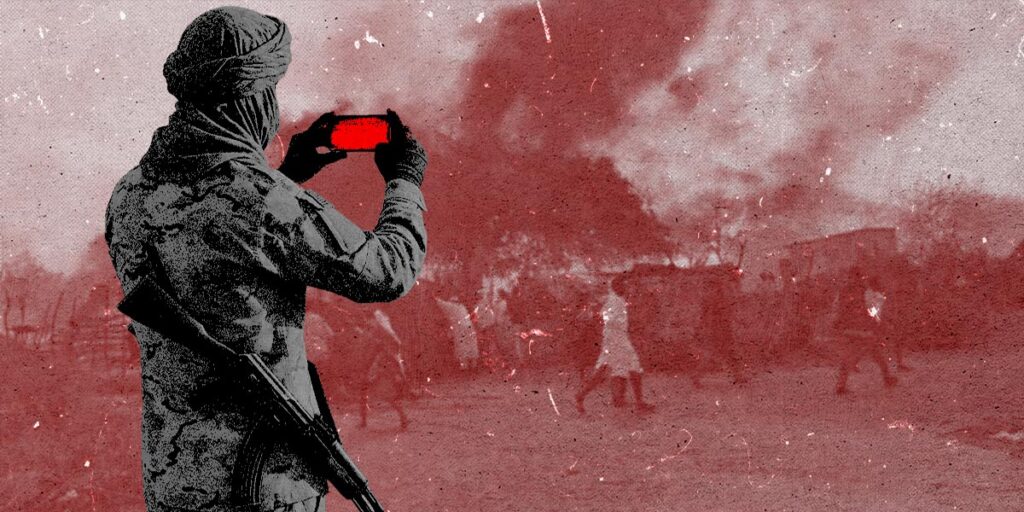
The Rapid Support Forces’ (RSF) announcement of the arrest of the notorious field commander known as “Abu Lulu” has stirred widespread controversy and questions across political and legal circles, as well as among Sudanese communities on social media. Many wonder whether the move signals genuine accountability or merely an attempt to polish the RSF’s image amid mounting international outrage over atrocities committed since the outbreak of war in April 2023.
Several human rights groups have expressed deep skepticism over the credibility of the investigation and whether “Abu Lulu,” known for cold-blooded killings that terrorized civilians in El Fasher, will truly face a fair and transparent trial. Legal experts view the RSF’s move as an attempt to ease growing international and regional condemnation, and to suggest the presence of disciplinary institutions within its ranks through the formation of “legal and military committees.”
Detention in Shala Prison
RSF-affiliated platforms released a video showing “Abu Lulu” being transferred to Shala Prison in El Fasher, handcuffed and escorted by heavily armed fighters. The arrest reportedly took place in El Fasher without resistance and involved three vehicles. Shala Prison, built by the British in 1947, is located southwest of the city.
An RSF spokesperson stated that, “In accordance with the leadership’s directives and in commitment to law, discipline, and military conduct during wartime, our forces have arrested a number of suspects in connection with violations in El Fasher, including the individual known as Abu Lulu.” The statement added that legal committees have begun investigations to bring the suspects to justice, stressing that the RSF is acting “responsibly and not for propaganda purposes.”
In a previous TikTok live broadcast, “Abu Lulu” confessed to killing hundreds of people and vowed to increase the number of his victims to 2,000, claiming revenge for family members killed during the conflict.
Before the war, the man known as Al-Fateh Abdallah Idris, or “Abu Lulu,” was virtually unknown in Darfur. However, during the conflict, he became infamous for his brutal executions in El Fasher, earning nicknames such as “The Butcher of El Fasher.”
Image Rehabilitation Attempt
Legal expert Ahmed Musa described “Abu Lulu” as a “professional killer” responsible for executing unarmed civilians under RSF protection. He argued that the arrest is part of a “poorly staged play” meant to appease global outrage and present the RSF as disciplined and law-abiding. According to Musa, “the RSF cares little about the Sudanese public, but fears international reaction — hence this publicity stunt to improve its image.”
He predicted that “Abu Lulu” might be temporarily imprisoned, face a mock trial, or even be eliminated to close the case quietly.
Call for ICC Handover
Chairman of the Darfur Bar Association, Al-Sadiq Ali Hassan, said that “in principle, any declaration of arrest should be treated seriously, but in the case of the RSF, it lacks judicial authority, an independent prosecution, or courts.” He argued that the only way for this step to gain credibility is through handing “Abu Lulu” to the International Criminal Court (ICC), especially since the ICC Prosecutor has expanded investigations under UN Security Council Resolution 1591 to include crimes committed in Darfur.
Hassan added that “impunity has become entrenched in Sudanese political culture, even among those wanted by the ICC, due to weak enforcement.”
Scapegoat Scenario
International law specialist Ezz Eldin Al-Sheikh said that the RSF is “neither competent nor credible” to try perpetrators of war crimes, as “its very leadership and members are implicated in these atrocities.” He described the arrest as a response to international pressure and a bid to create the illusion of accountability. “It’s impossible to pin two years of atrocities on one man,” he noted, predicting that “Abu Lulu” will be used as a scapegoat.
Al-Sheikh emphasized that the RSF’s moral and political standing has deteriorated dramatically, facing near-total domestic rejection and mounting foreign condemnation.
Temporary Calm
Human rights lawyer Zahir Abidin also questioned the RSF’s sincerity, noting its repeated failures to deliver justice in Al-Jazira and Kordofan states despite previous promises. He said the arrest “aims to absorb public and international anger rather than ensure real accountability,” describing the newly announced investigative committee as “a temporary pacification tactic without transparency or oversight.”
Documented Massacres
Since 2003, when the RSF’s precursor militias, the Janjaweed, emerged, they have been accused of war crimes, ethnic cleansing, and crimes against humanity in Darfur. To date, no one — except Ali Muhammad Ali Abd-Al-Rahman (“Ali Kushayb”) — has been convicted by the ICC for these crimes.
In September 2023, the RSF was accused of committing massacres in El Geneina, West Darfur, killing more than 1,200 people, mostly from the Masalit ethnic group. Following its capture of El Fasher on October 26, 2024, the RSF allegedly carried out further atrocities that left over 2,000 people dead within three days.