Drones have come to dominate the skies of Sudan, altering the nature of the conflict that began nearly three years ago, shifting it from direct confrontations on the ground to an aerial war that does not spare homes, schools, hospitals, and markets.
The war that broke out between the Sudan Armed Forces (SAF) and the Rapid Support Forces (RSF) in April 2023 has resulted in the deaths of tens of thousands, the displacement of more than 11 million people, and the spread of famine in some areas, causing the worst humanitarian crisis according to the United Nations.
The following is an overview of the most prominent elements related to drones in Sudan:
International Concern
In the Kordofan region, which has become the most violent front line since the RSF took control of most of the Darfur region in the west of the country, drone attacks kill dozens of people in a single strike.
During this February, a drone killed 15 children in an attack on a camp for displaced persons and 28 people in another attack on a market, according to medical sources and human rights activists.
The United Nations High Commissioner for Human Rights, Volker Türk, warned last January that the proliferation of sophisticated military equipment, particularly drones, has resulted in the enhancement of the military capabilities of both the RSF and the army, thereby prolonging hostilities and deepening the civilian crisis.
British Foreign Secretary Yvette Cooper told the UN Security Council that external support from at least 10 countries is prolonging the war, speaking specifically about funding, manufacturing, transferring, and training on weapons.
Sudanese state media reported in recent weeks that the army destroyed Chinese-made drones and air defense systems belonging to the RSF, while the latter said it had shot down several Turkish Bayraktar Akinci drones belonging to the army.
Army Drones
The RSF accuses the SAF of using Turkish-made Bayraktar TB2 drones, which are six and a half meters long with a wingspan of 12 meters. These drones can fly up to 150 kilometers and can stay in the air for up to 27 hours with a payload of 150 kilograms of guided ammunition.
According to the RSF, the SAF also uses the more advanced Bayraktar Akinci drones, which fly for a distance of 7,500 kilometers for up to 25 hours.
The army is also accused of receiving support from Iran. According to the Conflict Observatory funded by the US State Department, Tehran delivered Mohajer-6 drones to army bases in Port Sudan on the Red Sea between December 2023 and September 2024. The observatory also identified a Mohajer-6 drone stationed in Khartoum in 2024.
The Mohajer-6 drones have a range of 2,000 kilometers, are five and a half meters long, and can carry out strikes with guided munitions. French researcher Roland Marchal says that Iranian-made drones played a vital role in the counter-offensive launched by the army to retake Khartoum and cities in central Sudan, particularly Wad Madani, the capital of Al Jazirah State.
RSF Drones
The RSF uses Chinese Wing Loong 2 and FH-95 drones, supplied to them by the UAE, according to an Amnesty International report last year.
The organization spotted fragments of a Norinco GP50A guided bomb, consistent with the two aforementioned drones, used by the RSF in a raid on a town in North Darfur in March 2025.
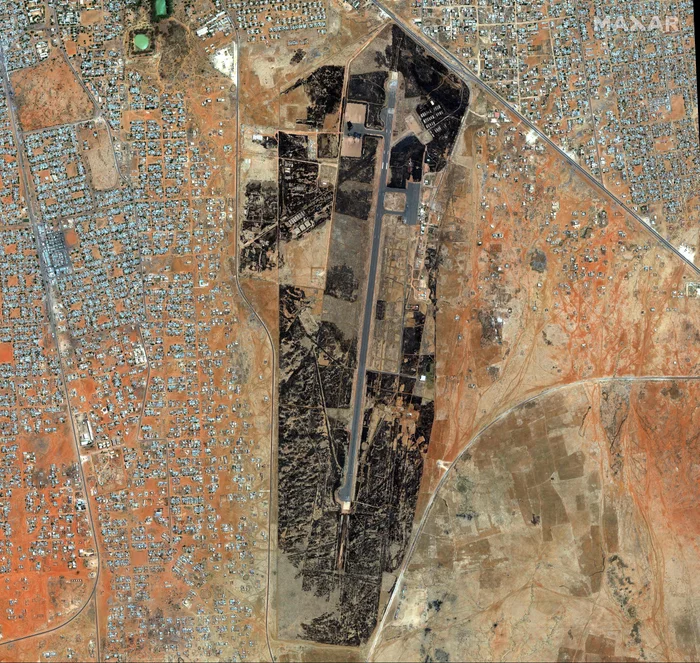
The Humanitarian Research Lab at Yale University spotted three FH-95 drones at Nyala Airport, which is controlled by the RSF in South Darfur, between December 2024 and January 2025. The lab also noted an increase in the RSF’s reliance on suicide drones in Nyala.
Satellite imagery identified at least 85 objects over the past two months consistent with the specifications of the mentioned ammunition at two RSF sites: Nyala Airport and the former headquarters of the AU-UN Joint Operation in Darfur.
The Sudanese army has repeatedly targeted Nyala Airport, accusing the RSF of using it to receive weapons and personnel from the United Arab Emirates, allegations that Abu Dhabi denies.
The suicide drones at Nyala Airport, according to the Yale University lab, are consistent with Iranian Shahed 136 drones, though it remains unclear how the RSF obtained them. The operational range of these drones varies between 1,500 and 2,500 kilometers, making them difficult to track.