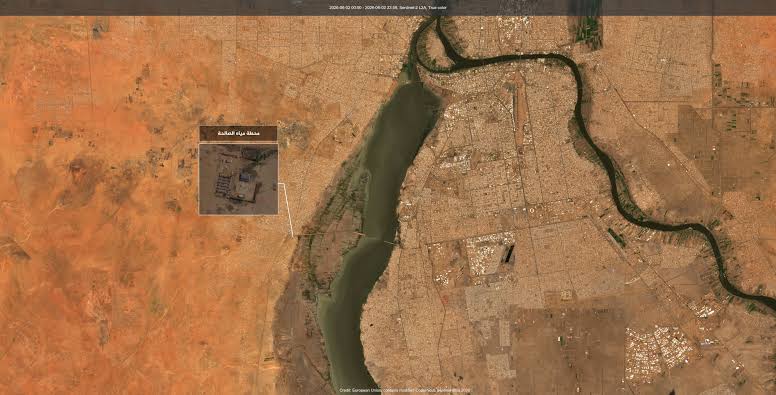
As the crisis in essential public services deepens in Sudan’s capital, Khartoum, newly analyzed satellite imagery reviewed by Al Jazeera’s Open Source Unit has revealed a sharp decline in the Nile’s water levels, forcing the Al-Salha Water Station, one of the city’s main water supply facilities, out of operation.
Coinciding with these findings, the Khartoum State Government announced an emergency plan aimed at containing the crisis and restoring water supplies to the affected areas in southern Omdurman.
Narrowing River Channel and Receding Waters
A comparison of Sentinel-2 satellite images, using the Normalized Difference Water Index (NDWI), shows significant changes in the river’s course over the span of one month. Images taken between 2 June and 12 July reveal a noticeable narrowing of the main river channel and the emergence of extensive dry areas that had previously been submerged.
The most significant changes were observed near the Al-Salha Water Station, where the receding water moved away from the station’s intake pumps, disrupting water extraction operations.
Emergency Measures and Alternative Solutions
In an official statement issued on 13 July, the Khartoum State Government unveiled a comprehensive emergency response plan to address the renewed drop in Nile water levels, which, according to Mohamed Ahmed Awad, Director of the State Water Authority, now requires more sustainable interventions after previous measures proved insufficient.
The immediate response includes mobilizing all available heavy machinery and excavators to operate around the clock to remove sediment and open a new water channel leading to the intake pumps. Authorities expect the station to resume operations within 48 hours, while water tankers are being deployed as a temporary solution to supply neighborhoods and villages in southern Omdurman.
To provide longer-term solutions, the Governor of Khartoum directed the relocation of the main intake pumps to deeper sections of the river to reduce vulnerability to fluctuating water levels. The plan also includes the immediate drilling of two high-yield groundwater wells to serve as emergency backup water sources.
In addition, the government emphasized the need for stronger coordination with the Ministry of Irrigation to better manage the opening and closing of dam gates, with the aim of preventing sudden fluctuations in river levels in the future.
A Double Challenge
The natural crisis has compounded the hardships already facing residents of Khartoum, where essential services have deteriorated significantly since the outbreak of armed conflict in April 2023.
Major water stations in Omdurman—including Al-Manara, Beit Al-Mal, and Al-Salha—have previously suffered damage from shelling and acts of sabotage. As a result, civilians now face a dual challenge: the combined impact of environmental changes and armed conflict, both of which continue to threaten water security amid declining Nile levels and a deteriorating infrastructure.