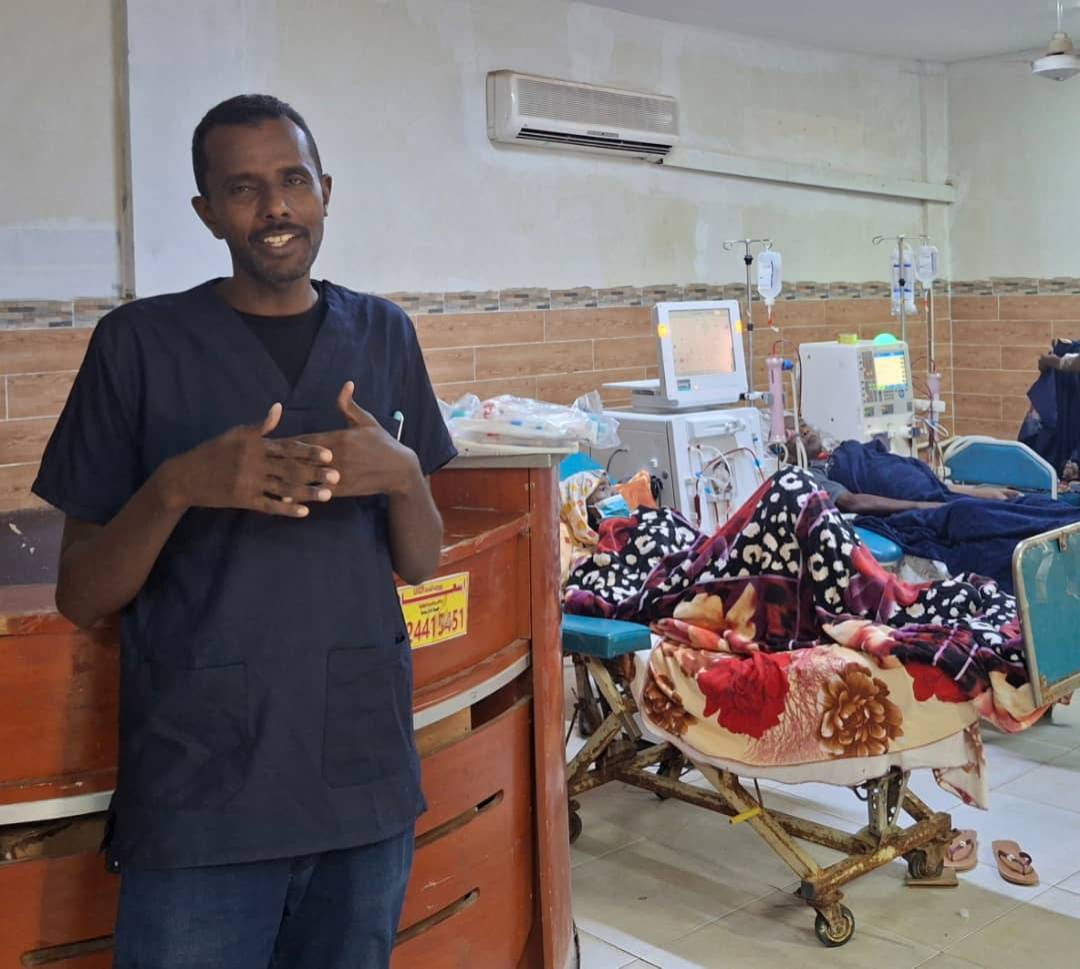
Adam Abdulrahman, 45, lies in the dialysis unit at the Specialized Hospital in Nyala, the capital of South Darfur, as kidney failure steadily ravages his frail body.
His eldest son, Alaa Al-Din, says, “My father had been suffering from kidney disease long before the conflict between the Sudanese Armed Forces and the Rapid Support Forces, which has now entered its fourth year. He used to receive dialysis twice a week on a regular basis. However, the expansion of the war and the fall of El Fasher, the capital of North Darfur State, have greatly worsened his struggle to access treatment. He is now fighting for his life as hospitals and specialized centers have gone out of service, while dialysis machines have stopped functioning due to complex logistical challenges.”
He added, “We were forced to travel to Nyala in search of treatment at the dialysis center in the Specialized Hospital. We cannot afford the cost of a single dialysis session, which has reached 360,000 Sudanese pounds (US$80), in addition to accommodation expenses. As a result, the hospital corridors have become our temporary shelter, and we have no idea when this ordeal will end. On top of that, the high cost of medications poses another burden, even though missing these medicines is a direct threat to his life.”
He continued, “My father’s suffering is not an isolated case. It reflects the reality of hundreds of kidney failure patients coming from Darfur and Kordofan. The center originally had around 12 dialysis machines, but nine of them are now out of service due to prolonged breakdowns and lack of maintenance. With only a few machines still operational, pressure on the center has intensified, making it extremely difficult to secure dialysis sessions.”
Alaa Al-Din also noted that the crisis extends beyond the shortage of machines. “Patients are also burdened by the cost of treatment, which includes purchasing dialysis supplies and contributing to operating expenses such as fuel and water. Even catheters, which should be provided by the hospital, must often be purchased by patients. This has turned life-saving treatment into a burden beyond the means of most families.”
Health Threats
Mahmoud Osman, who accompanies another patient, explained that “The destruction and looting of dialysis centers across Darfur, combined with severe shortages of resources, have forced patients to search continuously for any facility still offering treatment. This has led to severe overcrowding at Nyala’s dialysis center, where only a handful of machines remain functional.”
He added that the situation poses serious health risks. “Kidney failure patients have weakened immune systems and are highly vulnerable to infections. Due to the shortage of machines, the same dialysis equipment is used for multiple patients consecutively without sufficient intervals. Some patients are infected with viral hepatitis, raising fears among families that infections could spread because of shortages of sterilization materials and medical consumables.”
Osman further stated, “There have already been cases of hepatitis and HIV infections among dialysis patients, resulting in the deaths of many of them, particularly during May and June, when deaths occurred at an average of one every two days. Two additional patients died after contracting viral hepatitis, while the center lacks specialist physicians to supervise patient care.”
He stressed that kidney failure patients continue to endure immense suffering, trapped between illness and poverty. “All indicators point to a catastrophic reality in which most patients remain at constant risk of death amid a complete absence of life-saving support and medical services.”
Mounting Challenges
The dialysis center in Nyala has become the last line of defense against a slow death for dozens of kidney failure patients—not only from South Darfur but from all Darfur states and large parts of Kordofan. Despite the war, the collapse of health services, and severe resource shortages, the center has continued operating. Today, however, it stands on the brink of complete shutdown.
The center’s director, Hamid Musa, said, “Broken dialysis machines, problems with the water purification system, fuel shortages, the need for solar power, and low salaries for staff have all contributed to the deterioration of services.”
Musa explained that the center had been severely affected by the fighting in Nyala since the outbreak of the war in 2023. Maintenance services stopped, operational infrastructure deteriorated, medical supply chains and fuel deliveries were disrupted, and many qualified healthcare workers left, all of which significantly reduced the center’s ability to provide stable services.
He noted that the center currently serves about 16 kidney failure patients, while around six patients are referred to Khartoum every month—not because of the severity of their medical conditions, but due to shortages and high costs of medical consumables in Darfur. Before the war, the center operated two daily shifts totaling ten hours and had 15 dialysis machines. However, the absence of funding has prevented maintenance of machines that have been in continuous use for more than eight years.
A Humanitarian Crisis and Efforts to Respond
The kidney failure crisis has become a growing humanitarian disaster, driven by the destruction of healthcare infrastructure, particularly in Darfur states under the control of the Rapid Support Forces. With medical supplies disrupted and dialysis equipment out of service, the remaining patients face an increasing risk of death. Meanwhile, social media has been flooded with appeals for support to rehabilitate the only dialysis center at Nyala Specialized Hospital.
In response, Youssef Idris, head of the Civil Administration in South Darfur State, announced the allocation of 50 million Sudanese pounds (approximately US$83,263) to support the dialysis center. The funding will cover the maintenance of five dialysis machines, provide fuel for generators, offer incentives to staff, and ensure a regular water supply. He added that meeting the center’s full needs would require coordination with the Federal Ministry of Health.
Similarly, Abbas Hassan, Director-General of the State Ministry of Health, stated that the repaired machines would soon be returned to service, increasing the center’s operational capacity so that kidney failure patients arriving from across Darfur could receive treatment more quickly.
He also said that efforts are underway, in coordination with the Federal Ministry of Health, to provide dialysis solutions and essential medical supplies, with the aim of easing patients’ financial burdens and making dialysis sessions free of charge under the current conditions, where many families have lost their livelihoods because of the ongoing conflict.
Hassan concluded, “Until these promises become reality, kidney failure patients in Nyala—including children—remain in a race against time. Missing even a single dialysis session can cost them their lives and shatter their families’ hopes of saving them.”