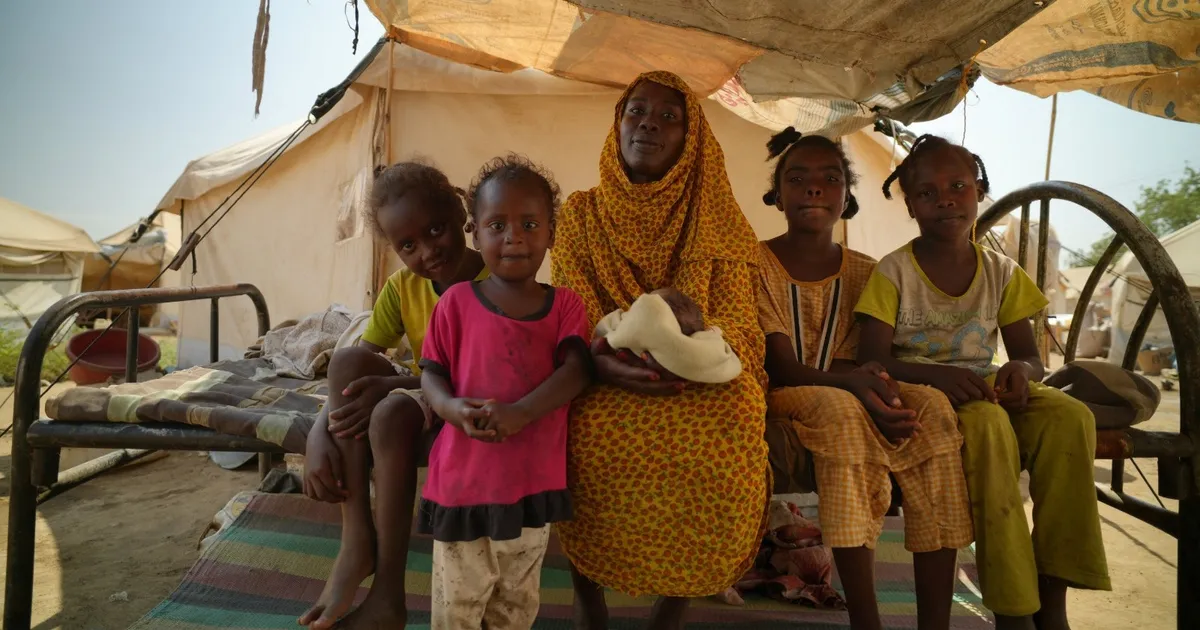
Hadia was unable to breastfeed her baby adequately, as hunger had weakened her body while she was detained with her child and other children inside a school in the Sudanese city of El Fasher. When she managed to escape and reach Tawila last August, all three of her children were diagnosed with malnutrition, and one was admitted to hospital.
The account of the mother, who is in her thirties, captures part of the suffering endured by civilians detained by the Rapid Support Forces (RSF) inside schools that were turned into detention centres. A report by Amnesty International documents torture, killings, forced labour, and restrictions on humanitarian aid in the capital of North Darfur State.
The organisation based its findings on interviews conducted in August and September 2026 with 25 civilians, including 19 residents and six humanitarian workers. Most of the residents interviewed had left the city in July and August, while one remained there.
Schools Turned into Detention Centres
Amnesty International said it interviewed nine people who had been detained inside schools, where food and medical treatment were scarce and children suffered from malnutrition. All nine had been released or had managed to escape by July or August.
Hadia, who belongs to the African Qimr ethnic group, said her husband was shot by the RSF during its takeover of El Fasher. She was subsequently detained alongside her children and hundreds of other women and children inside a school. There, they received only extremely limited amounts of food and water.
Alawiya, a woman in her fifties from the Zaghawa ethnic group, said she spent months detained inside a school and avoided speaking her own language for fear that her ethnic identity would be discovered. She said four to five people died every day, most of them due to a lack of food.
Detention was not limited to women and children. Hatem, who had suffered a serious shrapnel injury to his jaw, was detained when he returned to retrieve belongings from his home. He spent approximately four months inside a school alongside nearly 300 people, most of them women. After attempting to escape twice, he was beaten on his wounds before finally succeeding on his third attempt.
An analysis of satellite imagery showed a decline in activity at some school detention sites by September, suggesting that they may have been closed. However, signs of activity continued at Shalla Prison and the Port Sudan detention centre.
Torture and the Collection of Bodies
Of the 19 residents interviewed by the organisation, 17 had been detained. Survivors said that belonging to the Zaghawa and Masalit ethnic groups increased the likelihood of arrest and abuse.
At Shalla Prison, Mamoun recounted witnessing prisoners being shot and a diabetic patient dying after being denied assistance. He said he was repeatedly beaten and was eventually released after his family paid a ransom.
However, paying money did not guarantee freedom for everyone. Musa and his father, who were detained at El Fasher Children’s Hospital in October 2025, were transferred after a ransom was paid to a house guarded by RSF forces. They remained in detention until they managed to escape in May 2026.
During their detention, they were forced to collect bodies and appear on camera encouraging residents to return, while portraying the city as safe. The organisation also documented cases in which men and women were forced to cook, clean, and clear rubble without pay.
A City Under Surveillance
According to figures compiled by humanitarian organisations, fewer than 70,000 people remained in El Fasher, compared with more than one million before the war. Residents said that civilians and humanitarian workers were under surveillance and were prevented from speaking freely about conditions in the city.
Amnesty International Secretary General Agnès Callamard said fear hung over the city amid the persistent threat of detention, torture, and killing. She criticised the international community for failing to protect civilians.
The organisation said it had contacted the RSF on 9 October regarding its findings but had received no response by the time of publication.
Amnesty International called for the release of people arbitrarily detained, an end to torture and forced labour, a ceasefire, and the deployment of an international force to protect civilians. It also called for the expansion of the arms embargo to cover all of Sudan.