Hunger levels have recently increased among Sudanese communities due to a food shortage crisis caused by declining agricultural production across the country. This is compounded by the halt of daily work for thousands of families in the states of Khartoum, Al Jazirah, and Sennar. Even senior employees in both the public and private sectors are no longer able to meet their basic daily needs, as their salaries have lost more than 80% of their purchasing power.
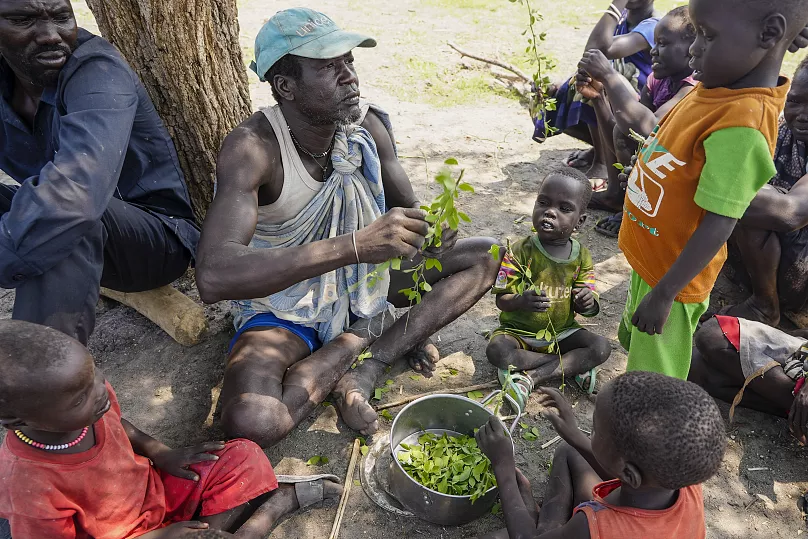
Conditions in active conflict areas in Sudan are witnessing alarming deterioration, with the specter of death by starvation haunting thousands. Chronic malnutrition is claiming hundreds of lives due to food shortages, road closures, depletion of financial savings, and the lack of humanitarian aid. Under these conditions, many families often go entire days without any food, forcing them to resort to eating tree leaves and animal fodder just to survive.
Hunger Advancing
A resident, Faisal Abu Idris, from the Al-Salha area in Omdurman, said that “the situation has exceeded all levels due to the difficulty of providing food for children and the elderly. Unfortunately, with each passing day, we grow more frustrated as our living conditions worsen. We have spent everything we own, and hunger is now surrounding hundreds of families after savings have run out and job opportunities have disappeared.”
He added, “Most neighbors go an entire day without a single meal, and it has become extremely difficult to secure even the minimum requirements of life for their families.”
He warned that if the current situation continues, the severe hardship faced by hundreds of families will soon turn into a widespread wave of hunger.
Difficult Conditions
Mariam Abbas, a resident of Wad Madani, the capital of Al Jazirah State, said that “thousands of citizens are facing acute food shortages due to price increases of up to 400%, the collapse of livelihoods, and the depletion of financial savings. This has forced many to sell their remaining possessions just to survive.”
She noted that “many residents have lost significant weight because they rely on just one meal a day, often cooked over using lentils or beans, and even that is not consistently available.”
She added that “hundreds of families who depend entirely on monthly salaries are now overwhelmed with debt and can no longer meet their essential food needs.”
Weak Immunity
In a related context, Jamal Al-Fatih, a resident of Al-Fula city, said that “West Kordofan State is besieged by hunger due to the halt of agricultural and pastoral activities, the disruption of trade with border states because of road closures and insecurity, and the difficulty of delivering humanitarian aid to those suffering from severe food shortages.”
He pointed out that “food scarcity and rising hunger levels have led to the spread of acute malnutrition diseases among children, the elderly, and pregnant women, resulting in multiple deaths.”
He added that “people feel helpless as they cannot provide food for their children, who wake up at night due to hunger. This has led to deteriorating health, weakened immunity, and poor nutrition among breastfeeding mothers.”
Tree Leaves for Survival
Similarly, Bashir Mukhtar, a resident of Al-Kargal area in South Kordofan, described the humanitarian situation as “catastrophic” due to the failure of the agricultural season, widespread unemployment, and rising poverty rates, all of which have resulted in severe food crises with no immediate solutions.
He explained that “low crop production and lack of financial resources have worsened living and humanitarian conditions. Hunger has spread across many areas, making it difficult to secure even one meal a day.”
He noted that “some people have been forced to eat boiled tree leaves mixed with spices just to stave off hunger, due to the record-high prices of sorghum and other daily necessities.”
He appealed to United Nations organizations operating in the country to urgently address the severity of the situation and intervene to provide humanitarian relief, especially food aid, to citizens trapped in South Kordofan State.
Extreme Poverty
Meanwhile, the World Food Programme described the situation in Sudan as “the largest hunger crisis in the world,” noting that more than 19 million people out of a population of about 45 million are facing acute food insecurity amid ongoing conflict and its economic and humanitarian consequences.
It added that “one in four Sudanese lives in extreme poverty on less than two dollars a day.”
Poverty rates in Sudan have doubled since the outbreak of war three years ago, with 70% of the population now living below the poverty line, according to Luka Renda, Resident Representative of the United Nations Development Programme in Sudan.
Renda confirmed that poverty rates rise to around 75% in conflict-heavy regions such as Darfur and Kordofan.
A report by the UNDP indicated that average income levels in Sudan have fallen to levels not seen since 1992, while extreme poverty has surpassed levels recorded in the 1980s.
According to the report, prepared in collaboration with the Institute for Security Studies, the war could push Sudan’s economy back to levels seen in the 1960s, with extreme poverty potentially exceeding 60%, affecting an additional 34 million people if the conflict continues until 2030.
The report also noted that Sudan lost an estimated $6.4 billion from its GDP in 2023 alone, with around 7 million people falling into extreme poverty that year.
Agricultural Disruption
Economic analyst Hassan Mohi El-Din stated that “the continuation of the war has led to a decline in agricultural production and the halt of pastoral activities. Government economic policies have also contributed to rising poverty and unemployment rates, alongside sharp increases in the prices of goods and services, placing a heavier burden on low-income groups.”
He added that “armed conflict in affected regions has pushed populations toward famine due to the disruption of agriculture, as well as the use of starvation as a weapon of war, including the deliberate destruction of farms and markets.”
He explained that “charity kitchens, which displaced people and residents of shelters rely on, are increasingly unable to meet growing needs, especially as significant cuts in donor funding are limiting the capacity of relief agencies to respond to emergencies in Darfur and Kordofan.”
One Meal a Day
In the same context, a report published by a group of non-governmental organizations revealed that “millions in Sudan are surviving on just one meal a day, as the food crisis continues to worsen and fears grow of its further spread.”
The report, issued by Action Against Hunger, CARE International, the International Rescue Committee, Mercy Corps, and the Norwegian Refugee Council, stated: “In the two regions most devastated by conflict—North Darfur and South Kordofan—millions of families eat only one meal a day.”
It added: “Many often go entire days without any food,” noting that many have resorted to eating tree leaves and animal fodder just to stay alive.