As the war between the Sudanese Armed Forces (SAF) and the Rapid Support Forces (RSF) enters its 38th month, growing fears are mounting among residents returning to the three cities of Greater Khartoum—Khartoum, Omdurman, and Bahri—as well as other states that witnessed intense fighting, particularly in central Sudan. They face the deadly threat of landmines and explosive remnants of war (ERW), both exploded and unexploded, scattered across roads, abandoned homes, and beneath the rubble. The widespread contamination underscores the complexity of the danger amid limited public awareness.
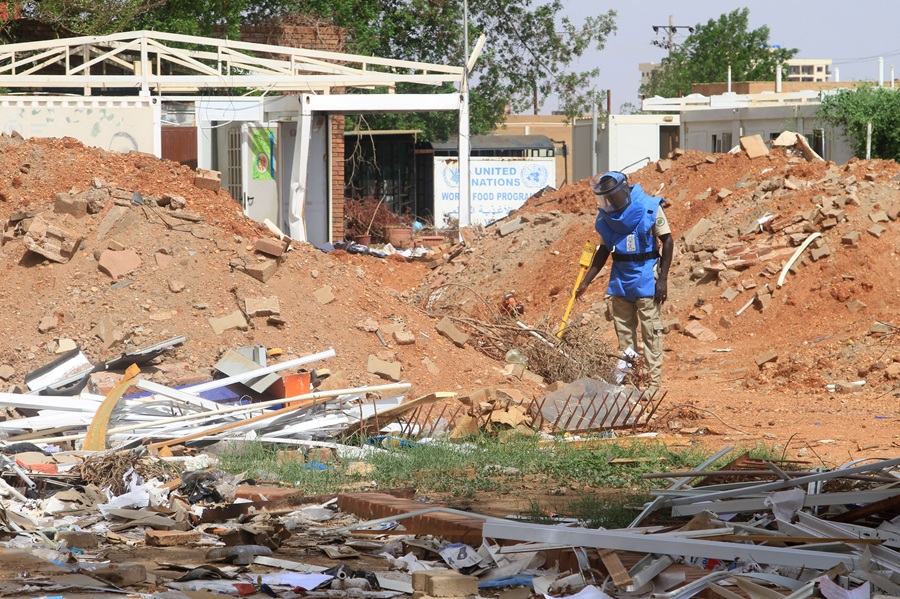
As part of efforts to restore security, Sudan’s National Mine Action Center continues operations to detect and remove landmines. However, it faces criticism over the slow pace of clearance, especially given the large number of mines reportedly planted during the conflict, particularly by the RSF while it controlled extensive areas of the capital. Alongside clearance efforts, the Center has intensified public awareness campaigns, urging residents to report suspicious objects, avoid touching or approaching them, and refrain from burning waste inside residential neighborhoods due to the risk of hidden unexploded ordnance. Nevertheless, these efforts continue to be constrained by severe funding shortages.
Meanwhile, a 14-year-old boy was killed several days ago in Um Al-Qura locality in Al Jazirah State after a suspicious object exploded. Residents were unable to identify the object despite repeated warnings against handling unknown explosive materials.
According to reports by humanitarian activists and volunteers, the RSF transformed several villages in Al Jazirah State into military operation centers and weapons depots during its control of the state from late 2023 until early 2025.
In its latest report, the United Nations classified seven areas in Khartoum as high-risk zones due to the presence of landmines and explosive remnants of war. It estimated that nearly 10 percent of the ammunition used during the conflict failed to detonate, posing an ongoing threat to civilians. The UN also noted that large parts of western Sudan remain inaccessible for mine clearance operations because of the deteriorating security situation.
A Grave Danger
Anwar Mahmoud, a humanitarian volunteer living in the Burri district of eastern Khartoum, said that repeated landmine explosions in both the capital and other states represent a serious threat to civilians, particularly as unprecedented numbers of displaced people return home after nearly three years of displacement and hardship.
“Landmines and explosive remnants of war are a silent catastrophe lurking beneath the soil, among the rubble, in overgrown vegetation, inside abandoned homes, and across open spaces,” Mahmoud said. “The incidents that have claimed the lives of dozens of civilians, including children, are a stark warning of the severity of this threat.”
He added, “Despite Sudan having a national mine action authority, we continue to hear about landmine explosions on a regular basis, suggesting that clearance efforts remain too slow. In my view, mine clearance should be among the state’s highest priorities as life gradually returns to normal. Beyond the direct danger, debris from destroyed buildings also poses environmental and health risks, while many returning families—especially children—remain unaware of the hazards surrounding them.”
Funding Shortages
Muataz Abdelgayoum, a United Nations mine action specialist, warned that the threat of landmines is likely to persist in Khartoum and other conflict-affected states, particularly Al Jazirah, for as long as ten years unless comprehensive, well-organized, and professionally managed clearance operations are carried out.
He explained that effective mine clearance requires well-trained teams equipped with modern technology and adequate resources to conduct rapid and efficient operations.
“Specialized teams with advanced detection equipment and a comprehensive operational plan can significantly reduce the time required to clear contaminated areas,” he said. “If current conditions continue, however, the process will take considerably longer.”
Abdelgayoum noted that the greatest obstacle facing mine action is the lack of funding. “International donors are reluctant to finance such operations under ongoing conflict. The United Nations and international organizations operate under strict security protocols that cannot be compromised. Large-scale funding for mine clearance is generally provided only after a ceasefire and the establishment of sustainable peace.”
Complex Field Conditions
Khalid Hamdan, former Director of Sudan’s National Mine Action Center, said that numerous minefields remain in central Khartoum and its outskirts, particularly in Al-Mogran, Kadaro in Bahri, and Al-Jaili in northern rural Khartoum. He attributed the slow pace of clearance—despite a year having passed since Khartoum was recaptured—to the complexity of field conditions and limited operational capacity.
“The mines found in central Khartoum and Al-Mogran are primarily anti-personnel mines,” Hamdan explained. “These are extremely dangerous and require highly meticulous handling. The area is littered with metal debris, causing metal detectors to produce constant signals, making it difficult for demining teams to distinguish between actual mines and scrap metal.”
He further noted that Khartoum State has not yet been officially declared mine-free, particularly in Al-Jaili, Kadaro, and several residential neighborhoods where unexploded ordnance is suspected to remain inside abandoned homes. “Demining teams continue to face significant challenges in inspecting deserted buildings,” he said.