Sudanese and Solar Energy: An “Enforced Friendship” in a Time of War
Mashaweer – Report by Ishraqa Ali Abdullah
As Sudan’s war entered its fourth year, the country’s electricity infrastructure suffered extensive damage, including power generation stations, transmission lines, distribution networks, and fuel storage facilities. During 2025, Sudan lost nearly 40% of its total electricity generation capacity, resulting in a 45–60% decline in electricity supply, with service largely limited to major urban areas. Consequently, residents in conflict-affected regions increasingly turned to alternative energy solutions, particularly solar power, driving demand to unprecedented levels.
This has raised an important question among Sudanese communities: Can solar energy evolve from being merely an emergency coping mechanism into a long-term solution amid the collapse of the national power sector?
A Necessity with Safety Concerns
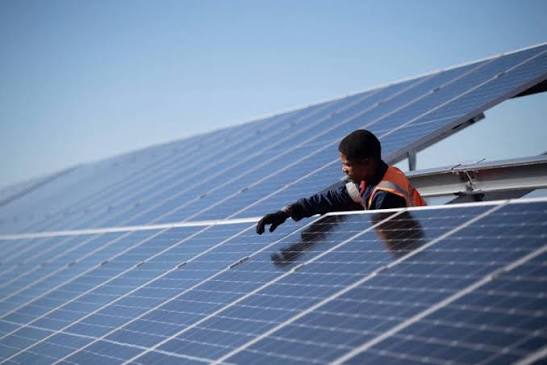
Solar energy specialist Amin Yahya explained that solar power has become one of the essential requirements for stabilizing the lives of people returning to their homes, especially as reliable electricity has become increasingly unavailable.
“The prolonged electricity crisis has forced citizens to seek alternative solutions, with solar energy becoming the primary choice,” he said.
According to Yahya, demand for solar panels has grown rapidly, particularly in the residential sector. In agriculture, farmers now depend almost entirely on solar energy because power outages often last for hours, days, or even months, making it necessary to operate irrigation wells independently of the national grid. The ongoing fuel shortage has further expanded the use of solar systems.
He noted that the spread of solar technology has also generated economic benefits by increasing agricultural productivity and enabling farmers—particularly in Northern State—to cultivate additional crops. Furthermore, 110 health facilities have been converted to solar power, allowing them to continue providing essential healthcare services, including vaccine storage and the operation of medical equipment in areas suffering from prolonged power outages.
For an average household, Yahya explained, a suitable solar system typically consists of:
A 3-kilowatt inverter
Four to six solar panels producing around 2,000 watts
Two 200-amp batteries to provide electricity during nighttime
Such a system is sufficient to power household essentials such as lighting, refrigerators, and fans, while homes with lower electricity consumption can operate with smaller and less expensive systems.
Regarding costs, he said prices vary according to specifications:
A 500-watt solar panel costs approximately 5.2 million Sudanese pounds (about US$999).
A 590-watt panel costs around 6 million pounds (about US$1,165).
A 200-amp battery costs roughly 4 million pounds (about US$832).
A 3-kilowatt inverter is priced at about 10.4 million pounds (around US$1,998).
Yahya added that although diesel generators may have a lower upfront purchase cost, their operating expenses have become extremely high because of the fuel crisis. Solar energy, by contrast, requires a significant initial investment but incurs virtually no operating costs afterward.
He also warned that proper installation is essential to ensure public safety.
“Solar panels must be securely mounted under professional supervision,” he said. “Poorly installed panels can become deadly hazards during strong winds. The risks increase further during the rainy season, when heavy rainfall and thunderstorms may damage inverters and other electrical components.”
Rising Demand
Musab Abdelmonim, who works in the electricity sector, said that extensive damage to power stations, transmission lines, distribution networks, and fuel depots—causing losses worth billions of dollars—has significantly reduced access to electricity and forced citizens to seek rapid alternatives such as solar energy.
He pointed out that Sudan possesses one of Africa’s richest solar resources, with average daily solar radiation ranging from 3 to 7.6 kilowatt-hours per square meter, while annual solar radiation exceeds 2,400 kilowatt-hours per square meter across large parts of the country.
“This places Sudan among the countries with outstanding potential for solar electricity generation,” he said.
According to Abdelmonim, this natural advantage has become particularly important during the war, as households increasingly rely on off-grid energy systems. As a result, imports of solar panels have risen significantly, while dependence on diesel generators has declined because of soaring fuel prices.
He added that demand continues to increase among households due to unreliable electricity supplies and is also expanding in the agricultural sector. Industrial demand, however, remains relatively limited because of the high cost of large-scale solar systems required for factories and major facilities.
Quality Differences
Meanwhile, Moataz Al-Haj, an importer of solar energy systems, explained that all solar equipment is imported from abroad, making prices heavily dependent on exchange rate fluctuations.
He said customs exemptions have helped reduce the impact of import duties, but currency instability remains the main factor affecting prices in the local market. In addition, rising demand or shortages in supply continue to push prices even higher.