War Deprives Millions of Education in Sudan’s Armed Conflict Areas
Mashaweer – Report by Mohamed Fadlallah Khalil
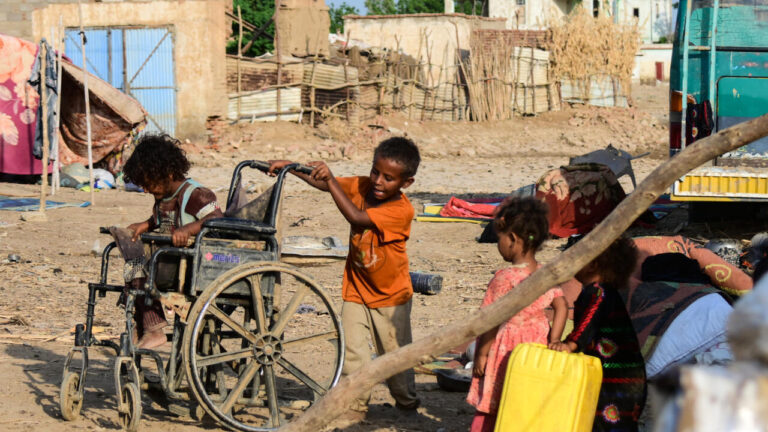
The prolonged war and continued instability in Sudan’s active conflict zones have deprived millions of schoolchildren and university students of their right to education. Many have also been exposed to violence, lost family members, or been drawn into armed conflict as fighters on various frontlines.
Education in the five Darfur states and the three Kordofan states has shifted from being a fundamental right to a distant dream. Schools and educational institutions, both public and private, have remained closed for more than two years, leaving the academic future of millions of students in jeopardy.
From Schoolboy to Firewood Collector
Adam Al-Sadiq, a young boy from Al-Lait locality in North Darfur, waited in the hope that the war would end so he could return to school. His wish never came true. As the eldest child in his family, he left school and began collecting and selling firewood, which families now rely on for cooking because cooking gas is unavailable.
Speaking to Mashaweer, Adam said:
«”I leave early every morning at sunrise and walk four to five kilometers to a nearby valley to collect firewood. I return around noon, and sometimes in the evening. I then sell the wood the following day, or sometimes several days later. Occasionally, I have to wait an entire week before I can sell it.”»
He added:
«”Before the war, I was in the seventh grade. I only had one more year before taking the intermediate certificate examination. That one year has now become two, and I don’t know when I will have another chance to sit for my exams.”»
Adam explained that education in his area came to a halt because of the war, as teachers fled to safer towns or neighboring countries such as Chad and Libya.
«”I now support my family through this simple work. If I ever get the opportunity, I will return to school. I still have many dreams that I hope to achieve.”»
Forced to Carry a Weapon
Nail Hamdan, from Al-Sanout in West Kordofan, experienced a dramatic transformation from a student carrying books to a young man carrying a weapon. He joined one of the armed groups alongside his cousins after the conflict erupted.
Although his father had encouraged his education and he became the family’s only hope for continuing his studies, he eventually followed the same path as his four older brothers.
Speaking to Mashaweer, Nail said:
«”When the war broke out, everything stopped. I felt I had no choice but to join the fighting. It was not my decision—I was forced by the circumstances. Fortunately, my mother intervened and convinced my father, who finally agreed that I should leave the battlefield. Instead, I now spend my days herding livestock.”»
He continued:
«”Unlike my brothers, I genuinely want an education because I believe it can change people’s awareness in this region. If I ever get the opportunity to leave this state, I will certainly go—not to a battlefield, but to a place of learning.”»
Severe Educational Impact
Education specialist Babiker Al-Tayeb told Mashaweer that the closure of schools for more than three years in conflict-affected areas has had devastating consequences.
“The majority of students have already lost more than half of their education because of the continuing conflict,” he said. “They are living with deep psychological distress and overwhelming uncertainty.”
He stressed that children in the early grades of primary school—especially first and second grade—have suffered the greatest damage.
“If this learning gap is not urgently addressed, and unfortunately it does not appear to be a priority for education authorities at any level, these children face a serious risk of long-term educational failure. These formative years provide the foundation upon which all future learning depends.”
Al-Tayeb also noted that intensified fighting in West and South Kordofan has displaced hundreds of thousands of people, preventing children from accessing education. Many displaced students have been unable to enroll in schools in their new locations, particularly those living in remote displacement camps far from urban centers.
UN Warnings
According to the United Nations Children’s Fund (UNICEF), more than 90 percent of Sudan’s school-age children—around 19 million—have been affected by the war.
Approximately 17 million children are currently out of school, including 7 million who were already excluded from education before the conflict began. UNICEF describes Sudan’s education crisis as one of the worst in the world due to the widespread disruption of learning.
The agency also reports that the conflict has displaced 3.5 million children, many of whom are now homeless and separated from their families. UNICEF warns that around 24 million Sudanese children remain at risk because of what it describes as a humanitarian catastrophe of unprecedented scale.