The Education Crisis Threatens the Future of Sudanese Children in Refugee Camps
Mashaweer – Report by Siddig Al-Dukhri
The schoolbook carried by 11-year-old Mohammed Omar was more than just a bundle of worn-out pages scattered by time. It had become the last remaining piece of his life before the war.
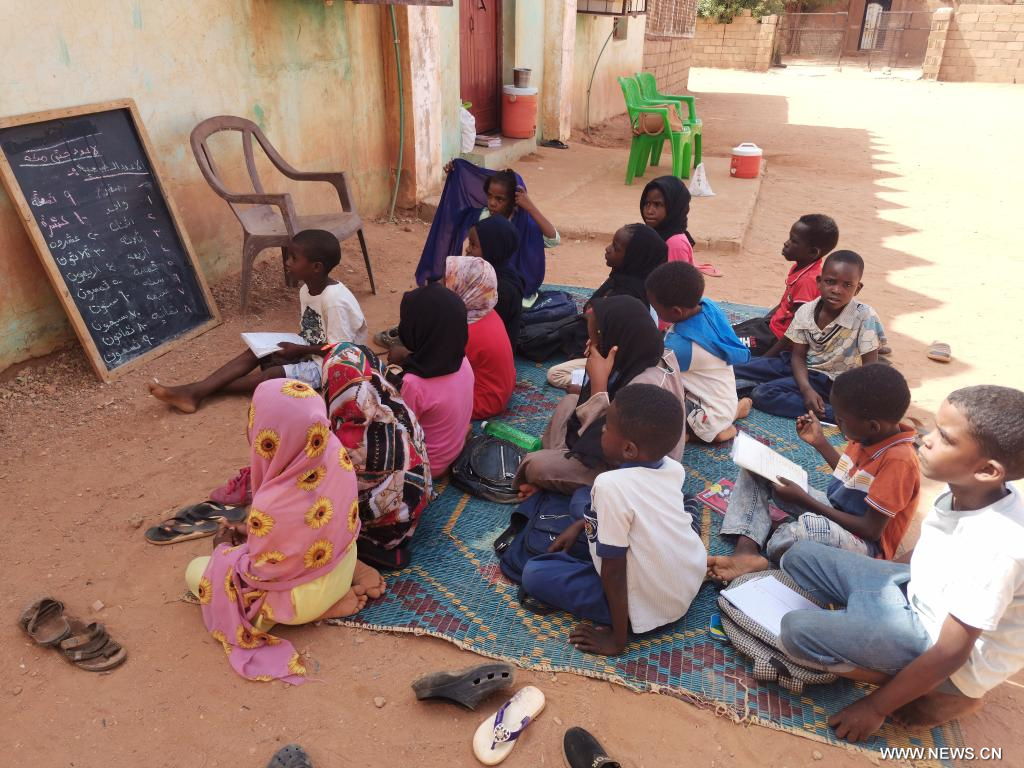
Inside a temporary classroom in Kakuma Refugee Camp in northwestern Kenya, which hosts Sudanese refugees, Mohammed sat on a narrow wooden bench as hot winds blew dust into the tent that had been turned into a school.
On the walls, made of metal sheets and burlap, faded educational posters hung while the voices of students echoed together as they recited their lessons.
Memories of Sudan
From time to time, Mohammed opened his old notebook and gently ran his fingers across its pages, as if afraid that the last memories connecting him to his school in El Fasher, the capital of North Darfur State, would disappear. He had fled the city with his family to escape the bombardment.
Speaking to Mashaweer, Mohammed said:
«”This is the last homework assignment I completed in Sudan. I look at it every day so I won’t forget how I used to study. I’m afraid I’ll grow up without knowing how to read.”»
The Struggles of Refugee Children
Mohammed’s story is repeated in different forms across refugee camps in Uganda, Ethiopia, and Chad, where the war that erupted in Sudan in April 2023 has evolved from a security and humanitarian crisis into an education crisis threatening an entire generation.
While thousands of families managed to save their lives, the educational future of their children remains suspended between displacement, a shortage of schools, and limited resources.
According to United Nations estimates, more than 17 million Sudanese children are now out of school, while over 16 million children require urgent humanitarian assistance.
More than 4.6 million children have been displaced, including around 1.1 million who have crossed into neighboring countries, where education systems are struggling to absorb the growing number of refugee children.
Classrooms Too Small for Dreams
Volunteer Idris Hassan told Mashaweer:
«”The crisis in Kakuma’s refugee camp schools is not only about the lack of buildings but affects every aspect of the education system. In some classrooms, more than 100 children sit on worn-out benches, while three or four students share a single textbook.”»
He added:
«”Some children write their homework on loose sheets of paper because there are not enough notebooks.”»
Hassan called on international organizations to provide greater support for education in refugee camps hosting Sudanese refugees.
Losing Confidence
Sudanese teacher Fatima Idris also spoke to Mashaweer:
«”I fled Khartoum after the war began. In Sudan, I knew the academic level of every student in my class. Here in the camp, I stand before more than a hundred children. Some have been out of school for two years, while others do not understand the language of instruction.”»
She continued:
«”Every morning I start from the beginning, but I hold on to hope because these children deserve a second chance.”»
She added:
«”Sometimes I see a child hesitate to read a simple sentence in front of classmates—not because they cannot read, but because they have lost confidence after years away from school.”»
An Uncertain Future
Outside the classroom, Najwa Al-Tijani waited for the school day to end while holding her young son’s hand. Nearby, groups of children gathered under the shade of a tree to escape the intense heat.
She told Mashaweer:
«”We fled the war to protect our children, but we never imagined that their education would become an even greater challenge. Every day my son asks me, ‘When will we return to Sudan? When will I go back to my school?’ I have no answer.”»
She explained that most of the family’s income goes toward food and rent, while school fees, textbooks, and uniforms have become unaffordable for many refugee families.