Sudanese Rush to Gold Mines Buries Dreams of Wealth
Mashawir – Report by Ishraqa Ali
The repercussions of the war between the Sudanese army and the Rapid Support Forces (RSF), now entering its 41st month, have driven increasing numbers of Sudanese to seek work in gold mining. Their number has reportedly doubled to around 6 million people, spread across approximately 800 sites in different parts of the country.
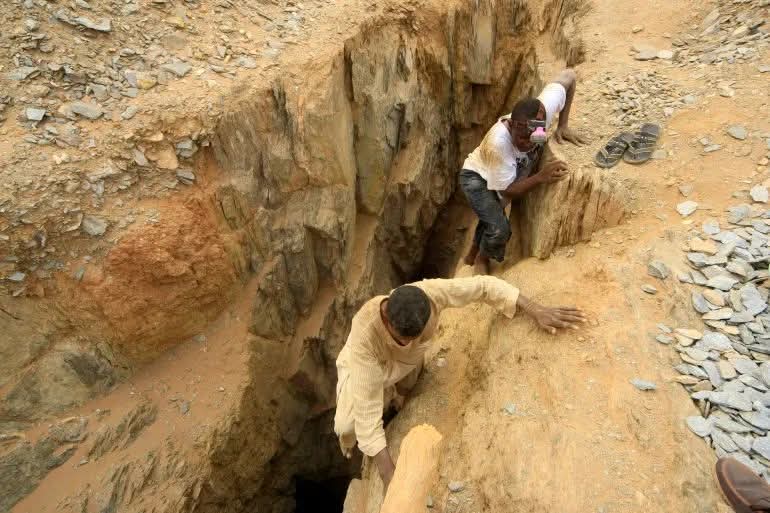
This rush comes despite the recurring disasters in gold-mining areas, particularly mine collapses that have turned mining sites into death traps for miners working in remote and mountainous areas using traditional methods. The sector also faces deadly chemical contamination, inadequate healthcare, and a lack of safety regulations, raising concerns that the number of casualties could continue to increase, particularly in areas controlled by the RSF.
Sudan is one of Africa’s largest gold producers. However, the vast majority of its gold is produced using rudimentary methods at informal sites and in abandoned shafts, before being smuggled out of the country. Government sources say the war has complicated efforts to monitor gold production and exports, as some government institutions have ceased operating and many employees are absent, negatively affecting the state’s ability to monitor mining sites.
A Series of Collapses
Accidents linked to informal gold mining in Sudan have become a recurring humanitarian and economic tragedy, regularly claiming dozens of lives.
The latest incident involved the collapse of five adjacent shafts at the traditional Al-Zara mine in the Al-Raqiq area of Al-Nuhud locality, West Kordofan State, killing 83 people and injuring 50 others. The collapsed shafts effectively became mass graves in one of Sudan’s worst traditional mining disasters. Reports circulating about the incident indicated that rainwater that seeped into the closely spaced shafts contributed to the collapse.
The Al-Zara mine disaster was not an isolated incident but part of a series of collapses at gold mines across Sudan. At the Umm Fikrun mine in Abu Jubaiha locality, South Kordofan State, a collapse killed 13 miners and injured six others after several abandoned shafts collapsed.
Six other mining workers were killed when an informal mining site collapsed in the Kleiti area of Red Sea State in eastern Sudan. In addition, a shaft collapsed in Wadi Halfa in Northern State, despite an official decision to close it after technical assessments determined that it was dangerous.
Gold mining in Sudan is not limited to the traditional sector. Around 60 companies, representing government, private and foreign entities, are active in exploration and mining. These companies account for the largest share of production and operate in areas controlled by the Sudanese army across the north, east, central and western parts of the country, while others operate in RSF-controlled areas of Darfur and Kordofan.
Despite the war, Sudan recorded its highest gold production rate last year, reaching 70 tonnes, according to official reports.
A Wartime Economy
Meanwhile, the United Nations Human Rights Office has said that gold has become a major source of revenue for the warring parties, with gold proceeds helping sustain the armed conflict and turning Sudan’s natural wealth into an economy that fuels the war.
Against this backdrop, the European Union and the United Kingdom have imposed sanctions linked to Sudan’s gold trade, including restrictions on the purchase and import of Sudanese gold and bans on the export of mercury and cyanide, which are used in gold extraction.
The Shortest Route
Ahmed Al-Khabir, a mining worker, said that the war, which deprived him of his agricultural livelihood in South Kordofan State, forced him to work in gold mines in northern Sudan.
«“I support an extended family, so I have to work to meet their daily needs, whatever the cost. This forced me to travel thousands of kilometres in search of a source of income. With factories shut down and agricultural seasons failing, I found no option other than gold mines, which are one of the shortest routes to quick income if luck is on your side, even though I know they are fraught with risks.”»
Al-Khabir added:
«“When I reached my destination, I was surprised to find thousands of young Sudanese people displaced by the war working in this sector. The numbers are not limited to Northern State; they are spread across every area known to be rich in gold, without much consideration for the risks or the possibility of death.”»
He continued:
«“Gold mines are usually located in remote, mountainous areas filled with rocks and lacking even the most basic safety measures. Mining is carried out using traditional methods, in addition to the use of substances that can cause serious diseases such as cancer and kidney failure. More than 50 miners may work in a single shaft, and there are also cases of suffocation, as well as exposure to scorpion and snake bites.”»
The miner said that those who have chosen to work in gold mining hope to improve their living conditions and escape the circumstances imposed by the continuing conflict, after millions of Sudanese people lost their livelihoods and faced severe humanitarian crises.
Waves of Rising Prices
Yassin Al-Tihami, a researcher and environmental affairs specialist, explained that the war, which erupted suddenly, pushed the Sudanese economy from a state of fragility into outright collapse.
«“Supply chains and trade and transport between the states have been disrupted, factories have stopped operating, and agricultural seasons have failed. Millions of Sudanese have been displaced, while unemployment has spread as people have lost their economic activities. Prices have also risen after the economy became increasingly dependent on the black market, exacerbating inflation and paralysing many aspects of citizens’ daily lives.”»
Al-Tihami said these repercussions had driven a large segment of the population toward gold mines in different parts of the country, without sufficient consideration of the negative consequences of traditional gold extraction, including the use of mercury and cyanide, which can cause long-term and potentially fatal health effects when safety precautions are ignored.
He stressed that mining operations should be accompanied by procedures and safety requirements designed to protect human lives. Before gold extraction begins, he said, geological surveys should be conducted to identify the type and structure of the rocks before they are excavated, in order to reduce the risk of collapses, which have become increasingly frequent in recent weeks. Groundwater should also be monitored because it can weaken the soil and increase the risk of mine collapses.
The environmental researcher warned that gold excavation during the war has become a highly dangerous undertaking.
«“Any hidden weakness in the ground, including weakened rock structures caused by fractures, combined with the use of cyanide and mercury, can significantly undermine the natural stability of the rock. Groundwater also greatly reduces soil cohesion. Together, these factors can cause a sudden shaft collapse that threatens people’s lives.”»
Al-Tihami stressed the need for studies and proper planning of excavation operations carried out by specialised companies. He noted that mining is a long-term investment, particularly amid deteriorating living conditions, and that traditional gold mining has increasingly become one of the few remaining sources of state revenue after Sudan lost a significant portion of its oil resources. This has driven large numbers of Sudanese, particularly young people, to seek work in gold mining.