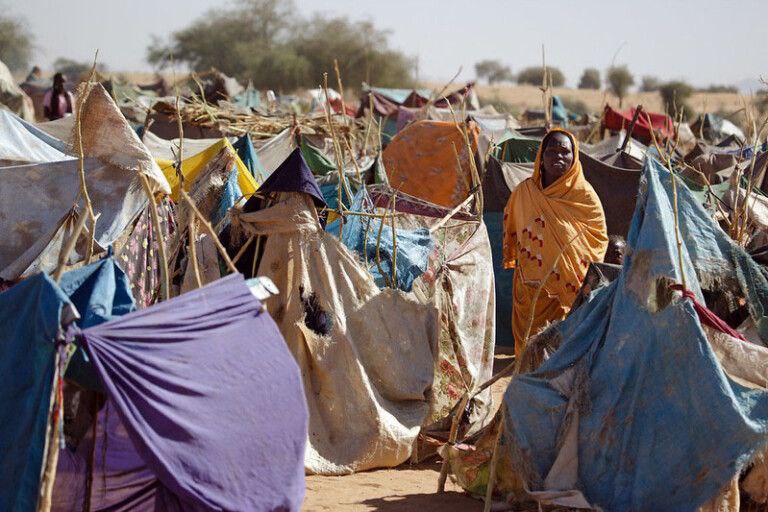
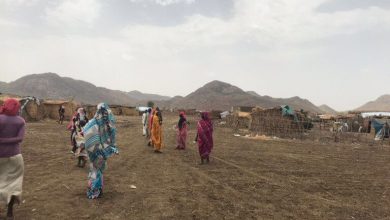
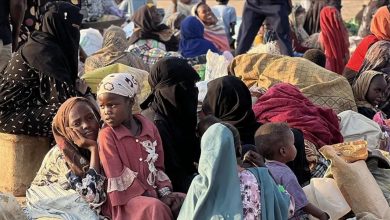
The destruction of livelihoods in both rural and urban areas of Sudan, caused by the war raging since mid-April 2023, has driven some to extreme measures. These include “sex for survival” with armed individuals from both sides of the conflict, particularly in besieged areas. Additionally, the report highlights the marriage of young girls to fighters in states active in the conflict, and the recruitment of children into armed groups under financial pretexts.
In parallel, community initiatives have raced to fill the food gap through self-help efforts, but the sheer number of people impoverished by the war has exceeded their capacity, leading many to shut down due to economic conditions. Appeals to international organizations to provide food have become louder, though these organizations face obstacles from both warring parties. Sudanese people, particularly women, are living in tragic and inhumane conditions; young girls who lost their parents in the fighting are left with the “difficult choice” of sex for survival just to obtain a morsel of food.
A large number of women have complained of sexual exploitation in exchange for aid distribution, especially in camps located along Sudan’s western borders. According to the United Nations Population Fund (UNFPA), approximately 7 million women are at risk of sexual exploitation, harassment, and rape.
A Stigma of Shame
S.M., a 16-year-old Sudanese girl, recounts the details of her sacrifice for her younger siblings following the death of her parents. She says: “The wars that broke out in Darfur in 2003 forced us to flee to the capital, Khartoum, after we lost my father. I never expected that the cruelty of life would double.”
She adds: “We settled in the outskirts of southern Khartoum, where most residents suffer from poverty. My mother worked selling traditional food in the Central Market. But the outbreak of armed conflict in the capital between the army and the Rapid Support Forces (RSF) led to my mother’s death by a rocket shell. In the wake of these events, I found myself alone with the circumstances of life preying on me.”
She continues: “I suddenly became responsible for my younger siblings. I tried to continue my mother’s work, but the problem was that I lacked experience in dealing with customers because my mother used to prevent me from accompanying her to the market. Despite that, I was forced to continue.”
She added: “Regrettably, I took a path that contradicts my upbringing. I succumbed to the pressure exerted by RSF soldiers and others to surrender myself to them in exchange for food for my siblings to keep them alive and to secure some needs that have become difficult to obtain, especially house rent.”
The girl added: “My situation applies to many women and girls in conflict zones. My biggest worry is if my brothers find out about my behavior, which goes against our family traditions. Moreover, Sudanese society does not tolerate those who have sex outside of marriage, but I find myself forced so that my siblings can live in safety and have food.”
Fear and Anxiety
The city of El Fasher, the capital of North Darfur, has witnessed the worst humanitarian crises. Ibrahim al-Nour, a local citizen, shares: “Due to the sound of rocket artillery and the targeting of citizens, I became unemployed. I cannot leave the house to seek a source of income or provide basic requirements like food and water for my family.”
Al-Nour added: “What worried me was protecting my three daughters from sexual abuse and providing food to keep my family alive. The prolonged war and the siege on El Fasher led me to marry off my daughters to fighters from the armed movements defending the city alongside the Sudanese army. Even though they are minors and their ages are not suitable for marriage, I lived in constant fear of them being sexually exploited or harmed, in addition to the harassment I face and the risk of us all dying of hunger.”
He noted that the threat to women and girls haunts the population because of hunger. While volunteers make efforts to provide meals, the problem lies in the overcrowding and long queues from early morning until noon; often, the pots return empty, leaving them in despair over securing the day’s meal.
Psychological Impact
Mental health consultant Mohamed Mustafa Abdel-Gawad explained: “It is well known that food lies at the base of Maslow’s hierarchy of needs. In the midst of this crushing crisis, some people have been forced to adopt methods that were never part of their lives before, such as sex for food.”
Abdel-Gawad added: “When such abusive behaviors occur, behaviors from which society was previously shielded, there are devastating psychological effects, especially for women who fear for their reputation. These include feelings of guilt, resentment, and despair. Persistent feelings of this nature lead to depression, sleep disorders, and heart issues due to deep grief.”
The specialist noted that the need for food without a means to get it often leads to acts contrary to one’s convictions, which can escalate to theft or killing. He stressed the need for food, water, and shelter for those displaced by war, alongside psychological support.
Pressure and Exploitation
Sulaima Isaac, Director of the Unit for Combating Violence Against Women and Children at the Ministry of Social Development, stated: “All projections indicate that the humanitarian crisis will continue to worsen. I do not rule out women engaging in sex for food to survive and provide for their families now that hunger has become a lethal weapon.”
She explained that her unit “works to document cases of sexual exploitation and abuse that can occur even in safe areas.” She added that they are working to establish offices in the states of Gedaref, Kassala, and White Nile to provide protection for women, noting that many do not report sexual exploitation due to the lack of a supporting mechanism. She emphasized that all procedures are handled with strict confidentiality.
She concluded: “We are seeking to form protection committees in displacement shelters to receive complaints about sexual exploitation and to train volunteers and workers in these centers.”