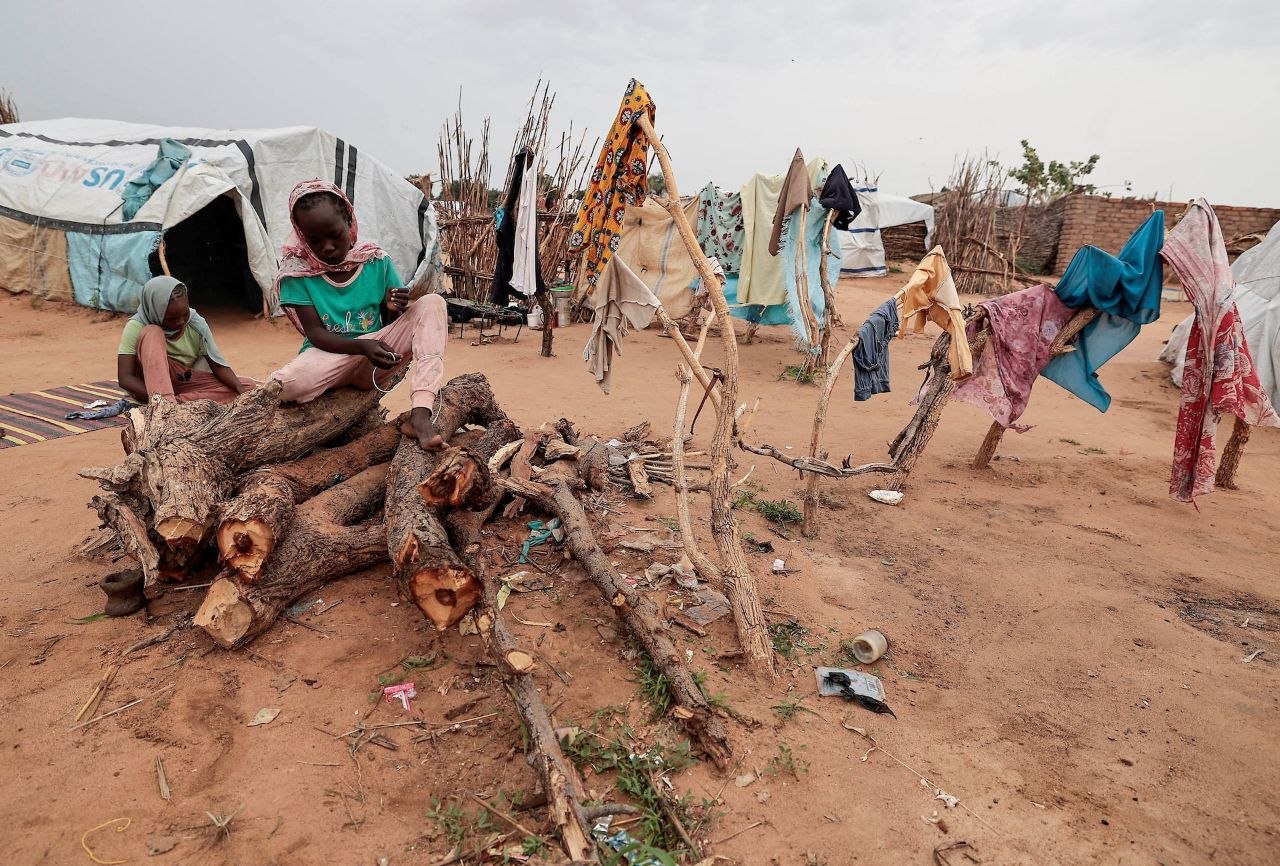
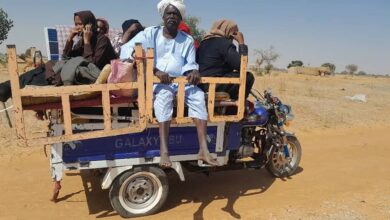
Amid a total lack of food in several Sudanese cities due to the ongoing war, conditions have deteriorated to an unprecedented level, especially in armed conflict zones. Despite the humanitarian catastrophe facing millions of Sudanese, the UN World Food Programme (WFP) announced it has been forced to cut food rations for the hardest-hit areas in Sudan since last January due to a funding shortfall.
Specialists believe this decision will increase hunger levels among Sudanese communities already experiencing a dangerous decline.
Malnutrition
In this context, Hawa Al-Bashir, a citizen from the city of Kadugli, told Mashaweer: “The conflict around Kordofan, especially the cities of Kadugli and Dilling, has transformed them from economically active hubs into areas besieged by hunger due to the halt of agricultural and pastoral activities. This is compounded by restrictions imposed by both parties of the conflict on humanitarian aid and the movement of goods. Fears are mounting as the delivery of food rations from international organizations is delayed; these organizations find it difficult to reach those starving due to food scarcity.”
She added, “The situation in South Kordofan has become catastrophic, leading us to flee in search of safety and join displacement camps in El Obeid, the capital of North Kordofan, after we were completely isolated.”
She continued, “We were forced to eat very few meals until children, the elderly, pregnant women, and nursing mothers suffered from malnutrition and associated diseases. Families are now losing a member every day.”
The Brink of Death
Similarly, Hussein Al-Basha, currently in the Kernoi area of North Darfur, told Mashaweer: “Hunger has begun to overshadow those stranded here, forcing them to eat animal fodder, which caused diarrhea and abdominal bloating in children before they were forced to displace under horrific humanitarian conditions.”
He added, “Our departure from El Fasher was to save our lives and search for humanitarian aid after the city, and indeed the entire region, lacked medicine, clothing, and basic necessities.”
He continued, “In my estimation, if the food rations provided by international organizations to vulnerable communities stop, the situation will reach the point of death. There is no work for us to do, and the communal kitchens “Takiya” cannot possibly cover these large numbers of displaced people who represent the core of the humanitarian crisis.”
UN Warnings
Additionally, UN-backed experts warned on Thursday of the expanding risk of famine to the towns of Kernoi and Ambara in North Darfur, western Sudan, due to massive displacement waves following the fall of El Fasher, the state capital, last October.
Experts from the Integrated Food Security Phase Classification (IPC) confirmed that “the famine threshold indicating acute malnutrition has been crossed in two additional areas in North Darfur: Kernoi and Ambara,” near the border with Chad.
The Rapid Support Forces (RSF), which has been at war with the army since April 2023, tightened its control over El Fasher at the end of last year, bringing the entire Darfur region under its grip except for small areas controlled by neutral local forces.
Since the fall of El Fasher, more than 120,000 people have been displaced, according to the UN. Many headed to other cities in North Darfur that are already suffering from a lack of resources and overcrowding.
Experts explained in their report that the waves of displacement from El Fasher have led to the “depletion of local community resources and capacities, increasing food insecurity and acute malnutrition.” The report noted that the warning does not constitute a formal declaration of famine “but directs urgent attention to the food security and nutrition crises based on the latest available evidence.”
Verifying data is difficult in most areas of western Sudan due to road closures and telecommunications blackouts. The report warned that acute malnutrition continues to worsen in 2026: “Prolonged displacement, conflict, and the erosion of healthcare, water, and food systems are expected to increase acute malnutrition and food insecurity.”
A Critical Stage
According to Ross Smith, WFP’s Director of Emergency Preparedness and Response, the cuts will reach 70% in areas facing famine and 50% in high-risk areas.
He warned that funding will reach a “critically low” stage by April 2026. This comes at a time when some areas face complex conditions, especially El Fasher, which is witnessing an appalling situation with an estimated 70,000 to 100,000 people still trapped inside, requiring humanitarian access as an urgent priority. This is exacerbated by communication outages and the absence of accurate information, as well as the dire conditions in Tawila (North Darfur), Kadugli, and Dilling (South Kordofan).
He added that UN aid convoys are currently heading to the Tawila area to meet the needs of 700,000 people for a full month, where approximately 650,000 displaced people reside. Additionally, 350,000 people suffer from acute food shortages in the areas of Bara (North Kordofan), Dilling, and Kadugli (South Kordofan).
Multiple Difficulties
According to a study prepared by the Norwegian Refugee Council (NRC) and the Danish Refugee Council (DRC) on the conditions of displaced persons in the Kadugli locality of South Kordofan (displaced in May 2025), 74% of families face difficulty obtaining food, and 96% have low food consumption scores.
The study mentioned that Kadugli is classified under Phase 4 (of the UN Famine Classification) and is considered a priority area for famine prevention.