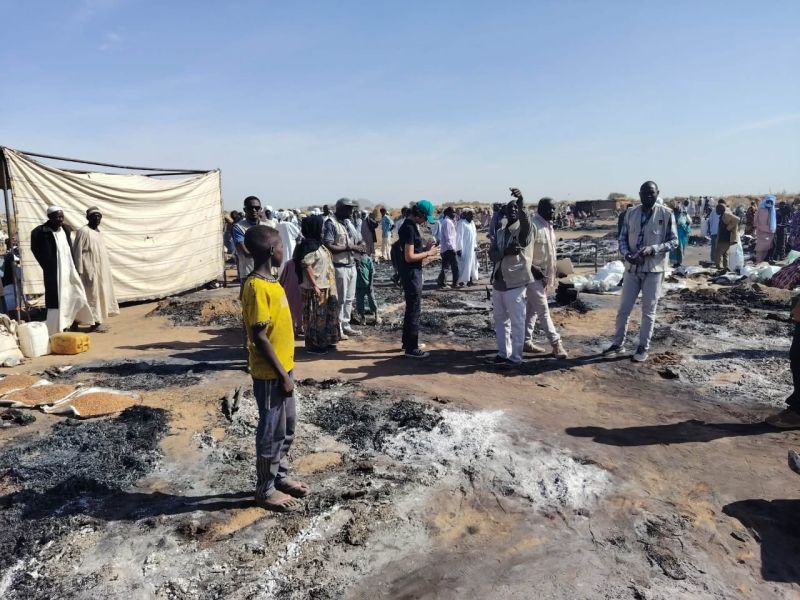
Thousands of displaced Sudanese are living in temporary shelters such as thatched huts and makeshift tents that offer little protection from heat or cold. Despite adapting to a harsh reality and life in displacement, residents of camps in Darfur and Kordofan now face a danger no less severe than war and deteriorating humanitarian conditions. Repeated fires have broken out in displacement camps, leaving more than 6,000 people homeless, destroying around 800 shelters, and damaging 300 huts and makeshift homes.
Since early March, emergency rooms and volunteer coordination groups in Kordofan and Darfur have recorded 15 fires in areas including Tawila, Kurma, and Kilimando, as well as Um Dam Haj Ahmed locality and villages east of Kazqil, Al-Qizan, and Um Badr. As a result, thousands of families have been affected and are now left without shelter under extremely difficult conditions, especially with rising summer temperatures.
Critical conditions
Hamed Mohammedi, who lives with a family in Um Dam Haj Ahmed locality in North Kordofan, said that the village of Al-Bunya has witnessed five fires since March in displacement gathering areas. These fires displaced around 1,500 people and damaged 120 homes in shelters. Despite the scale of the disaster, local authorities have not taken action to address the damage or provide essential aid such as shelter materials and food.
He added that such fires had never been seen before in their years in Kordofan, noting that they spread rapidly due to strong winds and dry vegetation caused by heatwaves. The fires resulted in the death of a nine-year-old child, injuries to 12 people, and the loss of large numbers of livestock.
Mohammedi described the humanitarian situation as extremely critical, with displaced families living in the open or under trees. He called on the central government and emergency groups to register all affected people, provide tents, and deliver urgent humanitarian assistance.
Widespread destruction
In Al-Qizan village in North Kordofan, a large fire broke out in a displacement shelter hosting 80 families, forcing most of them to flee under harsh humanitarian conditions. Around 1,200 people are now living in fragile shelters made of sacks, cloth, and plastic sheets that cannot withstand strong winds or intense summer heat, putting them at risk of collapse at any moment.
Taj Yaqoub, one of the affected residents, described the terrifying moments when the fire broke out. Fueled by strong winds, it quickly consumed all homes, leaving families no option but to escape with their lives, abandoning all their belongings, which were completely destroyed.
He said the scene was chaotic and frightening, as flames rapidly engulfed tents and straw huts within moments. Survival became the only priority, and while he managed to save his family, they were left exposed without shelter or food after the fire destroyed everything.
Al-Omda camp disaster
In a related development, a humanitarian research lab at Yale University documented the impact of a fire in Al-Omda camp for displaced people in Tawila, located about 64 km from El Fasher. This was the fifth fire to hit the camp since February.
The International Organization for Migration reported that the fire displaced 971 families, destroyed more than 881 huts, and damaged 90 others. The camp, located in Tawila, has become a refuge for hundreds of thousands fleeing fighting between the army and the Rapid Support Forces.
Local emergency coordination groups in Tawila and Jebel Marra reported the death of a child in the March 21 fire, attributing the cause to cooking lentils, strong winds, overcrowding, and the presence of flammable materials.
Fires are difficult to control in the camp, which hosts more than 269,000 people, as most shelters are made of wood and straw and lack firefighting resources.
Since early February, the International Organization for Migration has recorded five fires in Al-Omda camp alone, destroying more than 1,613 huts. Many residents had previously fled Zamzam camp in April 2025 following a major attack attributed to the Rapid Support Forces.
Heavy losses
In North Kordofan’s Um Dam Haj Ahmed locality, three fires broke out in March, causing severe damage to displaced people’s homes. More than 950 houses were destroyed, leaving 1,400 people homeless.
Adel Al-Omda, a humanitarian volunteer working in displacement areas in Kordofan, said dozens of families are still living in the open after losing their homes, tents, and all belongings. He noted that the causes of the fires remain unclear.
He added that the suffering of displaced people in Kordofan has worsened significantly, as they have fled violence only to face new disasters, with fires further deepening the humanitarian crisis.
He emphasized that hundreds lost everything and had to flee shelters quickly without taking personal belongings, as the danger was immediate—especially for children who were asleep and are now traumatized by the experience.
State of shock
Abdullah Khater, a resident of a shelter in Al-Batha village, said the fire struck at night and spread rapidly due to strong winds, forcing people to flee to avoid death.
Within hours, homes and nearby farms were completely burned, along with the loss of animals. He described the situation as devastating, leaving life bleak and causing psychological shock among many survivors.
He added that one of his neighbors suffered serious head and body injuries and might not have survived without the quick intervention of his children.
A humanitarian tragedy
Meanwhile, the Darfur Displaced Persons and Refugees Coordination reported worsening humanitarian conditions in camps following recent fires that destroyed more than 881 shelters and displaced large numbers of families.
Spokesperson Adam Rijal said displaced people are living in constant instability due to ongoing conflict and fear, compounded by repeated fires caused by overcrowding, especially in Tawila in North Darfur.
He stressed that these fires are not isolated incidents but a recurring humanitarian tragedy adding another layer of suffering to displacement.
He explained that shelters made of straw and locally sourced materials like cloth and plastic are highly flammable, and their close proximity makes fires spread quickly. The lack of firefighting resources and water makes controlling them nearly impossible.
He added that the psychological impact goes beyond material losses, including loss of life, injuries to children, and women losing their limited savings and important documents.
Rijal concluded that these fires highlight the fragility of humanitarian infrastructure in the camps, describing them not as natural disasters but as a direct result of lack of protection, poor planning, and insufficient international response.