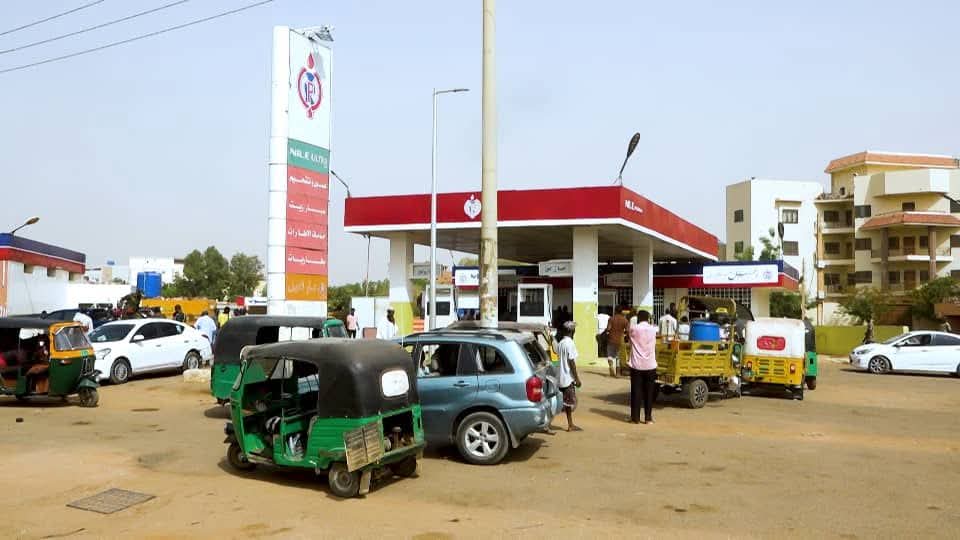
Several states across Sudan are facing a new fuel crisis due to shortages of gasoline and diesel, leading to the return of long queues outside service stations. Some stations have also been forced to close because of a lack of fuel, accompanied by rising prices. A gallon of gasoline has reached around 38,000 Sudanese pounds ($5.4), while a gallon of diesel has risen to approximately 33,000 pounds ($4.7).
The fuel crisis comes amid an increase in the customs exchange rate used to calculate customs duties on goods imported into the country. The rate rose from 3,960 to 4,346 pounds per dollar, an increase of around 9.7 percent. This is the fourth consecutive increase this year, directly affecting the cost of importing goods and commodities and the duties imposed on them, including products related to the transport and energy sectors.
Sudanese markets are experiencing a wave of price increases amid the depreciation of the Sudanese pound against foreign currencies, the continuation of the war, and its impact on supply chains. This situation is placing additional pressure on consumers and complicating efforts to contain inflation and improve the purchasing power of the pound.
Black Market
Abdelhamid Youssef, a resident of Al-Thawra suburb in Omdurman, said: “There are indeed clear signs of a crisis emerging in the cities of Khartoum State, particularly Omdurman. This has been evident in vehicles lining up outside fuel stations and the closure of some of them, especially as the worsening crisis coincided with reports of increases in the customs exchange rate and fuel prices.”
Youssef added: “It is unfortunate that workers in this sector are contributing to the crisis. Fuel may be available, but as soon as information emerges about an expected price increase, stations close and fuel is stored. Once a new price is announced, the same fuel is sold at the new price.”
He explained that “the wave of fuel price increases in the country has contributed to a severe shortage of fuel, affecting both gasoline and diesel, amid expectations that the price of a gallon in Khartoum State could reach 65,000 pounds ($9.2).”
The citizen noted: “In my view, the long queues, amid economic instability, have become a monthly occurrence, accompanied by protests that sometimes escalate into clashes between citizens and fuel-station workers. Vehicle owners are constantly moving from one station to another in search of fuel, in an attempt to avoid buying it on the black market at double the price.”
A Harsh Equation
Maryam Abdelwahab, a homemaker living in Port Sudan, Red Sea State, eastern Sudan, said: “Families’ suffering is not limited to the increase in fuel prices. It is also about how to manage each day amid the rapidly rising prices of basic commodities and the declining purchasing power for even the most basic necessities of life.”
Abdelwahab added: “The day now begins with exhausting calculations about what can be purchased and what can be given up. The equation of daily life has become unbearably harsh for families, amid the continuing increases in the customs exchange rate, which contribute to higher prices while leaving citizens without adequate protection measures. This has forced housewives to buy only essential items sufficient to get through the day, instead of purchasing in bulk as they did in the past.”
She stressed: “There must be solutions to these successive increases, because our livelihoods have become extremely vulnerable. It is well known that any increase in fuel prices, or any fuel shortage, directly translates into higher commodity prices and what can only be described as a dramatic surge. As a result, citizens bear the brunt of the economic collapse and deterioration.”
Direct Impacts
Meanwhile, Khalid Al-Sayed, a public-transport driver, explained: “The rapidly rising fuel prices are not a new phenomenon for citizens. They are an old problem that keeps recurring amid the consequences of the ongoing war in the country. Under the current circumstances, it is difficult to adapt to them, particularly with the wave of excessive price increases affecting all essential services and the inflation that has hit the Sudanese economy and worsened living conditions.”
He noted that “citizens have come to understand that the sudden disappearance of fuel and unexpected closure of stations may be a prelude to another price increase. Unfortunately, this has become almost an accepted pattern at fuel stations.”
Al-Sayed continued: “These crises push some better-off groups, as well as transport operators, to deal directly with the black market, contributing to its expansion despite the high price of a gallon of gasoline or diesel, or the need to wait for hours, sometimes an entire day. When fuel becomes available again after the increase, the main concern is simply obtaining it, even at a higher price, because current living conditions cannot withstand further disruption.”
The driver pointed out that “this increase coincided with the implementation of a new adjustment to the customs exchange rate, which directly affects the transport sector and consequently leads to higher public-transport fares. These are additional burdens borne by citizens who already face limited incomes, rising prices, and expensive bills for essential services.”
Crisis Management
In a related development, economic researcher Haitham Fathi said: “The current living conditions require a shift from a policy of crisis management to creating growth, through ambitious plans aimed at achieving energy and food sovereignty and investing in Sudan’s human capital.”
Fathi explained that “the rising costs of fuel and electricity, along with consumer goods, are exacerbating the living burdens on Sudanese people amid declining commercial activity and cash shortages.”
He noted that “people are facing additional hardship amid disruptions to essential services, the absence of economic stability, and limited incomes, particularly among workers in certain sectors. They are caught between weak incomes and the continuing need to work.”
The economic researcher warned that “the continued rise in fuel prices as a result of the increase in the customs exchange rate, coupled with the rapid depreciation of the Sudanese pound, contributes to higher inflation, while affecting production, transportation, and taxes. Food supply chains still rely heavily on imported or high-cost fuel, adding growing burdens to every link in the food chain, from agriculture through transportation and storage to retail outlets.”