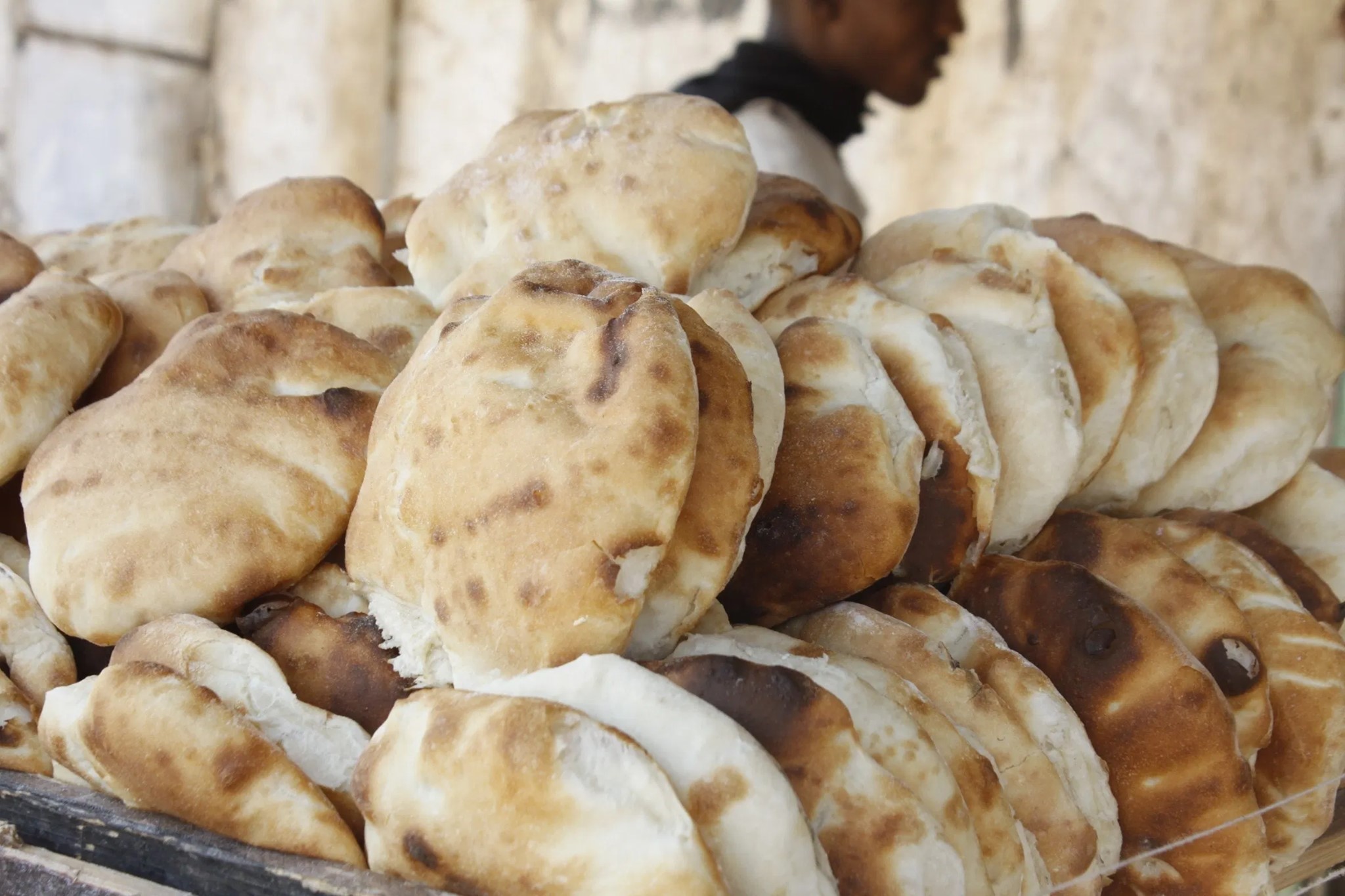
Families across all Sudanese states are facing severe living challenges that worsen with each passing day, particularly as bread prices continue to rise sharply, with the price of a single loaf reaching 500 Sudanese pounds (approximately five US cents).
The increases are driven by rising production costs, which have placed a heavy burden on bakery owners amid the depreciation of the national currency against the US dollar. Other contributing factors include electricity outages, the fuel crisis, soaring gas and flour prices, as well as the rising cost of production additives. These factors have become major obstacles to keeping bakeries operational.
Consequently, bakery owners have been forced to raise bread prices, further weakening citizens’ purchasing power. While consumers are calling for measures to ease the cost-of-living burden, bakery owners say they are facing operational pressures that are increasingly difficult to overcome due to rapidly rising input costs, particularly flour.
Specialists believe that the continuation of these conditions will plunge food security in Sudan into an increasingly complex crisis, making it difficult for citizens to secure their basic needs amid soaring prices that consume their already limited incomes.
Reports indicate that rising bread prices have also affected restaurant owners and households that depend on bread as a basic staple for their daily meals.
Meanwhile, the United Kingdom, the United States, the European Union and 29 international partners have warned of deteriorating food security in Sudan and the risk of famine. An estimated 19.5 million people are facing food insecurity. In a joint statement, they stressed that the war and obstruction of humanitarian assistance are exacerbating the crisis, calling for the removal of obstacles to aid delivery and an urgent increase in international funding.
Official Measures
Against this backdrop, Khartoum State Governor Ahmed Othman Hamza inspected grain mills in Khartoum Bahri following the continued rise in bread prices.
During his visit, he reviewed incoming wheat supplies, as well as the stages of processing, production, packaging and loading of quantities prepared for distribution by companies to distributors. He also examined the direct supply of flour from mills to bakeries.
Hamza affirmed that the state government was committed to ensuring the availability of bread for citizens and restoring prices to their previous levels.
The state government had previously announced a package of measures to control bread prices following the rapid increase in flour prices and production costs, which had prompted some bakeries in Khartoum State and other parts of the country to raise prices to unprecedented levels.
Production Challenges
In this context, Isam Okasha, head of the Bakers’ Union, said that “the depreciation of the Sudanese pound, rising wheat prices, the fuel and gas crisis, and higher production input costs were among the main factors behind the increase in bread prices, placing pressure on bakery owners and forcing them to raise their prices.”
Okasha added: “In my assessment, resolving this escalating crisis requires importing wheat flour, despite the rising value of the US dollar on the parallel market, which has eroded the value of the Sudanese pound and left citizens unable to cope with increases in the prices of basic food commodities.”
He continued: “Reaching sustainable solutions requires ending the war first, as it has pushed the country’s economy to the brink of total collapse.”
He further noted that bakeries operating under wartime conditions urgently need government support. However, he lamented that Sudan’s export revenues, which are largely derived from gold mining, are being channelled towards supporting the war effort.
Okasha warned that unless the government gives the crisis serious attention and addresses its root causes, the situation will deteriorate further, leaving the bakery sector with only two options: closure or successive price increases.
Additional Burdens
For his part, Ibrahim Abdelrahman, a bakery owner in Omdurman, explained that bakery operators are struggling to secure essential production supplies, with flour prices representing the biggest obstacle to production.
He added that fuel shortages have created an additional burden, with long queues at petrol stations forcing bakery owners to use diesel at exorbitant costs or resort to firewood as an alternative to keep production going.
This comes amid electricity outages lasting more than 12 hours, even before the recent drone attacks on power stations, which have further complicated the economic situation facing the sector.
He also pointed to workers’ wages and demands for salary increases in response to deteriorating living conditions.
Abdelrahman noted that rising bread prices were a natural consequence of soaring gas prices and the increasing cost of production additives, particularly yeast. He said these factors had collectively contributed to pushing bread prices to their current levels.
The bakery owner stressed the need for government intervention to reduce the cost-of-living burden on citizens, particularly low- and middle-income households, and to introduce measures to curb inflation amid the sharp deterioration of the local currency.
A Sector Facing Recovery and Threats
Meanwhile, Awad Al-Amin, who works at a restaurant in Khartoum, said the bread crisis had affected several businesses that depend on bread, including restaurants, fast-food outlets and schools, forcing them to raise their prices.
He added that customers were increasingly complaining that meals were no longer filling, attributing this to reductions in bread portion sizes.
Al-Amin explained that during more than three years of displacement and refuge, many young people had acquired experience in preparing a variety of meals. Upon returning, they applied these skills, contributing to a revival of restaurant businesses along Street 60 in Khartoum and Al-Wadi Street in Omdurman, while also creating employment and new sources of income.
However, he warned that concerns were growing over the possible closure of these businesses as a result of rising bread prices, alongside disruptions to essential services such as electricity and water. These challenges threaten economic stability and efforts to overcome the worsening cost-of-living crisis.
He also pointed out that most restaurants in the markets had shifted away from preparing meals that depend on bread towards traditional Sudanese food establishments specialising in kisra and aseeda, two popular dishes made from sorghum flour.
These traditional foods have attracted considerable demand from consumers because they are cheaper than fast-food meals.