The recent drone attacks on El Obeid, the capital of North Kordofan State, have had a significant impact on the humanitarian situation, particularly by worsening shortages of water and electricity, reducing the availability of food commodities, and driving up the prices of essential goods.
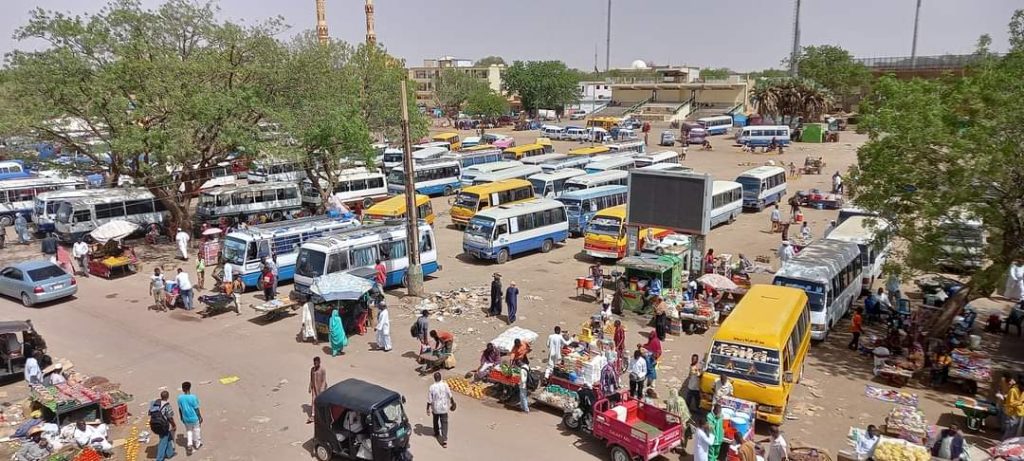
In the city’s main market, commercial activity is noticeably quieter than usual. Traders report fewer customers, while many families are limiting their purchases to basic necessities.
Uncertainty and Economic Slowdown
Mohamed Al-Danglawi, a food merchant in El Obeid’s main market, told Mashaweer that the prevailing atmosphere of uncertainty is directly affecting business activity.
“Since the escalation of fighting around Kordofan, customers have focused only on buying essential goods. Whenever news spreads about military movements, demand for flour, sugar, and cooking oil increases because many families begin stockpiling supplies out of fear that supply routes could be disrupted. This quickly pushes prices higher,” he said.
He added that many traders have become reluctant to purchase large quantities of merchandise, fearing disruptions to transportation or delays in the arrival of supply trucks. According to him, caution has become a defining feature of the market.
Transportation Challenges
At public transport stations serving residential neighborhoods, activity has also declined. Residents say they have reduced their daily movements in anticipation of possible security developments.
These conditions coincide with ongoing military operations across the Kordofan region, raising fears that the fighting could spread into El Obeid or disrupt the main supply routes linking the city with other parts of the region.
El Obeid is a major commercial hub for the Kordofan states and an important transit point for goods traveling to and from parts of Darfur. Any deterioration in security therefore has an immediate impact on markets and the availability of essential goods and services.
Concerns Over an “El Fasher Scenario”
Political analyst Mohamed Osman told Mashaweer that while comparisons between El Obeid and El Fasher do not necessarily mean the same events will unfold, such an outcome remains possible if fighting continues around urban areas.
“The longer hostilities continue around cities, the greater the cost to civilians. Keeping residential areas out of the conflict and ensuring safe humanitarian corridors for civilians and aid deliveries has become a necessity rather than a choice,” he said.
Conflict researcher Ibrahim Mohamed Ibrahim also noted that the military deployment and geographical conditions differ between El Obeid and El Fasher, but stressed that the continuing tensions remain a serious concern.
“Even temporary disruptions to supply routes will have direct consequences for markets and for the prices of essential goods and services,” he explained.
Security Concerns and Lawlessness
Residents’ fears are not limited to the possibility of expanding fighting; they also extend to the deteriorating security situation within the city.
Citizen Taj Al-Din Hussein told Mashaweer that the widespread presence of weapons and armed groups has created growing anxiety among residents.
“People are now afraid to go out at night. Many families try to finish their daily activities before sunset. What worries us most is the spread of weapons, because any breakdown in security would affect everyone,” he said.
He added that residents frequently exchange reports of robberies and arbitrary detentions, further increasing the sense of uncertainty throughout the city.
Many residents believe that if these conditions continue—with multiple armed groups operating and weak security enforcement—there is a growing risk that El Obeid could experience a scenario similar to that seen in other Sudanese cities unless effective measures are taken to protect civilians and restore security.
UN Warning
For months, the United Nations and humanitarian organizations have warned about the expanding conflict in Sudan. They say the continued fighting has triggered new waves of displacement, placed additional pressure on health and humanitarian services, and made it increasingly difficult for aid to reach many conflict-affected areas.
Although there is currently no confirmation that El Obeid is heading toward the same scenario experienced in El Fasher, the continuation of military operations around Kordofan, combined with residents’ growing fears and the slowdown in commercial activity, keeps those concerns very much alive.