Deteriorating Conditions for Displaced People in Kordofan Amid Calls for Humanitarian Corridors and Civilian Protection
Mashaweer – Report by Sediq Al-Dakhri
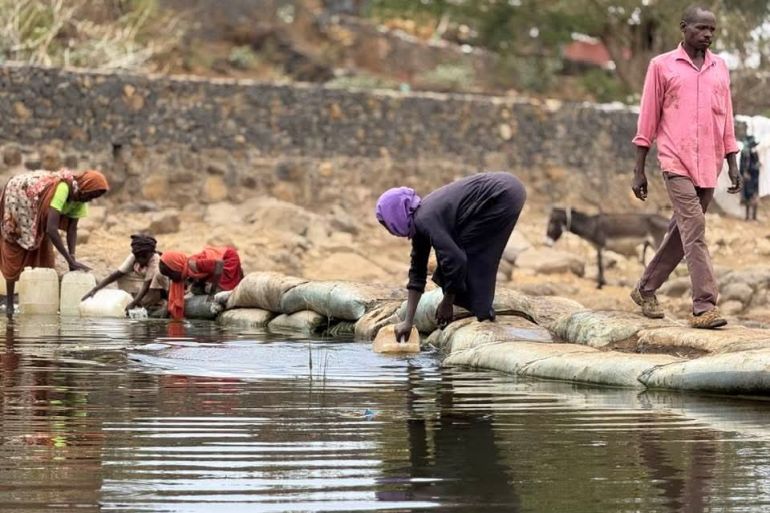
At the break of dawn, life begins to stir inside the unified displacement camp in El Obeid. Children carry empty plastic containers to the water point before the queues grow longer, while women wait patiently for their turn to receive food rations.
As the rainy season intensifies, fears are mounting over worsening shelter conditions, food shortages, unsafe drinking water, and the growing need for warm clothing and healthcare services.
These scenes have become part of daily life in El Obeid, which has received thousands of families fleeing the fighting in West and South Kordofan. As more displaced people continue to arrive, pressure on shelters, health facilities, and water sources continues to increase, while the city struggles to meet the basic needs of both residents and newcomers.
Daily Struggles
osman Al-Sharif), who was displaced from Al-Debeibat in South Kordofan State, arrived at the unified camp after a journey that lasted several days.
He told Mashaweer that his family had “lost almost everything.” Living in displacement shelters has brought growing daily demands for food and medicine at a time when most displaced families have exhausted their financial savings.
He added that the local authorities provide only limited assistance, which falls far short of meeting the daily needs of displaced people, particularly for food, clean drinking water, and healthcare.
“With the onset of the rains and the expectation of heavier rainfall,” he said, “everything is on the brink of disaster, especially since most shelters are made of burlap sacks, cloth, plastic sheets, and tents that have become worn out and torn by strong winds, some of which have been completely uprooted.”
Overcrowding and Multiple Crises
(Nawal Abbas), who fled from Al-Nuhud in West Kordofan State, told Mashaweer that displacement centers have become severely overcrowded due to the continuous arrival of displaced families from different towns and communities across the Kordofan region.
She noted a significant rise in cases of fever, malnutrition, malaria, waterborne diseases, and respiratory infections affecting both children and adults, in addition to the lack of adequate healthcare services.
She stressed that food supplies and medical assistance remain the most urgent needs, as many families have depleted their savings and can no longer afford meals for their children or purchase essential medicines.
Growing Pressure on Services
According to the International Organization for Migration (IOM), the number of displaced people in El Obeid, the capital of North Kordofan State, has reached approximately one million, placing enormous strain on public services.
Local trader Hamdan Saleh told Mashaweer that the flow of goods arriving through the Kosti road has declined in recent months, affecting both the availability and prices of essential commodities.
He explained that residents are facing increasing shortages of basic consumer goods alongside soaring prices.
“The suffering of displaced families has doubled because of food and medicine shortages and their inability to afford daily necessities,” he said.
Extremely Difficult Humanitarian Conditions
Al-Sirr Hassan Ahmed, a humanitarian worker in Kordofan, told Mashaweer that continued fighting along major roads has prevented aid from reaching those most in need.
“We are working under extremely difficult conditions due to insecurity on the roads and attacks by armed groups and criminal gangs targeting civilians,” he said.
He emphasized the urgent need to support displacement camps in El Obeid before the humanitarian situation deteriorates further.
Calls for Safe Humanitarian Corridors
As humanitarian conditions continue to worsen, calls have intensified for the establishment of safe humanitarian corridors that would allow civilians to leave conflict zones and reach safer areas while facilitating the delivery of food, medicine, and other essential relief supplies.
The “Ta’sis” Government called for the opening of safe corridors to enable civilians wishing to leave El Obeid to do so. It said it was prepared to coordinate with international and regional organizations to facilitate evacuations and humanitarian assistance, while accusing the Sudanese Armed Forces of preventing civilians from leaving the city.
The government also urged the international community to pressure all parties to the conflict to guarantee civilians’ freedom of movement and prevent the use of civilians as human shields or forcing them to remain in conflict areas.
Similarly, 21 Sudanese organizations and professional unions—including the Sudanese Journalists Syndicate and the Sudanese Teachers’ Committee—issued a joint appeal calling for the immediate opening of humanitarian corridors, unrestricted delivery of food and medical supplies, and protection for children, women, older persons, and the sick.
International humanitarian law expert Mohamed Al-Amin Osman stated that the Geneva Conventions and Additional Protocol I require all parties to an armed conflict to protect civilians and facilitate the delivery of humanitarian assistance.
He told Mashaweer that international humanitarian law prohibits using civilians as human shields or preventing them from leaving dangerous areas if they wish to do so. He also stressed that humanitarian aid should not be obstructed by military restrictions.