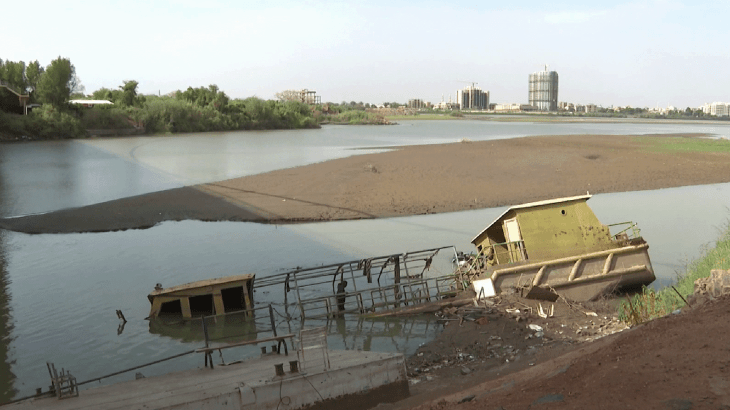
Sudan’s capital, Khartoum, is facing a severe and alarming drinking water crisis as declining water levels in the Nile coincide with the extensive destruction of water and electricity infrastructure caused by more than three years of conflict between the Sudanese Armed Forces (SAF) and the Rapid Support Forces (RSF). The damage has forced major water stations, including Al-Salha and Bahri North, out of service.
The crisis has exposed the scale of hardship facing residents, turning access to water into a matter of survival. Meanwhile, the Khartoum Water Corporation says it has taken emergency measures to address the shortage, including deploying equipment to clear the Nile channel supplying the pumping stations, expressing hope that water services to affected areas will resume soon.
Exploitation and Profiteering
Mohamed Gassim Al-Sayed, a resident of Al-Salha in southern Omdurman, told Mashaweer that the drop in the Nile’s water level has become unmistakable, with the river receding by dozens of meters from its banks.
“We have never witnessed such a dramatic decline before,” he said. “It has caused severe water shortages across several neighborhoods and villages in southern Omdurman, creating a genuine water crisis that has become a constant source of anxiety for residents.”
He added that affected communities have been left with no option but to purchase water from donkey carts, which transport it from groundwater wells, many of which are unsafe. “What is most unfortunate,” he said, “is that suppliers have taken advantage of the crisis by raising water prices to unprecedented levels, yet people have no choice but to buy it regardless of the cost.”
Al-Sayed noted that the crisis has persisted for an extended period despite repeated promises of a solution, attributing it to an unprecedented decline in Nile water levels—particularly in the Blue Nile. The recession, he explained, extends from Khartoum to River Nile and Northern states, leading to the emergence of sandbanks within the river.
Daily Search for Water
Mayada Abdel Fattah, a homemaker living in Al-Droshab in Bahri, said each day begins with an exhausting search for water.
“The water crisis in Bahri has become a struggle for survival,” she said. “It is compounded by electricity outages that prevent household water pumps from operating, as well as fuel shortages.”
She explained that residents wait for water tankers sent by charitable groups, but demand often far exceeds supply. At the same time, water sold by donkey carts has become increasingly expensive, while bottled water prices in local shops have also risen sharply.
“These additional costs are beyond the means of families already exhausted by war, displacement, and refuge,” she said, adding that many residents have begun considering digging community wells to ease the crisis.
Alternative Solutions
Ahmed Abdel Jabbar, a resident of Al-Jaili north of Bahri, warned that the worsening shortage has heightened fears of waterborne diseases as many households rely on untreated water sources due to the near-total disruption of Nile water supplies.
He said most families now disinfect water before drinking it, but boiling is often too expensive because of the high cost of cooking gas, charcoal, and firewood. As a result, many have turned to solar disinfection, placing water in direct sunlight as a low-cost alternative, taking advantage of the region’s high temperatures.
Abdel Jabbar added that the crisis has prompted some residents who recently returned from displacement in neighboring countries to consider leaving again until water and other basic services are restored.
“It has become clear,” he said, “that the state is currently unable to resolve these crises while its attention remains focused on the ongoing conflict.”
Extensive Damage
A senior engineer at the Khartoum State Water Corporation, who requested anonymity, told Mashaweer that Sudan has been facing exceptional and unprecedented circumstances since the beginning of the year.
“The decline in the Nile’s water level has coincided with extensive war-related damage to the infrastructure of major water stations,” he said.
He explained that technical teams are fully aware of residents’ suffering and are working around the clock to implement emergency measures, including extending additional intake pipelines further into the river and operating alternative groundwater wells.
The engineer stressed that restoring stable water supplies ultimately depends on protecting water facilities from repeated attacks and ensuring a consistent supply of electricity and water treatment materials.