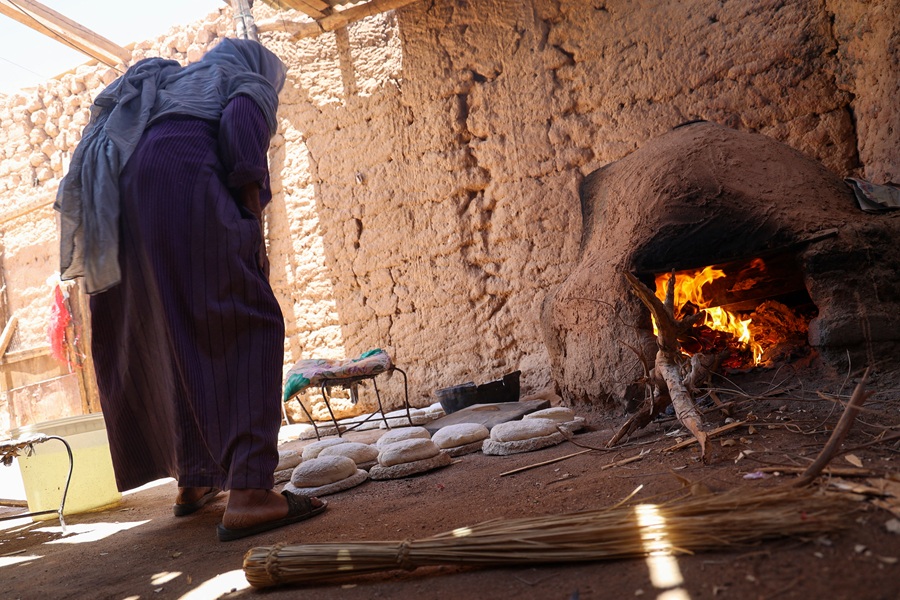
More than three years into the war between the Sudanese Armed Forces and the Rapid Support Forces (RSF), the conflict continues to undermine livelihoods across Sudan. Faced with prolonged electricity outages and soaring gas prices, many bakery owners have reverted to using firewood to fuel their ovens, replacing modern baking systems with traditional methods. While this shift has enabled some bakeries to continue operating, it has intensified pressure on Sudan’s forests and accelerated the loss of the country’s already depleted tree cover.
The crisis has reached into the daily lives of ordinary citizens struggling to access bread, highlighting the profound social and economic transformations brought about by the conflict. Dozens of bakeries across Khartoum have either closed or suspended operations, while those that remain open increasingly rely on firewood—the only fuel currently available. At the same time, bakery owners continue to face mounting production costs driven by rising prices for essential inputs.
Observers warn that the growing dependence on firewood is placing additional strain on Sudan’s forests at a time when the government has been unable to resolve the country’s energy crisis. They stress the need for strict measures to curb illegal logging and protect the remaining forest cover.
A Heavy Price
Maisara Fath Al-Rahman, a bakery owner in the Al-Fetihab district of Omdurman, said that keeping bakeries operating has become increasingly difficult because of soaring operating costs.
“The electricity crisis, the shortage of fuel for generators, and the relentless increase in gas prices have forced many bakery owners to shut down completely,” he said. “Others have chosen to continue by returning to methods used decades ago and firing their ovens with wood.”
He explained that before gas and electricity became widely available, bakeries traditionally relied on firewood supplied mainly from Darfur and Kordofan. The transition to gas- and electricity-powered ovens had significantly improved the stability of bread production. However, the outbreak of war devastated the electricity infrastructure and damaged the Al-Jaili refinery, creating severe shortages of both electricity and cooking gas.
Fath Al-Rahman noted that the conflict has created harsh realities for bakery owners. Although firewood is now virtually the only available fuel, public opinion remains divided over bread baked with wood-fired ovens. Some consumers believe it produces higher-quality bread despite the slower baking process, while others simply prioritize the availability of bread regardless of the fuel used.
Bread as a Lifeline
Asim Mahmoud, who has worked in a bakery in the Al-Azhari area of southern Khartoum for more than 25 years, described bread as “the lifeline of society.”
“Bakery work is a profession that cannot disappear, no matter how severe the challenges become,” he said. “Bread is an essential food that sustains life. Whenever options become limited, bakery owners find ways to keep production going.”
Mahmoud explained that despite previous economic crises, bread production had never completely stopped until the current war caused the collapse of the country’s energy sector. Following widespread displacement and the gradual return of residents, bakeries continue to struggle with persistent electricity outages and gas shortages, forcing many operators to rely on firewood.
He added that before the war, bakeries produced enough bread to meet public demand. Today, many struggle to maintain an average daily output of around 2,000 loaves, with production often declining further because of power cuts and limited supplies, requiring bakeries to ration bread among customers.
According to Mahmoud, the crisis extends far beyond rising gas and flour prices. Reduced production capacity, combined with growing demand as people return to their communities, has increased pressure on forests as more firewood is consumed.
Environmental Risks
Community activist Ayoub Abdel Latif warned that the widespread use of firewood for bread production is exacerbating environmental degradation.
“The growing dependence on wood fuel encourages indiscriminate tree cutting by both traders and local residents seeking alternative energy sources,” he said.
He added that displacement caused by the war has altered livelihoods across Sudan and contributed to the loss of approximately 250,000 hectares of forest, as increasing numbers of people harvest wood and produce charcoal either for fuel or as a source of income. Weak enforcement of forest protection laws across large parts of the country has further accelerated deforestation.
Abdel Latif emphasized that unless viable energy alternatives are introduced and stronger measures are taken to prevent illegal logging, Sudan’s remaining vegetation will continue to face serious threats. He suggested subsidizing fuel prices as one practical solution to reduce pressure on forests.
Challenges and Ongoing Efforts
Issam Akasha, spokesperson for the Sudanese Bakers’ Union, said that the return to firewood was not a preferred option but rather a consequence of the ongoing conflict.
“Firewood cannot fully replace electricity,” he explained. “Essential equipment such as dough mixers and production lines still depends on electricity, while firewood is used only to heat the ovens.”
He noted that continuous power outages, coupled with sharp increases in gas prices, have forced bakery owners to adopt traditional baking methods in order to maintain bread production for millions of Sudanese who rely on it as a staple food.
Akasha said production costs have risen dramatically. Although firewood remains less expensive than gas, its price has increased sharply, with a quintal of firewood rising from SDG 16,000 (about USD 2.70) to SDG 45,000 (about USD 7.50) within a short period. During the same period, the price of yeast climbed to around SDG 170,000 (USD 28.30), while other production inputs also experienced repeated price increases.
He added that the price of cooking gas has reached approximately SDG 100,000 (USD 16.70) per cylinder, placing an even greater financial burden on bakery owners already struggling to sustain their businesses.
Akasha concluded that unless lasting solutions are found to address Sudan’s electricity shortages, fuel scarcity, and escalating gas prices, the continued reliance on firewood—particularly among economically vulnerable communities—will remain a major threat to the country’s forests. Nevertheless, he noted that both government institutions and community groups are undertaking initiatives to restore green spaces and rehabilitate degraded forests.