Since war broke out in Sudan between the army and the Rapid Support Forces (RSF) in mid-April 2023, thousands of young men and women have faced a bleak reality and painful circumstances after obtaining university degrees in various academic disciplines. They had looked forward to better lives and promising futures, but the war has shattered their dreams and turned their degrees into worthless pieces of paper, amid the near-total collapse of the country’s economic infrastructure.
More than 90 percent of factories and institutions in the capital, Khartoum, and other states affected by the conflict have been impacted, resulting in the loss of thousands of jobs that once provided employment opportunities for graduates.
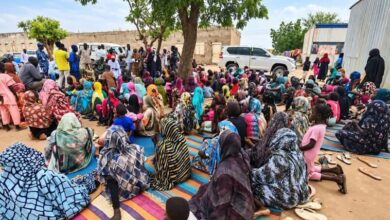
As the war expanded to Sudan’s five Darfur states, several areas—particularly North Darfur—were transformed into camps for victims of the conflict. University graduates found themselves stranded there, waiting for humanitarian assistance.
The Nightmare of Unemployment
Salah Ishaq, 32, who holds a bachelor’s degree in health sciences and lives in Tawila camp in North Darfur, said that when the city of El Fasher, his hometown, came under bombardment and the RSF took control of it in late October 2025, as the army’s last stronghold in the region, the situation of civilians deteriorated dramatically.
“Civilians were caught in bombardment from all directions. They were subjected to heavy gunfire and their homes were burned. The main concern was to flee in search of a safe place. Yet, amid all these developments, I did not forget to carry my university degree, on which my future depended,” he said.
Ishaq added, “Although I was stopped and searched at RSF checkpoints, they did not find my university certificate, which I had carefully folded until it became a small bundle of paper. I knew that if they found it, it might not survive their violence and could be torn apart, especially because my professional future depended on it.”
“But after I was displaced and came to live in Tawila camp in North Darfur, I never expected that my degree would become worthless—nothing more than ink on paper. I do not know when this nightmare will end. The prolonged conflict and its expansion across the country have destroyed the dreams of young people,” he said.
The displaced graduate noted that “this painful reality does not affect me alone. It applies to thousands of graduates lost in displacement and refugee camps who believed that escaping death would save them. They now face the dilemma of unemployment as a result of the complete collapse of the country’s economic infrastructure.”
A Fading Memory
Mohamed Al-Fekki, a graduate of the Faculty of Agriculture, said, “My grandparents’ profession was farming in large agricultural schemes, and this inspired me to study agriculture. I eventually graduated as an agricultural engineer, intending to put what I had learned into practice in agricultural projects and contribute to addressing the food gap in Darfur.”
Al-Fekki explained that “the expansion of the war into Darfur destroyed everything in its path, as well as my ambitions. Today, I live on international aid and wait for a single meal that barely keeps hunger at bay. It is painful that my university degree has become nothing more than a fading memory, despite all the effort I put into earning it and becoming a source of pride and support for my family.”
The agricultural engineer said the war had forced graduates with highly specialized academic qualifications to take up informal and menial jobs, including carrying goods and selling water using animal-drawn carts, among other work they could find to earn a living.
Dreams and Displacement
Ruqayya Abakar, a veterinary medicine graduate who is now a refugee in camps in eastern Chad, said that Nyala, the capital of South Darfur, is known for its livestock wealth and grazing areas, which encouraged her to study veterinary medicine.
“I believed my degree would give me an opportunity to work, whether in government veterinary units or in pastoral areas where veterinarians once went to gain practical experience, treat animals and assist herders and livestock owners,” she said.
“However, the war stood in my way. I have been forced into displacement and homelessness in refugee camps in eastern Chad, living in severe hardship after doors closed in my face. Carrying a university degree has become meaningless, even in Khartoum, following the destruction of veterinary laboratories,” she added.
Abakar said the most painful aspect was that the war had deprived young graduates of the opportunity to use their skills and energy.
“A large proportion of them now live in refugee camps, and most work in jobs unrelated to their fields of specialization. Nevertheless, these jobs help them, to some extent, support their families,” she said.
She added, “At the beginning of every new day, I wake up hoping that life will return to normal and that I will be able to practice veterinary medicine, after I managed to protect my graduation certificate from being burned during the attacks on Darfur states and the displacement of their people.”
The refugee graduate noted that university degree holders had become among the foremost victims of the catastrophe. Many are trying, through their knowledge and skills, to contribute to educating children, developing and implementing ideas through initiatives in the camps, and managing community kitchens.
“Among them are teachers, doctors and engineers who possess the ideas and human capital needed to support projects and make them successful, while others have simply surrendered to unemployment,” she said.
Victims of War
Meanwhile, Adam Rijal, spokesperson for the General Coordination for Displaced Persons and Refugees in Darfur, said thousands of young displaced men and women were living in Tawila camps in Darfur and eastern Chad under extremely difficult conditions after the conflict destroyed their prospects for the future.
“Displacement has spared no one. It has affected even highly qualified professionals and contributed to the migration of skilled workers and educated personnel, dramatically transforming their lives and leaving many dependent on international aid convoys,” Rijal said.
He pointed out that one of the most dangerous consequences of the war was “the depletion of Darfur’s human resources and the prolongation of their suffering, particularly because the continuation of this situation will deprive the region of its future leaders and increase its dependence on humanitarian assistance.”
“In my view, the international community and humanitarian organizations must pay particular attention to young people, especially university graduates, and establish urgent intervention programs aimed at stemming the loss of skilled professionals and rehabilitating young people so they can become part of the solution rather than victims of the war,” he said.
The spokesperson for the Coordination for Displaced Persons and Refugees continued: “Tawila camp in North Darfur has effectively become a refuge for victims of the war following the arrival of thousands of young people fleeing the fighting in El Fasher and the Zamzam and Abu Shouk camps, where hunger is consuming their frail bodies and unemployment is destroying their dreams.”