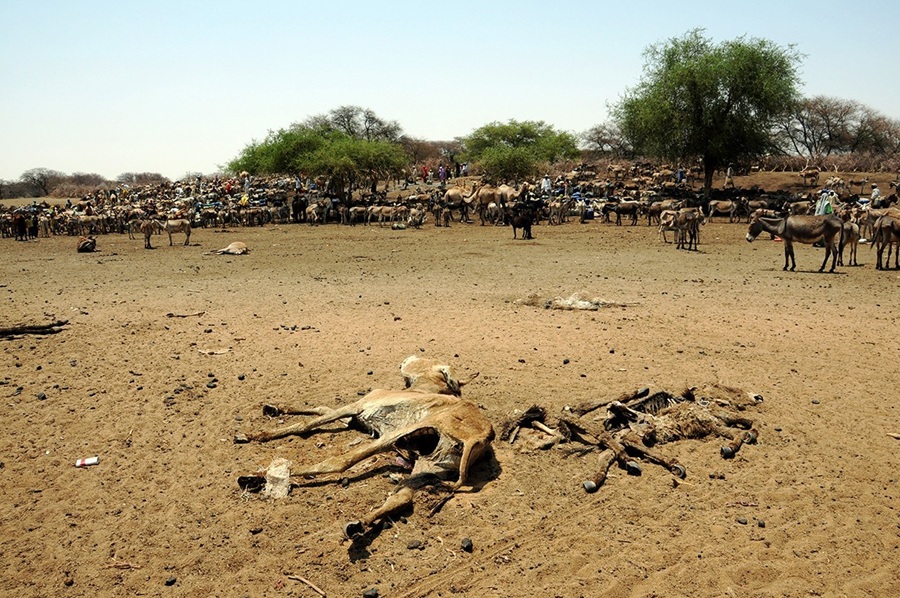
Sudan’s livestock sector is facing mounting challenges following the deaths of large numbers of animals in areas historically known for producing various types of livestock, particularly in the five states of the Darfur region. The losses have been attributed to delayed rainfall, which has resulted in a severe shortage of pasture and water sources. At the same time, livestock owners and traders are reporting deteriorating animal health and declining livestock prices.
Sudan is one of the richest Arab and African countries in terms of livestock resources, with an estimated 103 million head of livestock, including 30 million cattle, 37 million sheep, 33 million goats, and 3 million camels. Around 26 million Sudanese people are estimated to benefit from the livestock sector.
Amid the crisis, the Jabal Issa Emergency Response Room in Al-Malihah Locality, North Darfur, reported the deaths of 420 sheep, attributing the losses to drought conditions in the area. It warned that losses could worsen given the broader impact on livestock across the region.
The World Food Programme had previously pointed to drought as one of the most significant threats facing livestock in Darfur, noting that the region is experiencing unusually dry conditions despite the current period normally being part of the rainy season.
Concerns and Losses
Mohamed Imran, a livestock owner in North Darfur, said that “concerns are growing among traders and livestock owners in several areas of Darfur, particularly in the north, over the death of their animals and the losses they are suffering as a result of limited rainfall.”
He explained that the lack of rain has created major problems, including the disappearance of natural grazing areas and the depletion of water sources, resulting in deteriorating animal health and the deaths of hundreds of livestock, particularly sheep.
Imran added that “the majority of the population depends heavily on livestock breeding and trade for their livelihoods, while these resources are now threatened with extinction. This has forced people either to sell their animals at low prices in an attempt to reduce their losses or to travel long distances in search of pasture and water.”
However, he noted that such movements are increasingly dangerous because armed robbery gangs operate along the roads, making seasonal migration extremely difficult.
The livestock owner said the challenges facing Darfur’s livestock sector began with the outbreak of the conflict between the army and the Rapid Support Forces, as military operations contributed to the burning and contamination of grazing areas. Today, climate change has added another layer of difficulty, leaving families and traders constantly searching for alternative solutions.
Declining Prices
Meanwhile, Adam Al-Toum, a trader at the Tawila market in North Darfur, explained that “the shortage of rainfall and pasture has also affected livestock markets. Traders travel long distances and remain constantly on the move in search of markets where they can sell their animals, only to encounter falling prices because of increased supply.”
Al-Toum said drought is one of the main reasons livestock owners and traders are rushing to sell their herds out of necessity. Concerns are also growing that prices could fall further as the animals’ health deteriorates, potentially leaving them with little market value.
He added that the developments threatening Sudan’s livestock wealth have become a source of concern for everyone involved in livestock breeding, particularly families facing the difficult humanitarian situation in Darfur. Many have been forced to move in an effort to prevent their living conditions from deteriorating further, but road gangs pose a serious threat, with some people paying with their lives to protect their livestock.
The trader stressed the need for urgent intervention by humanitarian organizations to prevent further material and human losses. Efforts to find water sources and green pastures have largely failed, leaving livestock more vulnerable to diseases that have spread across Darfur, a major livestock-producing region, while the war has also disrupted access to vaccines.
Measures and Solutions
Meanwhile, Fadlallah Bakheit, a herder in Al-Salam Locality, North Darfur, said the region is facing an almost complete collapse of its livestock sector.
He explained that livestock had previously been threatened by diseases during the rainy season because of difficulties in delivering vaccines. “Unfortunately, the situation is now different, as livestock are facing death because of drought in grazing areas,” he said.
Bakheit said the livestock deaths in Darfur reflect the broader impact of the war on a sector that provides a major source of livelihood for thousands of people in the region. The movement of livestock herds across borders in search of safety and more favorable environments has also been disrupted.
“Livestock owners are currently looking for measures to address the crisis,” he said. “Owners of larger herds are purchasing animal feed despite its high prices, while transporting water from distant locations by tanker trucks to grazing areas to protect the health of their animals and prevent deaths. Others, however, are unable to meet the basic requirements needed to keep their livestock safe.”
The herder added: “In my view, Sudan’s livestock sector in general, and Darfur’s in particular, needs protection and urgent government intervention by the relevant authorities so that the country does not lose one of the pillars of its national economy.”
Economic Impact
Economic researcher Abdelwahab Juma said that the livestock sector in areas historically known for livestock production, such as Darfur, has been severely affected by the fighting, negatively impacting local communities and commercial activity. The consequences have also extended to Sudan’s export infrastructure as roads have been disrupted and commercial movement restricted.
Juma said climate change has also played a major role in the loss of livestock, as animals have died amid drought caused by delayed rainfall. Livestock owners, residents, and investors have consequently found themselves facing a shortage of pasture and water.
He continued: “Sudan was considered one of the leading Arab and African countries in terms of livestock wealth, with more than 103 million head of different types of livestock distributed across all states. This wealth had long supported the local economy with billions of dollars, serving as a source of foreign currency through livestock exports, before the country’s long-running conflict severely weakened the sector.”
The economic researcher acknowledged that the combined effects of war and drought have been substantial, but said the damage could be mitigated through community initiatives and solidarity, particularly as those directly involved are seeking ways to preserve the health of their animals, protect what remains of their livestock, and restore their livelihoods.
He concluded by emphasizing the importance of local and international organizations and their role in helping the livestock sector recover by implementing disease-control campaigns, providing food and water, and addressing the complex challenges accelerating the loss of one of Sudan’s strategically important economic resources.