Theatre Confronts the Effects of War: An Experience Supporting Children in South Khartoum
Doha – Mashawir: Magdi Ali
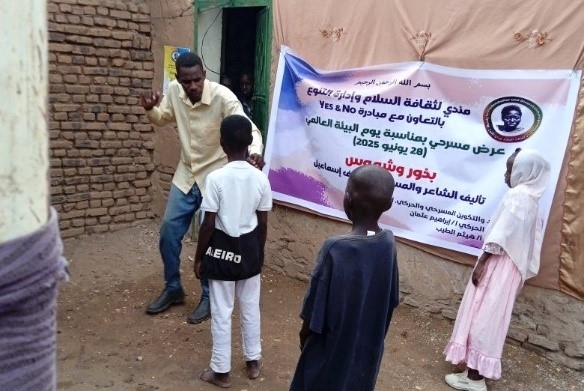
Theatre critic, trainer, and journalist Haitham Ahmed Al-Tayeb continues to lead and supervise the project “Theatre as Therapy for Children in Wartime,” which was launched in June 2024 at Al-Kader Educational School in South Al-Hizam, Jabal Awliya Locality. The project aims to use interactive theatre and performing arts to address the psychological and social effects of war on children and to restore their imagination and ability to express themselves.
The project is being implemented in cooperation with actor and director Ibrahim Osman, through a partnership between Mandi Organization for Peace Culture and Diversity Management and the Yes & No Initiative, alongside the “Green Education” project, which focuses on maintaining the school and supporting the educational process.
The experience includes workshops in drawing, public speaking, children’s literature writing, self-expression, communication skills, and a Children’s Parliament, in addition to a school library. It also links theatrical activities with education and psychosocial support. Texts by poet and playwright Afif Ismail and novelist Abdel Ghani Karamallah have been adapted into interactive performances in which children participate, while other performances have been developed from the children’s own ideas, including “The Broken Qarraz,” which originated from an idea proposed by a young girl.
The roots of the experience go back to the project “With Al-Shirinq, We Create Interactive Theatre in Darfur,” launched by Al-Tayeb and Ibrahim Osman in 2023. The project ran from January to mid-March, moving between different areas and states of Darfur and establishing an approach based on interactive theatre, teamwork, and community participation.
After the experience was transferred to South Al-Hizam, it continued for more than two years, integrating theatre with education and addressing the effects of interrupted schooling, while involving families and the local community in activities and performances.
Al-Tayeb told Mashawir that the project enabled children to present performances based on their own language, movements, and everyday experiences, despite the pain of recalling their war experiences, which remain strongly present in their memories. He said the project helped strengthen social interaction and provided a safe space for children to express their emotions and experiences, enhancing their sense of belonging and psychological security.
He noted that integrating theatre with educational initiatives contributed to improving academic performance. Most of the participating children successfully completed their primary school certificate examinations. The project also helped teachers develop educational tools based on theatrical play and interactive activities, making the learning process more lively and engaging.
Al-Tayeb is working to document and develop the experience as a Sudanese practice of theatre in wartime, focusing on stimulating children’s imagination and providing them with opportunities to freely express their everyday experiences. He hopes the experience will serve as a model that can be adapted in other schools and communities affected by conflict, and encourage the integration of therapeutic arts into educational curricula to support children affected by conflict.