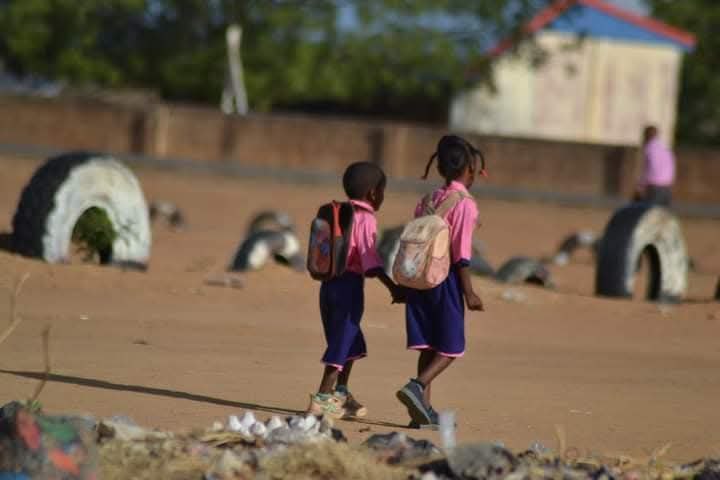
For two and a half years, children living in areas affected by armed conflict in Sudan have been exposed to deprivation of education, killing, sexual violence, loss of family members, and in some cases, forced recruitment as fighters on active frontlines. In these regions, education has shifted from being a right to becoming a distant dream.
As a result, the academic future of pupils and students hangs by a thread. They write their dreams on the walls of displacement centers as they wait for security and normal life to return.
An Uncertain Future
Huwaida Al-Sharif, a basic school student, told Mashawir that “the war has suspended studies for both basic and secondary levels in the city of Al-Nuhud in West Kordofan State for more than eight months. The situation became even worse after the forced displacement of the city’s residents by the Rapid Support Forces, leaving the fate of thousands of pupils and students unknown.”
She added, “Certainly, the long interruption of schooling due to the prolonged armed conflict has killed my desire to continue my education. I have been stuck in Grade 7 for nearly a year and a half, which has made me seriously consider dropping out completely, as I do not want to waste more time.”
Al-Sharif explained that her family’s financial situation prevents her from enrolling in schools in safer areas of Sudan, so she will be forced to enter the labor market to help provide for her family.
The Spread of Illiteracy
In this context, Al-Sadiq Mahjoub, a member of the Sudanese Teachers’ Committee, believes that “education in active conflict zones is going through the worst crisis in its history, affecting all aspects of the educational process. Thousands of students at the basic and secondary levels have been kept away from classrooms for more than two years, a reality that casts a long shadow over them and contributes to their regression into illiteracy.”
Speaking to Mashawir, he pointed out that “the crisis of accumulated student cohorts has affected more than two million students, along with the impact of prolonged absence from school, which leads to increasing dropout rates as long as education remains suspended.”
Mahjoub noted that despite the difficult humanitarian conditions faced by displaced families fleeing the horrors of war, the solution lies in opening emergency schools in shelters and temporary tents to ensure children receive education.
He suggested that displaced teachers from various specialties should supervise the learning process, and that school days be divided evenly between boys and girls.
Rising Dropout Cases
Educational expert Ali Salem added that “school dropout rates have risen at an unprecedented level in areas affected by armed conflict, especially in the states of Kordofan, Darfur, and Blue Nile. With the educational process halted for more than two years, hundreds of children have turned to working in markets and mining areas.”
He warned, in his statements to Mashawir, of “academic and psychological risks resulting from prolonged interruption of schooling due to the ongoing war. Children working in the streets until late hours may acquire behaviors inappropriate for their age, and some may resort to drug use, while others face sexual and verbal harassment.”
Salem stressed that addressing school dropout among children in Sudan’s conflict areas requires designing both short- and long-term programs based on gradual community awareness, until all residents of these regions are fully convinced that education is indispensable. This, he said, would secure children’s futures and enable them to lead healthy and stable lives.
UN Warnings
According to UNICEF reports, the ongoing conflict in Sudan has displaced 3.5 million children who are now without shelter, many of them having lost their families due to a war that has created the world’s worst crisis for children. UNICEF confirmed that roughly 24 million Sudanese children remain at risk due to the vast and catastrophic humanitarian crisis.
Lucia Elmi, UNICEF’s Director of Emergency Programs, stated that “more than 16 million children in Sudan are in urgent need of assistance, and girls face severe risks including sexual violence, trafficking, and forced marriage. Urgent action is needed to protect children.”