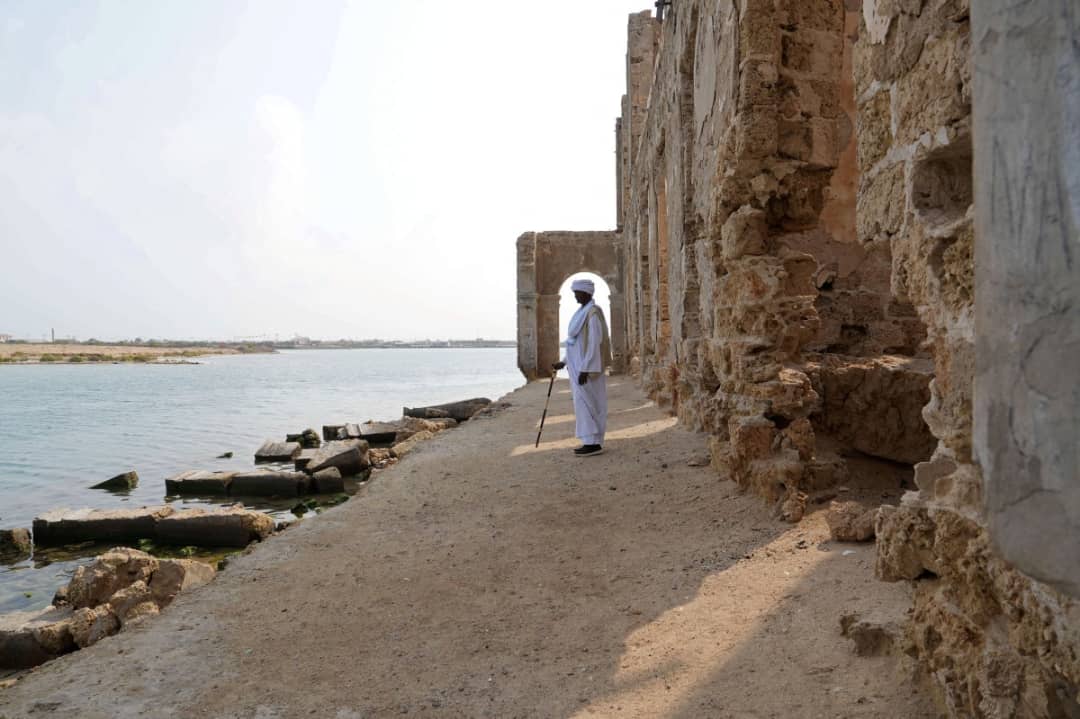
The mayor of Suakin dreams of reviving the heritage of his city, which houses an ancient port on the Red Sea. Though it has survived the various wars witnessed by Sudan, the city has largely fallen into ruins due to the passage of time.
Speaking of a past dating back to the era of King Solomon, Abu Mohammed al-Amin Artiga, leader of the Artiga tribe, part of the Beja ethnic group in eastern Sudan, says: “Suakin is a very ancient city, dating back more than 3,000 years. It was once called ‘The White City’ because of its unique buildings made of coral stone extracted from the seabed.” He adds, “This is a great treasure for Sudan.”
As the war that broke out nearly three years ago between the Sudan Armed Forces (SAF) and the Rapid Support Forces (RSF) continues, stagnation has taken hold of the once-thriving port that used to bustle with tourists.
However, amidst the ruins, a team of workers is busy restoring a mosque that houses the shrine of a Sufi sheikh. This project is funded by the British Council and supported by UNESCO.
“Before the war, many people and many tourists used to come,” says Ahmed Bushra, an engineer with the Association for the Protection of Sudan’s Living Heritage from Conflict and Climate Change. “We hope that in the future, when peace prevails in Sudan, they will come and enjoy our beautiful historical buildings here.”
Architecture student Doha Abdel Aziz Mohammed, 23, is participating in the restoration of the mosque. “When I arrived, the architecture amazed me,” she says, explaining that the builders “used techniques that are no longer in use today.”
Left Behind
The old port, located on an oval-shaped island, served as a transit point for caravans of traders and Muslim and Christian pilgrims traveling to Mecca and Jerusalem. It was also a hub for regional trade, according to the Rome-based International Centre for the Study of the Preservation and Restoration of Cultural Property.
During Ottoman rule, it became a vital commercial crossroads, according to Artiga, 55, who notes an urban boom the city experienced at the time, when its population reached 25,000. He adds, “The streets were so crowded; our ancestors used to say it was difficult even to walk through them.”
Everything changed in 1905 when the British built a deeper commercial port 60 kilometers to the north (Port Sudan) to accommodate the increasing maritime traffic following the opening of the Suez Canal.
At that time, “merchants and citizens moved to Port Sudan for education and money,” according to the mayor of Suakin. He adds that his grandfather, the leader of the Artiga tribe which has managed Suakin since the 6th century, “stuck to the city and refused to leave,” passing authority down from father to son.
As evidence of the Artiga tribe’s influence, he keeps in his home what he says are swords and military uniforms gifted by Queen Victoria to his ancestors during the British colonial period.
The rise of Port Sudan proved disastrous for Suakin. Its grand public buildings and elegant homes crumbled over time, eroded by the sea air and the summer heat.
Nevertheless, the 1990s brought new hope to the residents with the opening of a new passenger port linking Suakin to Jeddah in Saudi Arabia. Today, the Sudanese transport company “Tarco” operates daily flights, carrying about 200 passengers per trip from the new Suakin port.
Turkish Lease
In 2017, optimism spread among residents when former President Omar al-Bashir granted the old port to his Turkish counterpart, Recep Tayyip Erdoğan, under a 99-year lease for tourism development. However, the project was met with condemnation and fears of a military presence on a strategic waterfront.
In response to these concerns, Ankara denied any intention of establishing a military base, asserting that it wanted to encourage pilgrimage trips and boost tourism. Subsequently, a Turkish company restored the old governor’s palace, the customs building, and two mosques. However, the project stalled in 2019 following the ousting of Bashir in the face of mass protests.
With the outbreak of war between the army and the RSF in April 2023, cruise ship passengers and divers vanished from Suakin entirely. All that remains is a rust-covered cargo ship and a few fishing boats.
Yet, Ahmed Bushra remains optimistic. He hopes the mosque will host a traditional music festival once the restoration is complete “within five months.” He says, “When we finish the restoration work, tourists will be able to come.”