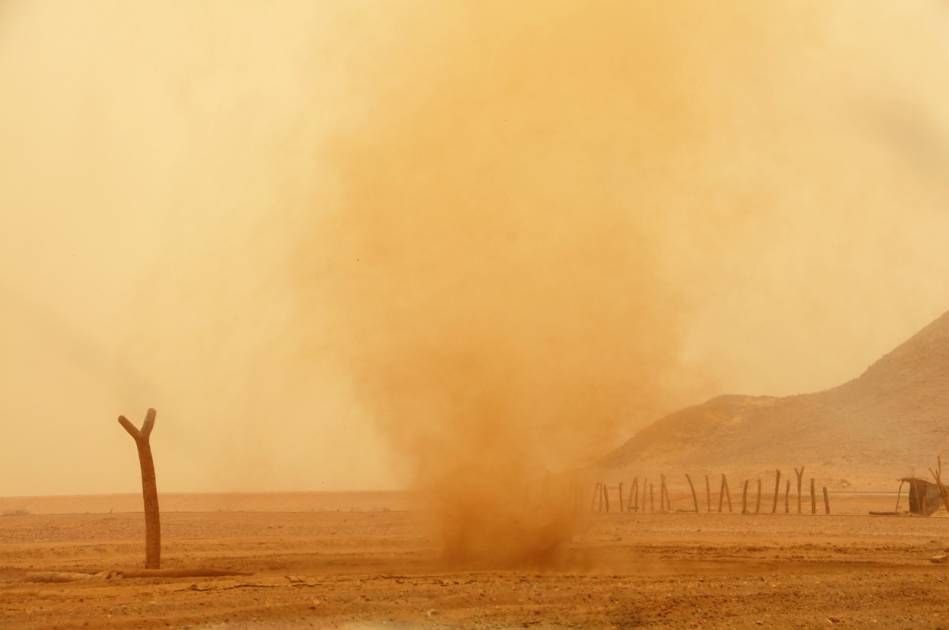
Amid the transitional period between summer and winter, the activity of northern winds in Sudan intensifies, causing dust storms—locally known as haboob. With them come renewed concerns about the climatic and environmental impacts associated with sharp weather fluctuations.
While observers note that this phenomenon is natural and occurs annually, its increasing consequences on soil, the environment, and public health—along with fires affecting homes, forests, and farms—are raising alarms. It also exacerbates drought and desertification, particularly in northern and central regions, and is more intense in desert areas where it transports into agricultural zones. This raises questions about adaptation and mitigation, which depend largely on community awareness and effective environmental policies to reduce human and land losses.
Thermal Inversion
Meteorologist Mohamed Saif El-Din explains that the activity of northern winds leads to the haboob phenomenon, a natural occurrence during the transition from winter to summer. It is often accompanied by rising or falling temperatures or scattered rainfall, usually preceded by dust storms that can develop into extreme weather events.
He adds that scientifically, the phenomenon is linked to the sun’s alignment over the equator, which raises temperatures and deepens the Sudan thermal low-pressure system. This draws in cooler northern winds from mid-latitude regions around the Mediterranean and Europe. Air naturally moves from high-pressure (cooler) regions to low-pressure (hotter) regions, intensifying wind
He continues that this results in a strong cold air mass displacing a hot air mass, leading to a thermal inversion where warm air rises and cooler air settles below. This contributes to heavy dust lifting, which can escalate into widespread dust or sandstorms depending on intensity.
Saif El-Din advises citizens to follow meteorological reports, especially those traveling on highways during unstable conditions, as visibility may drop significantly, increasing the risk of traffic accidents.
He also warns that chronic health conditions such as asthma and respiratory allergies worsen during dust storms. Therefore, people should stay indoors as much as possible and only go out when necessary, taking precautions like wearing medical masks, as such extreme weather events cannot be controlled.
Concerns and Challenges
Environmental specialist Bushra Hamid describes the haboob as a violent dust phenomenon that poses major concerns for Sudanese people, as it carries massive amounts of dust and sand. Along its path, it uproots large portions of soil, particularly fertile topsoil in agricultural areas, and transports from deserts into sensitive ecosystems.
She highlights major challenges, including severe soil degradation and desert encroachment in Northern State, Kordofan, and Darfur. It also significantly damages moist agricultural soils and grazing lands, creating complex economic and environmental impacts. Since about 70% of the population on these activities, their livelihoods are directly affected.
She adds that the phenomenon coincides with seasonal irregularities and climate unpredictability in Sudan, posing challenges that require sustainable solutions—such as planting shelterbelts (tree belts).
Hamid notes that Sudan is part of the Great Green Wall Initiative, which aims to produce large quantities of seedlings and restore vast areas of land. She emphasizes the importance of benefiting from this initiative, alongside local efforts to rehabilitate grazing lands, and adopting modern techniques for establishing tree belts.
She further stresses the importance of water harvesting, as rainfall is a critical resource in arid areas and is often wasted if not properly utilized. She also calls for improved early warning systems and weather forecasting.
Community Awareness
Environmental researcher Jalal Yassin states that the country is currently experiencing cold dust storms that are alarming environmental indicators causing significant damage. These storms typically occur between February and May, particularly affecting northern and central Sudan.
They contribute to the destruction of agricultural land, crop loss, increased drought and desertification, soil erosion, and the formation of sand dunes. They also directly cause fires in homes and forests.
Yassin adds that these storms can spread from northern and central regions to other areas, negatively impacting agricultural production and stressing plants, especially during critical growth and reproduction periods.
He concludes that Sudan faces a combination of environmental challenges—including floods during the rainy season, extreme heat in summer, haboob storms during transitional seasons, and cold winds in open areas. Addressing these requires recognizing them as interconnected issues tied to environmental sustainability and livelihoods. Reducing their impact depends heavily on community awareness and effective resource management policies to minimize severe losses to both people and land.