By: Muhannad Murshid
Khartoum, August 10, 2025 – (Jabraka News)
Since the outbreak of war in Sudan in mid-April 2023 between the army and the Rapid Support Forces (RSF), museums, archaeological sites, and cultural institutions in the capital, Khartoum, have suffered devastating damage. Most of them were located in areas that witnessed the fiercest battles, leaving them vulnerable to direct shelling and acts of destruction that continued for nearly two years. Widespread looting and systematic vandalism, apparently intended to erase the nation’s history, were also reported.
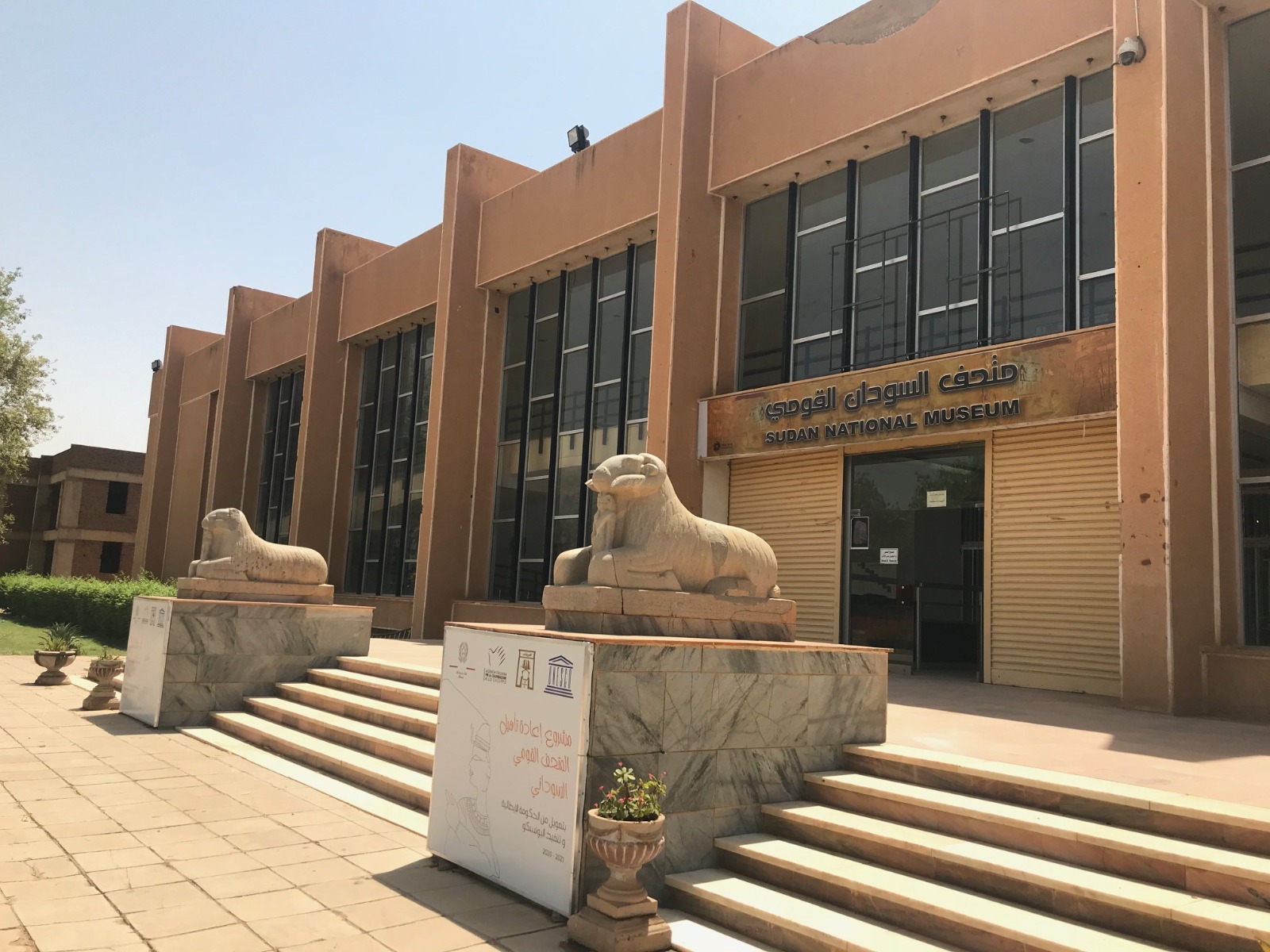
The Sudan National Museum — the country’s most important museum and the guardian of its heritage — was among the hardest hit. Located at the confluence of the Blue and White Nile on Nile Street in central Khartoum, the museum has long represented Sudan’s cultural soul. It houses artifacts spanning the entirety of Sudanese civilization, from prehistory through the Stone Ages, Nubian and Christian periods, and into the Islamic era. Its collection included thousands of invaluable items such as statues, pottery, stone tools, and gold pieces dating back thousands of years.
Systematic Looting and Efforts for Recovery
Ghalia Jar Al-Nabi, acting director of the Sudan National Museum, told Jabraka News that the RSF systematically targeted Sudanese museums to erase the country’s history. She explained that the museum held more than 100,000 artifacts, with over 60% looted — including gold, pottery, metalwork, and jewelry belonging to the kings and queens of Napata — while much of the remainder was damaged, including documentation records.
She noted that Sudan’s looted treasures have been smuggled out of the country to regional and international markets: “Most of these items will likely be sold for meager sums compared to their historical and cultural value, making their recovery nearly impossible in the absence of detailed documentation.”
Jar Al-Nabi stressed that these assaults on Sudan’s cultural heritage represent a grave threat to the nation’s identity and memory: the stolen objects are not mere material possessions but embody the collective history and cultural identity of the Sudanese people.
She revealed that an international team of Sudanese and foreign archaeologists, in collaboration with UNESCO and Interpol, has begun working to recover thousands of stolen artifacts, emphasizing the need for coordinated global efforts to restore and preserve what remains.
Other museums also suffered. Omdurman’s Khalifa House Museum — chronicling the Mahdist State — was looted, including rare manuscripts, coins, and personal belongings of key Mahdist leaders. Among the stolen items were the swords of commanders Osman Digna and Abdel Rahman Al-Nujoumi, figures central to the 1881–1899 Mahdist revolt against Turco-Egyptian rule.
The destruction also hit the Natural History Museum at the University of Khartoum, which housed preserved and living specimens of birds, reptiles, and other wildlife, including endangered species — an essential resource for students and researchers.
The Ethnographic Museum, which documented Sudan’s cultural diversity and traditional life across the country’s many ethnic groups, was also damaged, along with the Geological Museum, the Military Museum, the Presidential Palace, and many cultural centers and places of worship in Khartoum.
A Nation Without Memory
Historian Dr. Bashir Ahmed Mohi El-Din told Jabraka News that Khartoum’s museums, along with the National Records Office and the National Library, sustained severe damage from what he described as a “systematic campaign by the RSF” during their control of the capital. He argued this campaign intentionally targeted Sudan’s 7,000-year-old national memory, either deliberately or out of ignorance of its value, resulting in the near-total destruction of the city’s cultural landmarks — “the greatest wound to the national memory” and a crime for which the RSF bears responsibility.
Sudanese sculptor and artist Mustafa Bashar added: “The disappearance and destruction of artifacts is a tragic loss for the Sudanese people, who depended on them to build a new nation. They were the database of the nation’s memory. Nations return to their collective memory after wars, preserved in museums. Without them, Sudan is left without a compass.”
He explained that while destroyed artifacts can be replicated using modern technologies such as laser scanning, replicas will always remain mere imitations lacking historical value.
Archives and Manuscripts at Risk
Dr. Mohi El-Din also pointed out that the National Records Office suffered water and humidity damage after windows were shattered, exposing the archives to rain and wind. Some documents were scattered on the ground, particularly old newspapers, though overall the building’s condition remains “relatively good” given its proximity to heavy fighting near the army’s general command.
Professor Yousif Isa, president of the Sudanese Library and Information Association, confirmed that numerous documents, manuscripts, and state records suffered severe damage not only from war but also from natural factors such as leaking rainwater, rodents, and fungi. He urged future-proofing cultural buildings with proper materials.
He emphasized that completely or partially lost documents could be restored using surviving copies from other archives, and announced the launch of “The Dr. Bashir Ahmed Mohi El-Din Initiative to Save the National Records Office.”
UNESCO’s Alarm and International Action
UNESCO issued an appeal in late 2024 urging a halt to the acquisition, trade, or transfer of Sudanese cultural property, stressing that illicit sales undermine the country’s cultural identity and its ability to recover. Reports and photos have since emerged accusing the RSF of offering priceless artifacts from the National Museum for sale online at bargain prices, underscoring their lack of awareness of their value.
After the army recaptured Khartoum in May 2025, cultural experts, historians, and volunteers began inspecting and cleaning museums and archives, removing debris and unexploded ordnance, and restoring basic conditions.
Artist Murtada Jadin expressed dismay at the loss of irreplaceable cultural treasures: “Their destruction robs future generations. We hope a civilian government can help recover and restore these stolen and destroyed works. Sudanese artists can reproduce much, but nothing can replace the original.”
Although no precise figures exist for the losses, experts believe the damage to Khartoum’s cultural institutions is vast and will require a massive combined local and international effort to revive them.
Reconstruction Efforts
Professor Isa noted that his association has begun cataloging damaged institutions, including university and public libraries, to prepare a detailed report with photos outlining the extent of destruction and the time needed for repairs. This report will be submitted to international and regional organizations to mobilize assistance for reconstruction.
He emphasized that reconstruction is following planned strategies, not only to restore but to improve cultural institutions, alongside raising public awareness of their value. This includes libraries, museums, theaters, cultural centers, publishing houses, bookstores, and private collections, with long-term strategies for their protection.
The Sudanese Ministry of Foreign Affairs stated in April 2025 that the government will continue working with UNESCO, Interpol, and relevant cultural organizations to recover looted items and hold perpetrators accountable. It stressed that these acts constitute war crimes under Article 8 of the Rome Statute, the 1954 Hague Convention for the Protection of Cultural Property in Armed Conflict, and UNESCO’s 1970 Convention against illicit trafficking in cultural property.
The Sudanese Media Forum and its member institutions publish this Jabraka News report to shed light on the scale of destruction, looting, and loss suffered by Khartoum’s museums, the National Records Office, and libraries during the conflict — damage that threatens Sudan’s civilizational memory — and to highlight ongoing efforts to recover and restore what can still be saved.