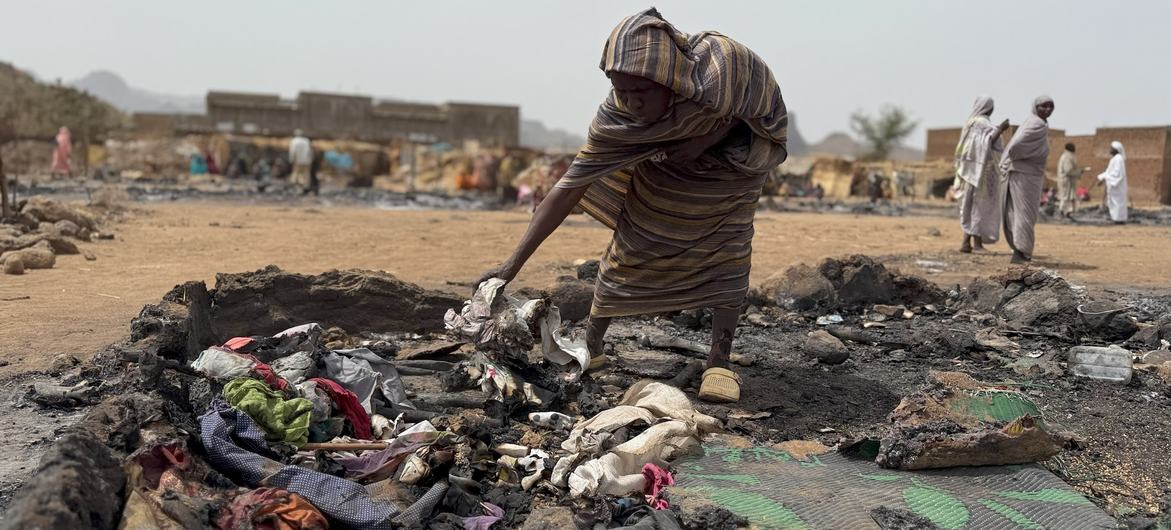
Amid the war raging between the Sudanese Armed Forces and the Rapid Support Forces since mid-April 2023, the issue of those killed in the conflict—estimated to be in the tens of thousands—has emerged as a profound tragedy that cannot be captured by official figures. Most victims are never registered by name, due to the collapse of civil registration systems and emergency health services.
According to the UN Office of the High Commissioner for Human Rights, approximately 3,384 civilians were killed in the first half of 2025 alone in the context of the armed conflict. Meanwhile, data from conflict analysis groups suggest that since the outbreak of the war, the death toll may reach tens of thousands, with estimates indicating that the true number is far higher due to direct killings, hunger, disease, and deteriorating humanitarian conditions.
Collapsed Records
Qasim Al-Mujtaba, an employee at the Ministry of Health, said that “as the war continues, the system that once regulated the cycle of life and death in Sudan has disintegrated. Hospitals are no longer treatment institutions as much as they are makeshift first-aid points, while civil registry offices have gone completely out of service in most conflict areas. Power outages, internet shutdowns, the flight of staff, and the destruction of paper and electronic archives have made death registration an impossible procedure—one that has lost all priority amid the struggle for survival.”
He added, “Before the war, every death went through a clear chain of procedures: diagnosis, a medical report, a death certificate, and then official registration. Today, all of these links have completely vanished. Sometimes we work in buildings without doors, without morgues to preserve bodies, and without basic writing tools. Bodies arrive from shelling or gunshot wounds, and others from diabetes or kidney failure because treatment was interrupted. No one asks about the cause of death as much as they ask: where do we bury the body?”
Al-Mujtaba continued, “In many cases we do not know the deceased’s name—just ‘a man in his forties’ or ‘an unidentified girl.’ Displaced people arrive without documents, IDs, and sometimes without relatives. We write down what we can on scraps of paper, but these papers are lost with the first bombardment or a new wave of displacement. There is no central authority to collect data, and no network linking us to the Ministry of Health or the civil registry.”
He went on to say, “Most dangerous of all, humanitarian pressure forces families to bury their dead immediately, for fear of decomposition, shelling, or arrest. There is no time to wait and no capacity to comply with official procedures that no longer exist. In practice, death has become a silent event that passes before our eyes without any administrative trace. We witness people disappearing from the records every day—not because they did not die, but because the state itself has disappeared.”
Silent Burials
The war has imposed a brutal rhythm on death rituals themselves. Burial has shifted from an act of farewell to an emergency procedure, carried out hastily and with minimal visibility for fear of targeting, the accumulation of bodies, or accountability. This has driven thousands of families to bury their dead without notifying any authority, without recording names or causes of death.
Mustafa Othman, who witnessed burial operations in one conflict area, recounted: “We did not think about documenting burials—it was never an option. With continuous shelling, our only concern was to save whoever was still alive. Bodies were in the streets and houses, the smell was spreading, and there were no ambulances, no police, and no authority telling us what to do. We collected the dead ourselves—some were neighbors, others we did not know—and buried them quickly, sometimes at night.”
He added, “Burials usually took place in nearby open areas or temporary graves. We did not write names or take photos, because fear dominated us—fear of shelling, militias, and of being accused of involvement in the conflict simply for documenting. Even talking about the number of dead was dangerous.”
Othman noted that “in many cases, the deceased had no family present at all, or their relatives had already fled. A person is buried as an unknown number—or without a number at all. Days later, no one remembers the count accurately, because the shock was greater than memory. Many disappeared from any record, not because they were unimportant, but because fear forced us into silence.”
Reburial
Murtada Hashim, a volunteer involved in reburial efforts, said: “Months after the hurried burials, we returned to the graves—not because the time was right, but because the scene had become unbearable. Many bodies were buried in haste under shelling or during displacement—in house courtyards, on the edges of neighborhoods, or in temporary cemeteries never prepared for burial. There was no time or safety to write names or place markers. Some graves were nothing more than shallow pits covered with soil.”
He continued, “Exhumation is not easy—psychologically or humanly. We stand before a grave without knowing who lies inside. Sometimes a family reports a missing person; other times we act on community initiatives alone, fearing that graves will be lost to rain or reconstruction. We try to identify bodies through remnants of clothing, a distinctive piece of fabric, a ring, a torn card, or a mother’s description—‘he was wearing a blue shirt the day he left and never returned.’ In many cases, we fail. The body may have decomposed or been mixed with others in a mass grave. Then we feel that we are burying nameless people for a second time. But we do it because burial in known cemeteries—even without names—is more dignified than leaving them in forgotten temporary graves.”
Hashim added, “What we are witnessing is not only a tragedy of death, but a tragedy of the absence of the state. There are no official teams, no protocols, no records. Everything depends on individual initiatives and volunteers. Cemeteries have become an alternative archive—a silent witness to a war that did not only kill people, but stripped them of their names and their right to be known even after death.”
Fragmented Families
Forced displacement has redrawn Sudan’s social map, but at the same time erased the connections that allow victims’ fates to be traced. Millions fled their homes without documents, and families were scattered across cities, camps, and international borders. In this fragmentation, it has become impossible to determine: who was killed, who went missing, and who later died from hunger or disease. The absence of communication and a central authority to collect reports has turned death into an unresolved event, suspended in uncertainty.
Sara Al-Naeem, the sister of a missing man, said: “My brother left with the first wave of displacement. He said he would return after a few days, but he never did. We searched for him in hospitals, shelters, and cemeteries, and asked displaced people from the same area. Each time, we heard a different story—someone says he was killed, another says he was detained, others say he fled to another country. There is no death certificate, no official report, and no authority to tell us the truth.”
She continued, “We are stuck in between. We cannot mourn because we lack certainty of death, and we cannot wait forever. Even aid or legal procedures require proof that we do not have. In official papers, my brother does not exist—neither alive nor dead. This void is the hardest thing we live with, because the war did not only steal their lives; it stole our right to know.”
Suspended Loss
Social researcher Ahmed Tayfour explained that “family disintegration in wartime is not limited to physical loss, but extends to the collapse of the social meaning of death itself. When documentation disappears, families experience what we call ‘ambiguous loss,’ where there is neither complete mourning nor clear hope. This type of loss produces chronic psychological disorders and weakens individuals’ ability to reorganize their lives or make decisive choices.”
He added, “Socially, families become fragile units. Women in particular face legal and economic complications, because the absence of a death certificate means the absence of rights to support, inheritance, or even proof of marital status. Children grow up amid uncertainty that disrupts their identity and sense of security.”
Tayfour continued, “In the long term, this collective absence of documentation creates a distorted collective memory, where victims are erased from the public narrative and families are left alone to face unanswered questions. What is happening is not merely a humanitarian crisis, but a breakdown of the social structure itself. A society that does not know how many of its people have died is unable to acknowledge its wounds or heal them.”
Deliberate Obstruction
Legal expert Suleiman Saleh stated: “In armed conflicts, numbers are not just data—they are instruments of power. What is happening in Sudan today is a deliberate obstruction of the justice and documentation system, because numbers mean accountability and transparency, and acknowledging victims means political and legal responsibility. When accurate data is not published, or only partial figures are released, the victim is politically redefined—who is counted, who is excluded, who is recognized, and who is forgotten.”
He added, “This manipulation creates a wide gap between reality on the ground and what is officially announced, turning civilians into invisible victims in war records, despite being subjected daily to killing, hunger, and disease.”
Saleh continued, “Moreover, the lack of transparency affects not only future justice, but all aspects of humanitarian response. International and local organizations rely on data to distribute aid and plan emergency interventions. When figures are distorted or incomplete, the response becomes insufficient and unfair, increasing civilian suffering. Many indirect deaths—caused by lack of medication, inadequate healthcare, hunger, and exposure to harsh climatic conditions—are excluded from any official statistics, even though they often outnumber direct deaths from fighting.”
He concluded that “at the legal level, the absence of numbers makes it difficult to document war crimes or crimes against humanity in the future. Any victim without a number is a double violation—first, the violation of their life, and second, the violation of their right to recognition and documentation. This makes future accountability almost impossible and complicates the efforts of human rights organizations and international courts to present an accurate record of the crimes committed.