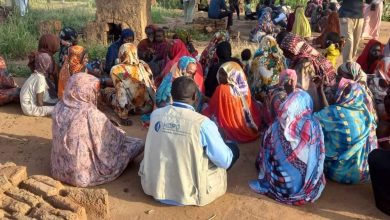
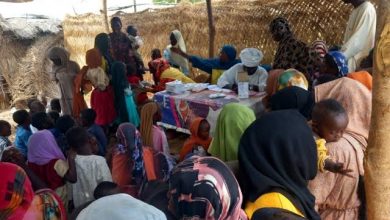
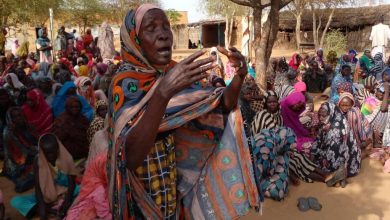
The suffering of Sudanese refugees continues to worsen, taking on horrific dimensions in refugee camps within neighboring African countries. Thousands are living in extremely difficult humanitarian conditions, particularly due to the lack of food, medicine, and healthcare. This is a result of dwindling aid and services provided by international organizations due to funding shortages.
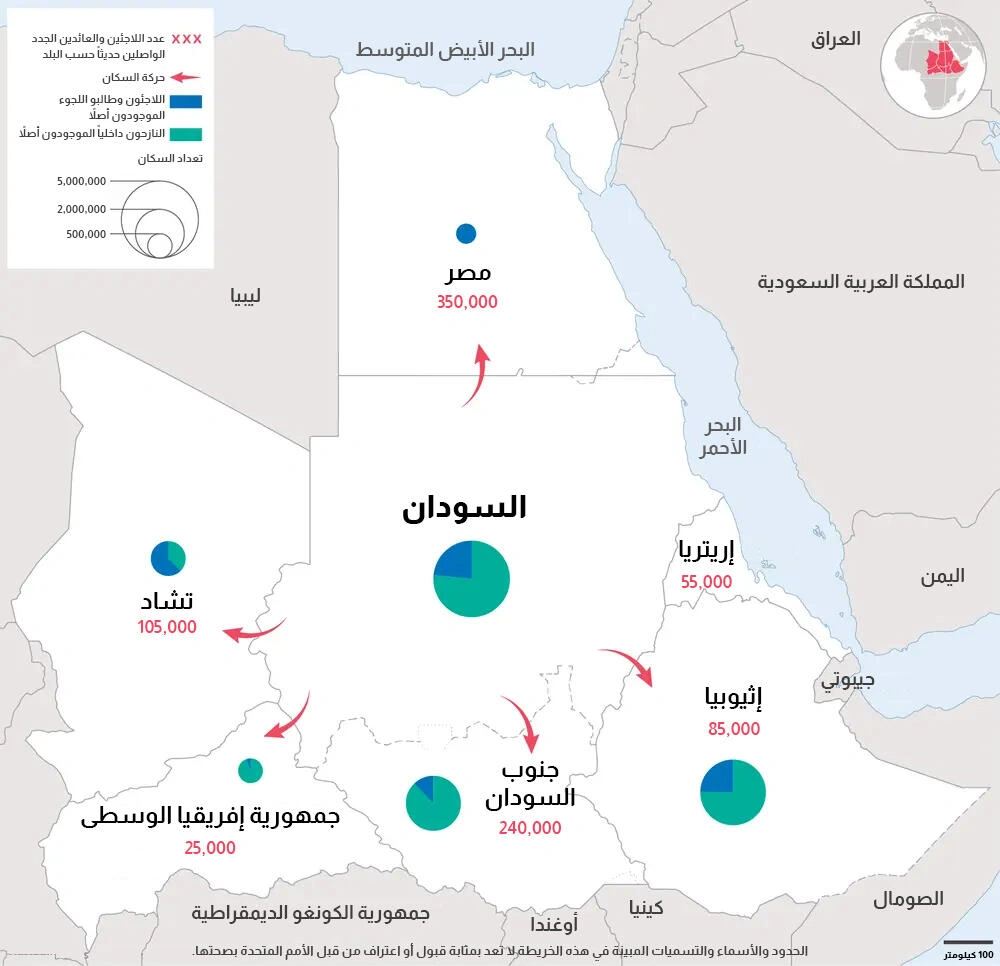
Neighboring border countries have become the closest haven for thousands fleeing the hell of war in Sudan via land routes. Topping the list are Egypt to the north and South Sudan to the south, Ethiopia and Eritrea to the east, and Chad and Libya to the west. Refugees seek shelter and guaranteed access to food and medicine, while some harbor dreams of migrating to Europe or America to escape the consequences of armed conflict and the blockade they endure.
Lack of Healthcare
Alaa El-Din Ishaq, a Sudanese citizen currently residing in a camp in the Wadi region of Chad, says: We live in sub-standard conditions regarding food and health. Our hope of receiving aid has been lost, especially after the reduction in American funding. There is no support from humanitarian organizations to rescue thousands from the current situation and restore a sense of optimism for a better reality.
He added: The camp lacks adequate healthcare. There is a center located far away that does not provide life-saving medicines and offers very limited service, providing only Panadol tablets and antibiotics. Consequently, the suffering of Sudanese patients is in constant escalation.
Ishaq explained: There are no signs of conditions improving at the moment. What is particularly worrying is that children have not had the chance to receive an education due to the lack of schools and the inability to leave the camp to enroll them in educational institutions because financial savings have run out.
Miserable Conditions
Events in the city of El Fasher, the capital of North Darfur State, last October forced Sudanese citizen Awadiya Nasser to displace to Libya and reside in a camp in the city of Kufra amid catastrophic humanitarian conditions. She says: Hunger has struck the majority of families. Everyone is living in extremely difficult and miserable conditions amid the spread of epidemics and the lack of healthcare, medicine, and drinking water, in addition to a sanitation crisis.
She noted that she expected adequate food and medicine services, as well as suitable housing in the refugee camps, but she was surprised by miserable conditions no less tragic than the consequences of the war in Sudan.
Nasser pointed out: Relief organizations do not provide any permanent shelter or even tents, especially for new arrivals from El Fasher. Staff distribute plastic sheets to block the sun so that refugees can have a small amount of protection at a time when the region has been hit by an unprecedented cold wave.
The Sudanese refugee continues: Hundreds of families who arrived in the Kufra region need sufficient food supplies, medicine, and blankets to protect against the biting cold, especially for children and the elderly. We fear the outbreak of epidemics in light of the lack of medical supplies and medicine.
Reduction in Aid
Walid Akasha, who has lived in the Kiryandongo camp in Uganda for about a year and a half, explained: The majority of Sudanese refugees rely on humanitarian aid to secure their daily needs. However, the reduction of food aid since last January to about five dollars per month per person, along with the exclusion of a large number of groups from support, has exacerbated living conditions inside the camps.
Akasha noted: The dwindling support portions contributed to the worsening conditions of thousands of Sudanese. With the cessation of food aid and the decline of health services to dangerous levels, there are warnings of the spread of diseases and malnutrition among children and women, especially after the onset of the autumn season.
He added: The camp administration provides local shelter materials to refugees consisting of tarpaulins and wood to build houses, especially for families, children, and the elderly. However, these are unsuitable and do not protect against the biting cold and the heavy rains falling these days.
Homeless
In the same context, Mohammed Al-Baqir, a volunteer at land crossings in North Darfur, expects the influx from the region’s areas toward Chad and Libya to continue, especially after the overcrowding of displacement camps in the towns of Tawila, Jebel Marra, and Mellit, in addition to the lack of shelter in northern Sudan.
He added: The situation for the majority of Sudanese refugees has begun to deteriorate because their estimates were based on the idea that their stay there might not exceed a few months at most. However, the prolongation of the war for nearly three years has disrupted all their estimates and calculations, and they have begun thinking about returning regardless of the reality they will face.
Al-Baqir stated: Dozens of families who reached Chad and Libya are now homeless. Furthermore, organizations are working to distribute food in a limited manner to pregnant and breastfeeding mothers and children under the age of two to prevent malnutrition. Most resources have been diverted to other camps far from the borders in an effort to encourage refugees to move to safer areas.
Crises and Restrictions
In a related vein, Al-Sadiq Jibril, a researcher in the field of migration and asylum, considered that: The volume of Sudanese refugees flowing into the camps of neighboring African countries has paralyzed the capabilities of UN organizations and produced humanitarian crises, especially after the funding cuts. Therefore, the situation has become complicated and has exceeded the available capabilities.
Jibril noted: The United States’ reduction in foreign aid is the primary reason behind the funding gap. While American contributions amounted to 68.4 million dollars in 2024, representing 32 percent of the total budget of the UNHCR, this year American contributions dropped to 35.6 million dollars, representing about 10 percent of the total budget, which has increased along with rising humanitarian needs.
He pointed out: The intensity of pressure on the camps and the increasing number of people coming from Sudan has made some neighboring countries view the situation as a security threat, prompting them to impose some restrictions and tighten entry procedures into their territories.
Shocking Displacement
More than two and a half years after the outbreak of the war in Sudan, the United Nations estimated that this war has displaced nearly 13 million Sudanese. More than 4 million have sought refuge in neighboring countries where security and economic conditions are better.
The difficulty of obtaining visas and entry permits did not prevent those fleeing from crossing toward safety through illegal routes and braving the dangers of cross-border human smuggling in deadly and harsh journeys, where many lost their lives before reaching their destination.
According to the European Commission, more than 360,000 Sudanese have arrived in Libya, noting that these influxes have put pressure on infrastructure. The UNHCR expects the number of Sudanese refugees in Libya to exceed 650,000 by the beginning of 2026.
According to the Commission, Uganda hosts more than 110,000 Sudanese refugees who fled since the war broke out in April 2023. The Norwegian Refugee Council confirmed the presence of more than 720,000 Sudanese refugees in Chad.
There are 643,254 refugees in South Sudan and 51,666 others in Ethiopia, alongside other small groups that headed toward Eritrea and the Central African Republic.
Thousands of young people chose to migrate by boarding small boats and facing the waves of death in the Mediterranean toward an unknown fate, where the lucky ones among them reached camps on European shores.